Vagus Nerve Stimulation Devices: How to Compare Your Options
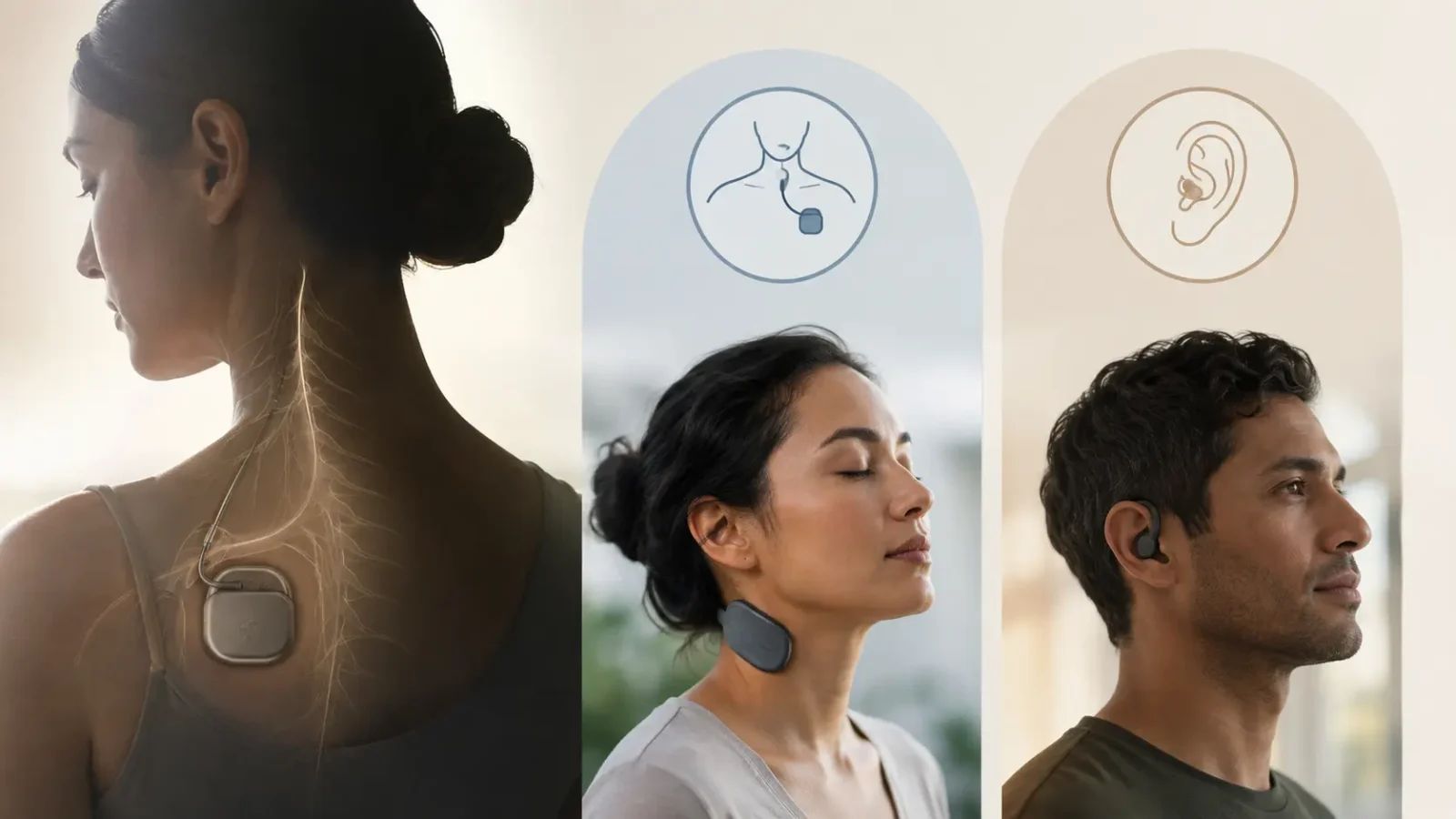
Search for “vagus nerve stimulation devices,” and you will find products that may look comparable while belonging to very different categories.
Some are implanted prescription systems. Others stimulate the neck without surgery. Some are prescription medical devices with FDA-cleared uses, while others are consumer products positioned for general wellness. Still others stimulate selected areas of the outer ear—or use a different mechanism despite appearing in vagus-related product roundups.
Those differences matter more than a simple feature list.
Before asking which device looks better, first ask: What kind of product is this, and what evidence and regulatory status belong to this exact product?
That classification makes the comparison much more useful.
First, Identify What Kind of Vagus Nerve Device You’re Looking At
Not every product associated with the vagus nerve belongs in the same shopping category.
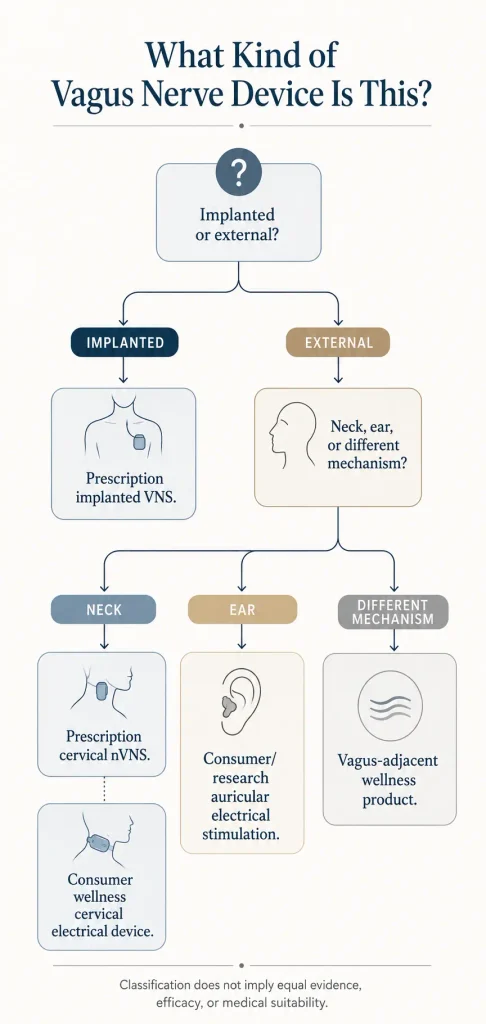
A useful first step is to separate five broad product types.
Implanted Prescription VNS Systems
Implanted vagus nerve stimulation involves surgically placing a pulse generator and associated hardware so that electrical stimulation can be delivered to the vagus nerve.
The LivaNova VNS Therapy System is an example of this medical-device category.
An implanted prescription system is fundamentally different from a consumer product you order for home use. Surgery, clinician management, medical indications, and device-specific regulatory requirements put implanted VNS on a different decision pathway.
For the broader terminology separating implanted, cervical, auricular, and other forms of VNS, see types of vagus nerve stimulation.
For this article, implanted VNS is a boundary category rather than a consumer comparison option.
Prescription Non-Invasive Cervical VNS
gammaCore Sapphire represents a different category: prescription non-invasive cervical vagus nerve stimulation.
Rather than requiring an implant, it is applied externally at the side of the neck. In the United States, gammaCore Sapphire is a prescription Class II device with FDA-cleared uses for specific indications.
That makes it a useful medical benchmark when comparing external VNS products.
But its status belongs to gammaCore and its specific cleared uses. It does not mean every electrical product placed on the neck has the same regulatory status, clinical evidence, or intended use.
Consumer Cervical Electrical Wellness Devices
Truvaga Plus and Pulsetto are examples of consumer-accessible electrical products used at the neck.
Their placement can make them look superficially similar to prescription cervical nVNS, but anatomical site alone does not establish equivalence.
A consumer cervical product can differ from a prescription medical device in intended use, regulatory status, exact-product clinical evidence, stimulation protocol, labeling, and safety information.
That distinction is especially important with Truvaga because electroCore is associated with both Truvaga and gammaCore. A shared manufacturer does not make the products medically or evidentially interchangeable.
Pulsetto likewise needs to be assessed on evidence and claims that belong to Pulsetto—not on the strength of unrelated cervical nVNS studies.
Consumer Auricular Electrical Stimulation
Nuropod illustrates another category: electrical stimulation delivered at the external ear rather than the neck.
Parasym currently directs U.S. customers toward Nuropod, while its Nurosym branding has a different regional availability context.
The manufacturer describes a shared underlying AVNT technology lineage, but that does not mean every study involving Nurosym or a related research platform should be silently relabeled as an exact Nuropod study.
For product comparison, the provenance of the evidence matters.
Vagus-Adjacent Wellness Products
A final group consists of products that appear in “vagus nerve device” comparisons without delivering the same type of direct electrical VNS used in the categories above.
These may use vibration, haptics, sound, or other approaches marketed around relaxation, nervous-system regulation, or vagus-related concepts.
Their presence in the same online roundup does not make their mechanism equivalent to cervical or auricular electrical stimulation.
That is why classification should come before comparison.
The Questions That Matter Before You Compare Devices
Once you know the broad category, eight questions help reveal whether two products are meaningfully comparable.
1. Where does it stimulate?
Neck stimulation is not the same as ear stimulation.
And sharing a stimulation site does not mean two products use equivalent waveforms, protocols, targeting, or doses.
Same site ≠ same evidence.
2. What kind of product is it?
An implanted prescription system, a prescription external medical device, and a nonprescription wellness product may all be discussed using vagus-related language.
They do not have the same medical role.
3. What is its intended use?
Look at what the manufacturer actually says the product is intended to do.
A device with a specific medical indication occupies a different regulatory and evidentiary position from a product marketed for general wellness.
General-wellness positioning does not prove a product is ineffective. It does mean you should not automatically interpret it as having an FDA-cleared treatment indication.
4. What exact U.S. regulatory status applies?
Terms such as FDA-cleared, FDA-approved, general wellness, NSR, and FCC describe different things.
They should never be treated as interchangeable badges of clinical validation.
5. What human evidence tested the exact product?
This is one of the most useful questions in the entire comparison.
If a marketed device has been tested directly in humans, determine what kind of study it was. Was it randomized? Controlled? Peer-reviewed? Preliminary? Was the outcome clinical, physiological, or simply related to user experience?
“Studied in humans” can describe evidence of very different strength.
6. What evidence belongs only to a related platform or modality?
A company may have research on another product. A related platform may share technical features. A broad category such as cervical nVNS or auricular stimulation may have a growing scientific literature.
None of those automatically becomes exact-product evidence.
Same manufacturer ≠ same evidence.
Same platform ≠ exact-product evidence.
7. What device-specific safety information applies?
Contraindications, warnings, treatment-site restrictions, not-evaluated populations, and usage instructions should come from the exact device’s current labeling or safety materials.
Do not borrow a contraindication from one VNS device and apply it universally to another.
8. What does ownership involve?
A product may require:
- a prescription or clinician involvement;
- an app;
- conductive gel or spray;
- a replacement earpiece or another component;
- charging;
- repeated setup before use.
These differences may matter in daily ownership even when they say nothing about clinical efficacy.
Vagus Nerve Stimulation Devices Compared
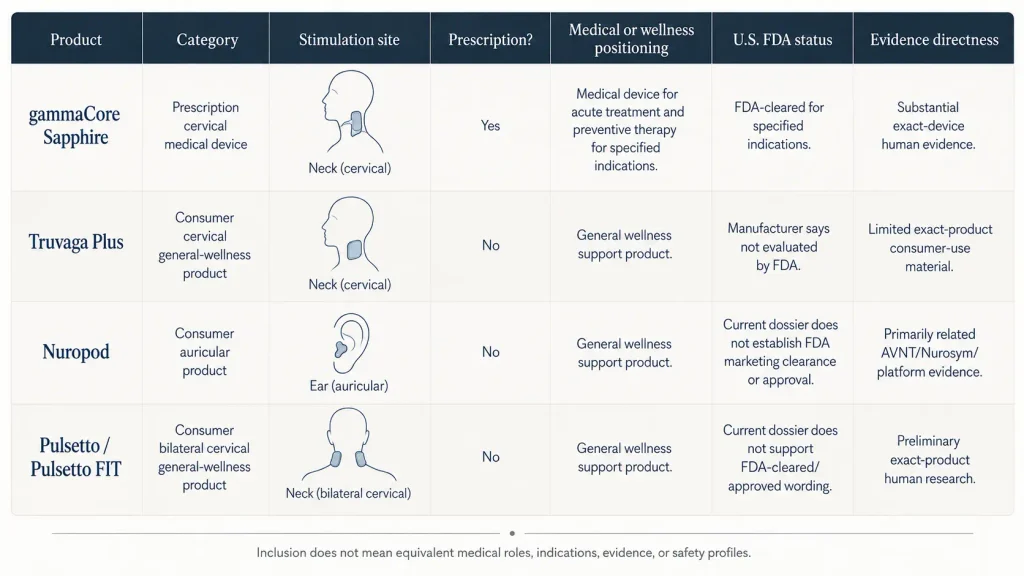
The table below compares product identity and decision-relevant attributes.
Inclusion does not mean these products have equivalent medical roles, indications, evidence, or safety profiles.
| Product | Device category | Stimulation site | Prescription? | Medical or wellness positioning | Exact U.S. FDA status | Exact-product human evidence | Related-platform / modality evidence | App required? | Contact medium / replacement component | Key ownership note |
| gammaCore Sapphire | Non-invasive cervical VNS medical device | Side of neck | Yes | Medical; specific labeled uses | FDA-cleared Class II prescription device for specific indications | Substantial exact-device human research | Broader cervical nVNS evidence also exists | Verify current model instructions | Uses conductive electrode gel; verify current model instructions | Prescription pathway and device-specific labeling matter |
| Truvaga Plus | Consumer cervical electrical wellness device | Neck | No | General wellness | Manufacturer states Truvaga products have not been evaluated by the U.S. FDA; do not treat gammaCore status as Truvaga status | Limited exact-product consumer-use material identified in current dossier | Related electroCore/gammaCore and cervical evidence exists but is not exact Truvaga evidence | Yes — free Truvaga Plus app required for operation | Supplied conductive electrode spray/solution required | Same manufacturer as gammaCore does not mean same evidence or regulatory status |
| Nuropod | Consumer auricular electrical stimulation device | External ear | No | Consumer/wellness positioning; disease-treatment claims require separate regulatory support | Current dossier does not establish FDA marketing clearance or approval; cited NSR research status is not market authorization | Exact Nuropod evidence must be distinguished from platform evidence | Current dossier primarily identifies related AVNT/Nurosym/platform literature | No for device operation; optional companion app exists | No conductive gel required; moisture may aid contact; separate ear-contact component | U.S.-available product; evidence lineage requires careful attribution |
| Pulsetto / Pulsetto FIT | Consumer cervical electrical wellness product | Bilateral cervical/neck placement in current product and research context | No | General wellness | Current dossier does not support calling it FDA-cleared or FDA-approved | Preliminary exact-product human research exists | Broader cervical VNS evidence cannot automatically be transferred to Pulsetto | Yes, according to current use materials | Conductive gel/contact medium used under standard instructions | Exact-product research exists but remains preliminary |
Footnote: “Inclusion does not mean products are medically interchangeable or supported by equivalent evidence.”
SAME CATEGORY DOES NOT MEAN SAME EVIDENCE
Products may share neck or ear placement—or similar vagus-related language—while differing in intended use, FDA status, exact-product evidence, stimulation protocol, and safety information.
How the Main Options Differ
gammaCore Sapphire: The Prescription Medical Benchmark
gammaCore Sapphire, made by electroCore, is an external cervical VNS device applied at the side of the neck.
Unlike the consumer products in this comparison, gammaCore is prescription-only in the United States and has FDA-cleared uses for specific indications.
It also has a substantial body of exact-device human research compared with many consumer VNS products. Some of that research has involved industry funding or investigators with industry relationships, which should remain visible when evaluating the evidence.
Those characteristics make gammaCore a useful medical benchmark—not a universal winner.
The key comparison rule is narrower:
gammaCore’s clinical evidence and regulatory status belong to gammaCore and its labeled uses.
They do not automatically transfer to another neck-stimulation product.
Truvaga Plus: Same Company Does Not Mean Same Regulatory Status
Truvaga Plus provides a particularly useful example of why manufacturer identity should not substitute for product identity.
electroCore is associated with both gammaCore and Truvaga, and both involve stimulation at the neck. But Truvaga is positioned as a nonprescription general-wellness product rather than as gammaCore under a different consumer name.
Current manufacturer materials state that Truvaga products are general-wellness products that have not been evaluated by the U.S. Food and Drug Administration and are not intended to diagnose, treat, cure, or prevent disease or a medical condition.
That distinction matters because it prevents two common errors:
gammaCore FDA status ≠ Truvaga FDA status
and
gammaCore clinical evidence ≠ exact Truvaga evidence
The current dossier includes limited consumer-use material involving Truvaga itself. That is relevant exact-product information, but consumer-use research should not be presented as equivalent to a randomized clinical evidence program.
Current manufacturer materials state that Truvaga Plus requires the free Truvaga Plus mobile app to operate and uses a supplied conductive electrode spray/solution for skin contact.
None of these distinctions establishes that Truvaga is “better” or “worse” because it is wellness-positioned. They simply identify what kind of product it is and which claims belong to it.
Nuropod: Auricular Stimulation and the Platform-Evidence Question
Nuropod, from Parasym, provides the clearest auricular contrast among the core consumer products in this comparison.
Instead of neck stimulation, it delivers stimulation at the external ear.
Current manufacturer information directs U.S. customers toward Nuropod rather than Nurosym, which has a different regional availability context. The company also describes Nuropod and Nurosym as sharing core AVNT technology.
That technological relationship is relevant, but it creates an evidence-attribution problem.
Research involving Nurosym, AVNT, or a related platform can help establish background for the technology. It should not automatically be described as though the exact marketed Nuropod product was the intervention tested in every study.
The current dossier therefore treats much of the research lineage as related-platform or technology evidence, unless the study itself confirms exact Nuropod use.
Current manufacturer information indicates that Nuropod does not require an app for device operation, although an optional companion app exists. Conductive gel is not required; the manufacturer states that a small amount of moisture may be used to improve contact. The device is rechargeable.
Research-device language also requires care. Parasym cites Non-Significant Risk status in U.S. research. NSR is an investigational-study risk classification, not FDA marketing clearance, approval, or a therapeutic indication for the marketed product.
The practical conclusion is not that platform evidence is worthless. It is that its distance from the exact product should remain visible.
Pulsetto: Exact-Product Research Exists, but the Evidence Is Still Preliminary
Pulsetto is a consumer neck-worn electrical wellness product using bilateral cervical placement. Current use materials involve an app and conductive gel/contact under standard instructions, and the manufacturer positions the product around general wellness.
The current dossier does not support describing Pulsetto as FDA-cleared or FDA-approved.
Unlike a product for which no human research can be identified, Pulsetto does have some exact-product human research.
A 2026 European Psychiatry supplement abstract reports a small Pulsetto-specific four-week study in healthy adults. Forty participants were enrolled and 37 completed the study.
Importantly, the principal comparison was unilateral versus bilateral stimulation rather than a conventional no-stimulation or sham-controlled efficacy comparison.
One author was affiliated with Pulsetto. The published abstract reports no declared conflicts of interest and does not identify company funding for the study.
Pulsetto FIT also appears in a registered human research protocol. A registered protocol shows that research is planned or underway; it is not a positive efficacy result.
Some exact-product human research exists, but its current design and maturity do not make Pulsetto clinically equivalent to gammaCore or establish broad treatment efficacy.
A full evaluation of Pulsetto’s evidence, claims, safety, and ownership belongs in a separate exact-product investigation rather than this category guide.
Where the Evidence Comes From Matters
A product comparison becomes misleading when every citation is treated as equally direct evidence for the product being sold.
For a fuller review of the underlying science, see evidence for non-invasive VNS.
For device comparison, evidence can be thought of as a hierarchy of directness.
1. Exact-Product Human Evidence
This is research in which the actual product being discussed was used in human participants.
It is the most direct evidence for that product—but “exact product” does not automatically mean “high-quality evidence.”
A small uncontrolled pilot study and a large randomized, sham-controlled trial can both be exact-product studies while supporting very different levels of confidence.
2. Related-Platform or Technology Evidence
Sometimes research involves a related device, an earlier platform, or technology the manufacturer says is shared with the current product.
This evidence may be informative, but the relationship needs to be stated.
It should not be silently relabeled as exact-product evidence.
3. Broader Modality or Category Evidence
Research may support scientific interest in cervical nVNS, taVNS, or another stimulation approach without testing the marketed product being considered.
That literature helps establish the broader evidence landscape.
It does not automatically validate every device using the same anatomical site or category label.
4. Mechanistic Support
Mechanistic research can help explain why a stimulation approach is scientifically plausible.
It is the farthest of these categories from proving that a specific marketed product improves a specific clinical outcome.
The farther the evidence is from the exact marketed product, the more cautious the product-specific conclusion must be.
Peer review adds another layer.
A peer-reviewed study has passed through a scientific review process, but peer-reviewed does not automatically mean independent. Funding, author affiliations, study design, population, comparator, and outcome still matter.
Applied to the products in this comparison:
- gammaCore: substantial exact-product peer-reviewed human evidence exists, with industry involvement in some research.
- Truvaga: limited exact-product consumer-use material is identified, while broader electroCore/gammaCore and cervical evidence must remain separate.
- Nuropod: the current dossier relies primarily on related-platform, AVNT, or Nurosym evidence unless exact Nuropod use is confirmed.
- Pulsetto: preliminary exact-product human research exists, including a 2026 supplement abstract with a Pulsetto-affiliated author, but current evidence maturity remains limited.
Lower evidence directness does not prove that a product does not work.
It means that claims about the exact product require more caution.
FDA-Cleared, General Wellness, NSR, and FCC Are Not the Same Thing
Regulatory terminology can sound more interchangeable than it is.
It is not.
FDA-cleared refers to a specific device and regulatory pathway and must be interpreted within the device’s cleared uses.
FDA-approved is not a synonym for FDA-cleared.
General wellness describes a different product-positioning context. It is not equivalent to an FDA-cleared disease-treatment indication, but it also does not prove that a product is ineffective.
NSR, or Non-Significant Risk, is an investigational-study risk classification. It is not FDA marketing clearance, FDA approval, or a therapeutic indication for the marketed product.
FCC certification or compliance relates to applicable electronic or communications requirements. It is not clinical validation and is not FDA clearance.
In this comparison, gammaCore provides the concrete example of a device with specific FDA-cleared uses. Truvaga illustrates general-wellness positioning despite sharing a manufacturer with gammaCore. Parasym cites NSR status in U.S. research involving its technology, which should not be converted into market authorization. And an FCC-related statement for a consumer product such as Pulsetto, where applicable, should not be presented as medical authorization.
FDA-RELATED LANGUAGE IS NOT INTERCHANGEABLE
FDA-cleared ≠ general wellness ≠ NSR research classification ≠ FCC certification.
Safety Is Device-Specific
The safest way to compare VNS products is not to build one universal contraindication list.
It is to check the current safety information for the exact device.
A prescription medical device such as gammaCore has prescription labeling and instructions for use. A consumer product such as Truvaga, Pulsetto, or Nuropod relies on its own current manufacturer instructions, warnings, and safety materials.
Those sources are not interchangeable.
For each exact product, check:
- formal contraindications, if any;
- warnings;
- populations in whom the product has not been evaluated;
- restrictions involving implanted electronic devices, where stated;
- treatment-site restrictions;
- age limitations;
- pregnancy-related language;
- cardiovascular cautions, where explicitly stated;
- whether a prescription or clinician involvement is required.
The wording matters.
“Contraindicated,” “warning,” “not evaluated,” and “do not use at this treatment site” are different classifications and should not be collapsed into the same category.
Manufacturer safety materials also should not be treated as independent proof that a product is broadly safe. They tell you what the manufacturer currently instructs users to do and which restrictions it identifies.
Most importantly, a warning attached to one product should not be copied onto another simply because both products stimulate the neck or ear.
Safety belongs to the exact device and its current labeling or instructions.
Practical Ownership Differences That Actually Matter
Clinical evidence and regulatory status are not the only differences a prospective user may care about.
The daily ownership experience can vary substantially.
Prescription and Clinician Involvement
gammaCore follows a prescription medical-device pathway in the United States.
Truvaga, Nuropod, and Pulsetto are consumer-accessible products in the current dossier.
That difference can affect how the device is obtained and whether clinician involvement is part of the intended pathway.
Form Factor and Stimulation Site
gammaCore and Truvaga are external neck-based products with different product roles.
Pulsetto uses a wearable bilateral cervical format.
Nuropod uses an auricular format at the external ear.
Form factor can influence setup and convenience, but it should not be mistaken for evidence of effectiveness.
App Requirements
Current manufacturer materials state that Truvaga Plus requires the free Truvaga Plus mobile app to operate.
Pulsetto’s current use also involves an app.
Nuropod does not require an app for device operation, although an optional companion app exists.
For gammaCore, the current model-specific instructions should be checked rather than assuming that app requirements from another product apply.
Gel, Spray, and Contact Components
gammaCore uses conductive electrode gel; current model instructions should be checked for the exact supplied or required contact materials.
Truvaga Plus uses a supplied conductive electrode spray/solution for skin contact.
Pulsetto uses conductive gel/contact medium under standard instructions.
Nuropod does not require conductive gel. Current manufacturer information states that a small amount of moisture may be used to improve contact, and the device uses a separate ear-contact component.
These details matter because they affect setup and recurring ownership tasks. They do not establish clinical superiority.
Rechargeability and Reuse
Consumer products in this category may differ in charging, reusable components, earpieces, and contact materials.
Nuropod is described by the manufacturer as rechargeable.
For every product, current model instructions should be checked before assuming that an accessory, consumable, or replacement schedule applies.
This article intentionally omits price, discounts, coupon codes, and “best value” rankings because those terms change quickly and do not resolve the more important questions of product identity, evidence, regulation, and safety.
Can These Devices Be Ranked From Best to Worst?
Not defensibly as one universal leaderboard.
That is not because meaningful comparison is impossible. It is because the products can have fundamentally different medical roles, intended uses, stimulation sites, evidence maturity, regulatory status, and safety requirements.
Putting an implanted prescription VNS system, a prescription headache-related cervical device, a consumer cervical wellness product, and a consumer auricular product into a single “best vagus nerve stimulator” ranking would hide those differences.
A more useful decision sequence is:
- Medical/prescription pathway or consumer wellness product?
- Neck or ear stimulation?
- What is the exact intended use?
- What regulatory status belongs to this exact product and use?
- What human evidence tested the exact product?
- What safety requirements belong to it?
- What does ownership require?
The answer may lead different readers toward different categories before they ever compare individual products.
That is more informative than declaring a “best overall” device across products that are not medically interchangeable.
A Final Checklist Before Comparing Any Vagus Nerve Device
1. Is it implanted or non-invasive?
2. Does it stimulate the neck or the ear?
3. Is it a prescription medical device or a consumer/wellness product?
4. What exact intended use does the manufacturer state?
5. What exact FDA status applies?
6. Was the exact marketed product tested in humans?
7. Was the research peer-reviewed?
8. Who funded the research?
9. Are the studies actually from a related platform or different device?
10. Are clinical claims being borrowed from another stimulation modality?
11. What device-specific contraindications and warnings apply?
12. Is an app required?
13. Are gel, spray, electrodes, earpieces, or other consumables required?
14. Is clinician involvement required?
15. Are any commercial terms you are relying on current and date-stamped?
The central principle is simple:
Identify the exact product first. Then identify the evidence, regulatory status, safety information, and ownership requirements that actually belong to it.