Sarcopenia: What It Is, Possible Signs, and What Can Help
Sarcopenia is a muscle disorder associated especially with aging in which declining strength and physical function matter at least as much as changes in muscle quantity. It is not simply a label for getting older or looking less muscular.
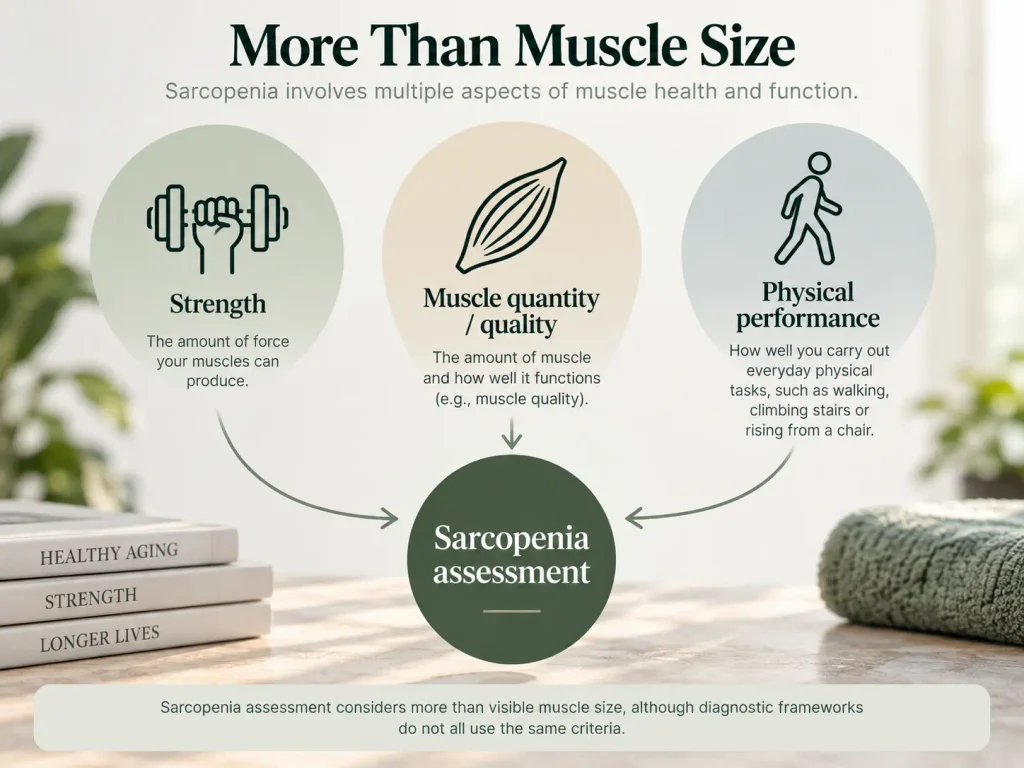
That distinction matters because sarcopenia can affect mobility and independence, yet the condition cannot be diagnosed from appearance or one home test. Clinical frameworks use combinations of strength, muscle quantity or quality, and physical performance, and they do not all define the condition in exactly the same way.
What Is Sarcopenia?
Sarcopenia is a clinically meaningful muscle disorder characterized by impaired muscle strength and function, with muscle quantity or quality also playing an important role in major diagnostic frameworks.
Modern approaches have moved away from defining sarcopenia as muscle mass loss alone. A person can lose some muscle with age without automatically having sarcopenia, and visible body size cannot confirm or rule out the condition.
Is Sarcopenia Just a Normal Part of Aging?
No. Muscle-related changes commonly occur with aging, but sarcopenia is not an inevitable diagnosis for every older adult. Clinically important changes in strength and function are central to the condition.
For readers thinking proactively about muscle health rather than a sarcopenia diagnosis, our guide to building muscle after 50 addresses that separate goal.
Possible Signs of Sarcopenia: Changes That May Raise Concern
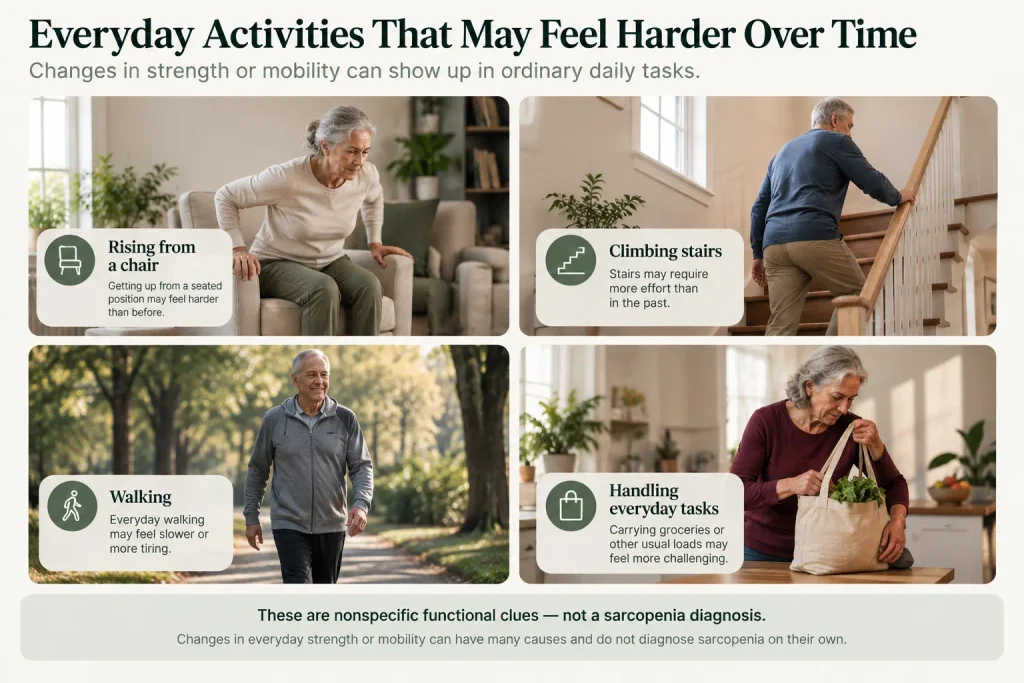
There is no single definitive first sign of sarcopenia. Possible clues can include persistent or progressive weakness, greater difficulty rising from a chair, trouble with stairs, slower or more difficult walking, or reduced ability to perform ordinary physical tasks.
Unexplained muscle or weight loss can also warrant attention in context. These changes are nonspecific and can have many causes, so they are reasons to consider evaluation rather than a basis for self-diagnosis.
Why Strength and Everyday Function Matter
Muscle quantity does not fully describe what muscle can do. Strength and physical performance help show whether muscle impairment is affecting real-world tasks such as getting out of a chair, climbing stairs, walking, carrying groceries, or maintaining independence.
For practical implementation beyond this condition overview, see our guide to strength training for older adults.
Why Does Sarcopenia Happen, and Who May Be at Greater Risk?
Sarcopenia can develop through more than one pathway. Aging-related changes in muscle are important, but physical inactivity, prolonged immobility or bed rest, chronic illness and broader disease burden, and inadequate energy or protein intake can also contribute.
Nutrition can matter for other reasons as well. Malabsorption or circumstances that make it difficult to obtain or eat enough nutritious food may contribute to poor muscle health. These factors can overlap rather than acting independently.
Consensus frameworks sometimes distinguish predominantly age-related “primary” sarcopenia from “secondary” sarcopenia associated with disease, inactivity, or inadequate nutrition. In practice, however, several contributors may be present at the same time, so sarcopenia is often better understood as a multifactorial condition than as the result of one isolated cause.
Having one or more of these risk factors does not diagnose sarcopenia. Strength, physical function, the broader clinical context, and appropriate professional assessment still matter.
Why Sarcopenia Matters for Mobility, Independence, and Health
Sarcopenia has been associated with outcomes including falls, fractures, functional decline or disability, hospitalization, and mortality. These are risk associations, not a guarantee that a person with sarcopenia will experience any particular outcome.
For everyday life, the more immediate concern is often function: whether declining strength or performance is making ordinary movement and independence more difficult.
How Is Sarcopenia Diagnosed?
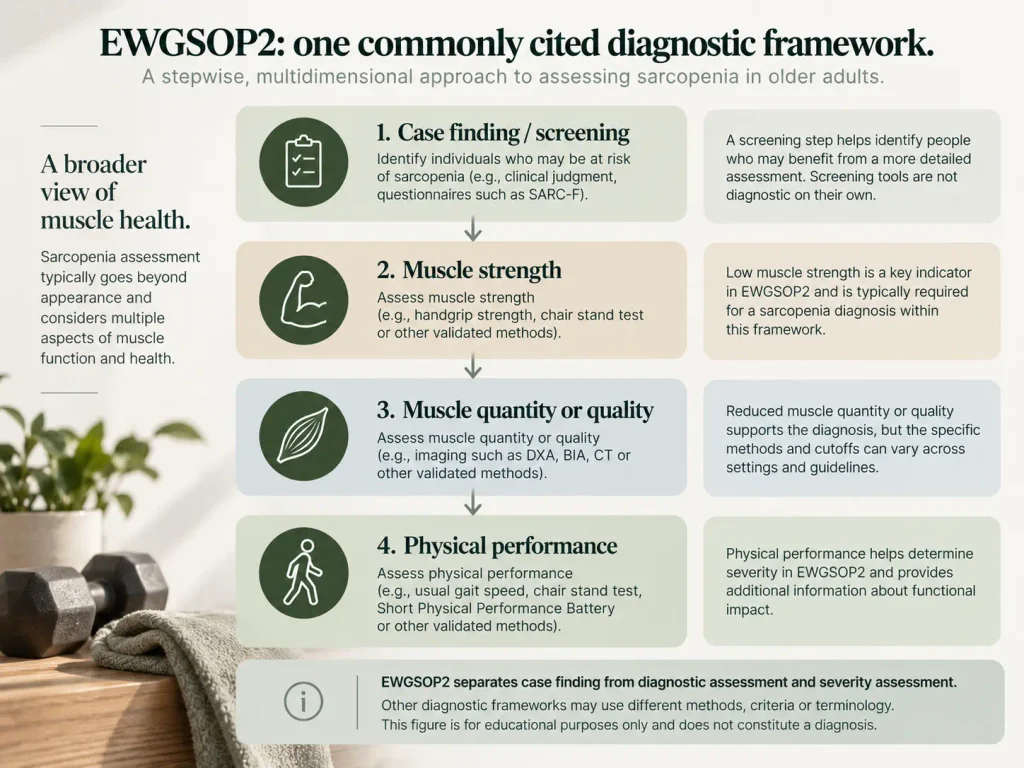
Sarcopenia is evaluated clinically using combinations of information that may include muscle strength, muscle quantity or quality, physical performance, screening information, health history, and the broader clinical context.
Measures can include grip strength or chair-stand performance, DXA or BIA for muscle-related measurements, gait speed or other performance measures, and screening tools such as SARC-F. None of these should be treated as a universal DIY pass/fail test.
Why Diagnostic Frameworks Do Not All Use the Same Definition
EWGSOP2 is one widely cited framework. It prioritizes low muscle strength as a sign of probable sarcopenia, uses low muscle quantity or quality to confirm the diagnosis, and uses low physical performance to identify severe sarcopenia.
Other groups use different operational definitions. The Sarcopenia Definition and Outcomes Consortium emphasizes weakness and slowness and does not require DXA-measured lean mass in its definition. The Asian Working Group for Sarcopenia uses a framework developed for Asian populations that incorporates low muscle mass with low strength and/or low physical performance.
The practical takeaway is that no single test or cutoff universally diagnoses sarcopenia. Clinical context and the framework being used matter.
What Can Help Manage Sarcopenia?
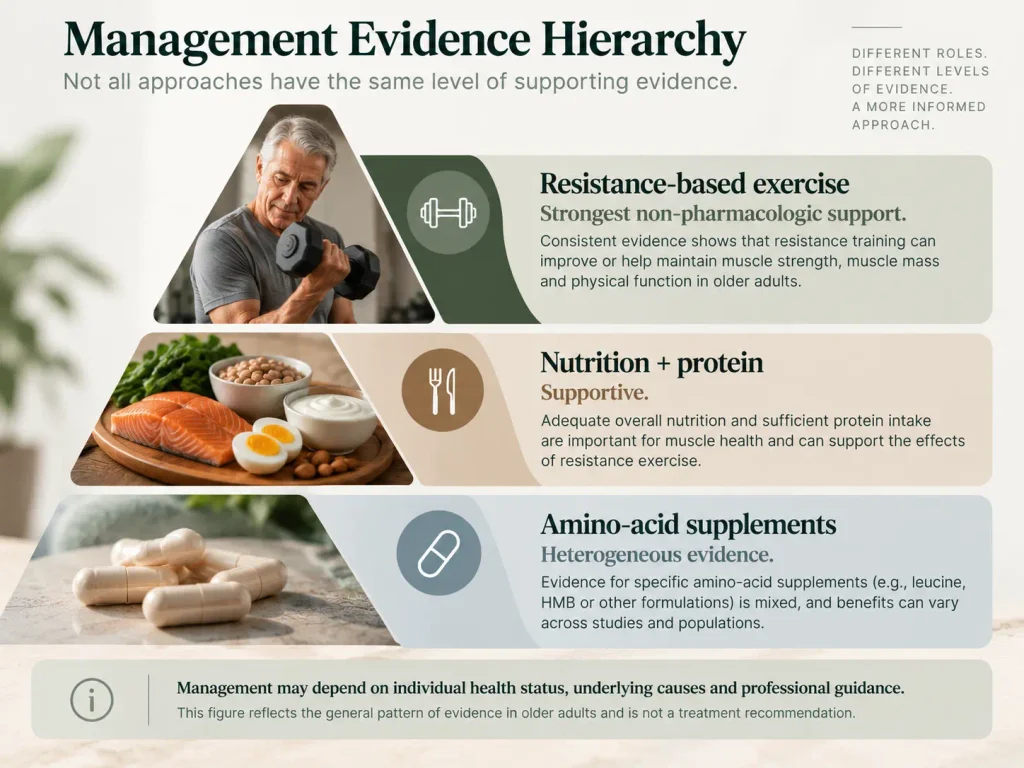
Management generally focuses on modifiable contributors, muscle strength and physical function, adequate nutrition, and relevant health conditions. The evidence is not equally strong for every intervention.
Resistance-Based Exercise Has the Strongest Support
Resistance-based exercise has the strongest support among the non-pharmacologic approaches discussed here. Research generally supports improvements in strength and physical performance, although the size and clinical importance of benefits, program characteristics, and effects on muscle mass vary.
Readers who want the practical training side can continue with resistance and strength training for seniors.
Nutrition and Protein Support Muscle Health
Adequate nutrition and protein intake can support muscle health, particularly when intake is inadequate. Protein supplementation should not be treated as a stand-alone cure for sarcopenia, and potential benefit depends on factors such as baseline nutrition, exercise, population, formulation, and the outcome being measured.
For detailed intake guidance, see protein needs for older adults.
What About Amino-Acid Supplements?
Evidence involving essential amino acids, BCAAs, leucine, HMB, and mixed formulations is heterogeneous. These interventions are not interchangeable, and some recent evidence evaluating amino-acid supplementation alongside resistance training has been rated low or very low certainty.
Evidence involving a nutrient, ingredient, or intervention category does not establish that a particular commercial supplement produces the same outcomes. A finished formulation needs to be investigated on its own composition and evidence.
That is why our separate Advanced Amino Formula review evaluates the named product separately. The link is not evidence that Advanced Amino Formula treats, prevents, cures, or reverses sarcopenia.

Considering Advanced Amino Formula?
Generic evidence about amino acids cannot tell you whether a specific finished supplement will produce the same results. Our separate Advanced Amino Formula investigation looks at the named product on its own terms so you can evaluate it separately.
Read the Advanced Amino Formula investigation
Evidence note: This banner is an investigation route, not a treatment, prevention, cure, or reversal claim. No efficacy is inherited from generic EAA, BCAA, leucine, HMB, protein, or other amino-acid evidence.
Other Management Considerations
Management may also involve addressing relevant illness, inactivity, nutritional problems, medication issues, or other contributors identified during professional evaluation. The appropriate approach depends on the individual context rather than one universal sarcopenia protocol.
There is currently no FDA-approved medication specifically indicated for sarcopenia. That regulatory fact does not mean there is no management, and it should not be used as a reason to substitute an unproven supplement for evidence-based care.
Can Sarcopenia Improve — or Be Reversed?
Strength, physical function, and selected sarcopenia-related measures can improve with appropriate management. Resistance-based exercise is particularly important, with supportive nutrition also playing a role.
Improvement is not the same as a guaranteed cure or complete reversal. Some people may improve enough that particular measurements change substantially, but outcomes vary and “reverse sarcopenia” is too categorical as a universal promise.
For readers focused on the longer-term goal of building and maintaining muscle after 50, that topic is covered separately from sarcopenia diagnosis and management.
Sarcopenia vs. Muscle Atrophy, Frailty, and Cachexia
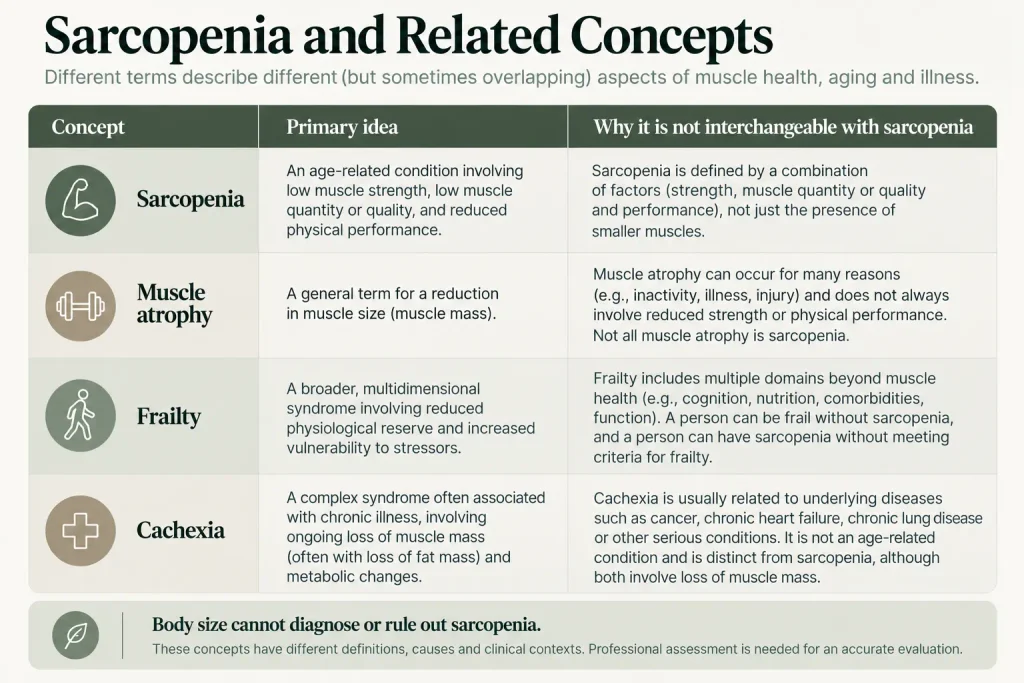
Sarcopenia overlaps with several other concepts, but the terms are not interchangeable. The distinctions matter because muscle size, whole-body vulnerability, and disease-associated wasting describe different clinical ideas.
Sarcopenia vs. Muscle Atrophy
Muscle atrophy primarily describes loss or shrinking of muscle tissue. Sarcopenia is a clinical muscle disorder in which reduced strength and impaired function are central considerations. The two may overlap, but they are not synonymous.
Sarcopenia vs. Frailty
Frailty is a broader syndrome of reduced physiologic reserve and vulnerability. Sarcopenia can overlap with frailty, but one term should not be used as a substitute for the other.
Sarcopenia vs. Cachexia
Cachexia is a disease-associated metabolic wasting syndrome. It is distinct from sarcopenia, even though both can involve loss of muscle.
The underlying clinical context matters, which is another reason unexplained muscle or weight loss deserves appropriate evaluation rather than self-diagnosis.
Can Someone Have Sarcopenia Without Looking Thin?
Yes. Someone does not need to look thin or underweight to have clinically important muscle impairment.
Sarcopenic obesity is one context in which excess adiposity and sarcopenia can coexist. More broadly, appearance and body weight alone cannot diagnose or rule out sarcopenia.
This reinforces the central point of the article: strength, function, and appropriate clinical assessment tell us more than appearance alone.
When Should You Talk to a Healthcare Professional?
Persistent or progressive weakness, increasing difficulty with mobility, recurrent falls, unexplained muscle or weight loss, or declining ability to perform everyday activities can be reasonable reasons to talk with a healthcare professional.
The purpose of evaluation is not to assume that sarcopenia is the explanation. It is to determine what may be contributing to the change and whether further assessment or management is appropriate.
Sudden weakness, especially weakness affecting one side or a specific part of the body, should not be interpreted as sarcopenia and requires urgent medical assessment. Other serious acute symptoms likewise warrant urgent evaluation rather than a sarcopenia explanation.
For gradual changes, a professional can consider strength, physical performance, muscle measures where appropriate, and the broader health context rather than relying on appearance or self-testing alone.
Supporting Muscle Health as You Age: What Happens Next?
Sarcopenia is not an inevitable label attached to getting older, and muscle health is not determined by one measurement.
For people concerned about declining strength or function, the first priority is appropriate assessment rather than self-diagnosis. For ongoing muscle health, resistance-based exercise has the strongest support among the non-pharmacologic approaches considered here, while adequate nutrition and protein can complement that work.
Readers who need practical nutrition guidance rather than another overview of sarcopenia can continue with our guide to getting enough protein as an older adult.
The broader perspective is straightforward: sarcopenia involves more than visible muscle size. Strength and function matter, meaningful improvement can be possible, and persistent or progressive decline deserves attention rather than automatic attribution to age.
Frequently Asked Questions About Sarcopenia
Is sarcopenia a normal part of aging?
No. Muscle changes can occur with age, but sarcopenia is not an inevitable diagnosis for every older adult. Clinically important changes in strength and function are central to the condition, so age or muscle loss alone is not enough to identify sarcopenia.
What are the early signs of sarcopenia?
There is no single definitive “first sign.” Possible early clues can include persistent or progressive weakness, increasing difficulty with mobility, or declining ability to perform ordinary physical tasks. These changes can have many causes and may warrant evaluation rather than self-diagnosis.
How is sarcopenia diagnosed?
Sarcopenia is assessed clinically using measures that may include muscle strength, muscle quantity or quality, and physical performance. Tools can include grip strength, chair stands, gait speed, DXA, BIA, and screening instruments such as SARC-F, but the exact criteria differ among diagnostic frameworks and should not be treated as a DIY pass/fail test.
Can sarcopenia be reversed?
Strength, physical function, and selected measures can improve with appropriate management, particularly resistance-based exercise and supportive nutrition. That measurable improvement should not be confused with a guarantee that sarcopenia can be completely reversed or cured in every person.
What is the difference between sarcopenia and muscle atrophy?
Muscle atrophy primarily describes loss or shrinking of muscle tissue. Sarcopenia is a clinical muscle disorder in which reduced strength and impaired function are central considerations. The two may overlap, but they are not synonymous.
When should you talk to a healthcare professional about muscle loss or weakness?
Persistent or progressive weakness, mobility problems, recurrent falls, unexplained muscle or weight loss, or declining everyday function can justify a professional evaluation. Sudden or focal weakness should not be assumed to be sarcopenia and requires urgent medical assessment; other serious acute symptoms likewise warrant urgent evaluation.