
How to Increase Stamina for Running: Are You Running Too Fast to Run Longer?
If you repeatedly run out of steam earlier than you want, pace is one of the first variables worth checking.
That does not mean you are objectively running fast. A pace that looks slow on paper can still be too intense for your current capacity, the duration you are trying to sustain, or the purpose of that particular run.
When excessive relative intensity is the limiter, slowing down can let you stay active longer and accumulate more running.
But that solves only part of the problem.
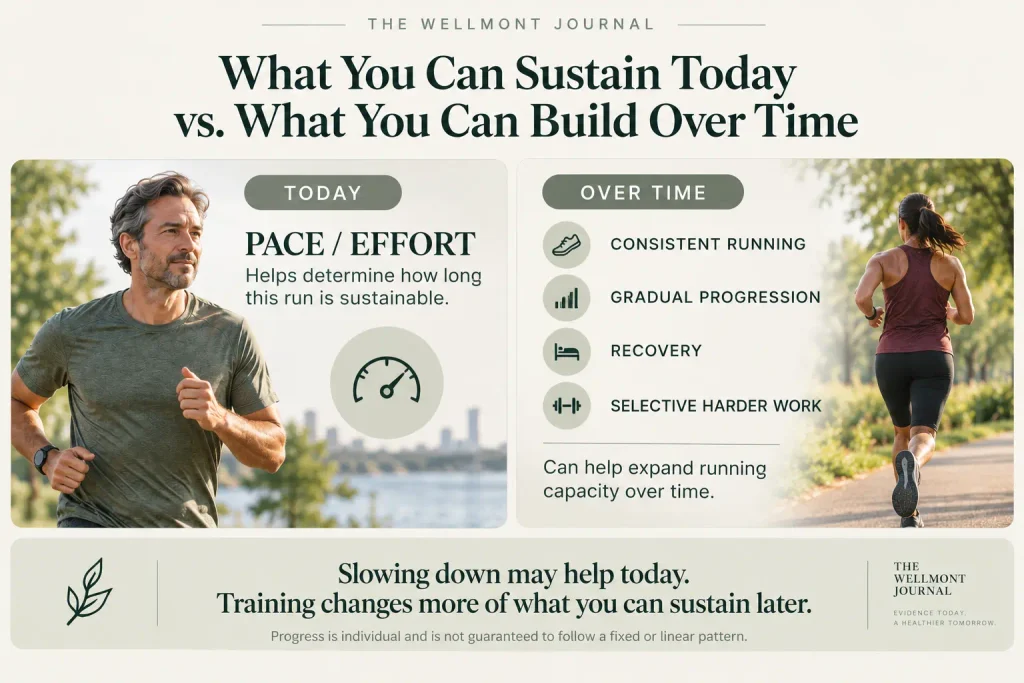
Running longer today and building more endurance over the coming weeks and months are related, but they are not the same thing.
Pace helps control what you can sustain today.
Training determines more of what you can sustain tomorrow.
Long-term running stamina develops through repeated running exposure, gradual progression, recovery, and, when appropriate, harder training too.
So the answer to the title is: possibly, yes. You may be running too fast to run longer right now.
But slowing down is not the whole endurance strategy.
First, Ask Whether You Are Running Too Fast for This Run
Many runners judge pace by the number on a watch.
That can be misleading.
A certain pace may be easy for one runner, moderate for another, and unsustainable for someone else.
The more useful question is whether the effort matches the purpose of the session.
If your goal is to stay active continuously for longer, but you repeatedly start at an effort you can only hold briefly, the immediate limiter may be intensity rather than a complete lack of endurance.
That does not mean pace explains every case of running fatigue.
Heat, hills, sleep, unfamiliar running load, accumulated training fatigue, fueling, hydration, and medical factors can all affect how hard a run feels.
But pace is an accessible place to start because you can adjust it immediately and see whether the run becomes more sustainable.
“Too Fast” Is Relative, Not a Number on Your Watch
There is no universal minutes-per-mile or minutes-per-kilometer pace that qualifies as “too fast.”
There is also no single heart-rate number that every runner must stay under.
“Too fast” means too intense relative to:
- your current running capacity;
- the length of the run;
- the terrain and conditions;
- and what that session is supposed to accomplish.
A runner moving at a pace that looks modest on paper may still be working at a very high relative intensity.
That matters because the harder you work relative to your current capacity, the shorter that effort can usually be sustained.
For a hard interval, that may be exactly the point.
For a run intended to last much longer, it may be a pacing mismatch.

Use the Talk Test as a Practical Check
The talk test can help you estimate relative effort without pretending that a watch can give you perfect physiological precision.
At a lower relative intensity, speaking in full sentences is generally easier.
As effort rises, conversation becomes more difficult.
That does not mean the talk test is an exact clinical threshold.
It also does not mean conversational running equals a precise “Zone 2.”
And if you cannot talk comfortably, that does not automatically mean the workout is wrong.
Some sessions are intentionally hard.
Does this level of effort match what this run is supposed to do?
If you intended a sustainable run but can barely speak early in the session and repeatedly fade soon afterward, reducing the pace may be worth testing.
If you intended a harder workout, greater breathing difficulty may be completely consistent with the purpose of the session.
Running Longer Today Is Not the Same as Building More Endurance
This distinction solves a lot of confusion.
There is an acute problem:
How can I make this run sustainable enough to last longer today?
And there is a chronic problem:
How do I build the capacity to sustain more running over time?
Pacing affects the first question immediately.
Training answers more of the second.
Pace Helps Control Today’s Sustainable Duration
If your current effort is too intense for the duration you are trying to achieve, backing off can extend how long you remain active.
That is not a trick.
It is simply a consequence of matching the effort to what you can currently sustain.
But pace does not explain every short run.
You may still be limited by running-specific conditioning, hills, heat, poor recovery, unfamiliar terrain, or other factors.
The value of slowing down is that it helps test one important possibility:
Was the effort itself preventing you from staying out longer?
Training Expands What You Can Sustain Over Time
Slowing down may help you last longer today.
It does not automatically increase your future endurance by itself.
Long-term improvement comes from training that your body can repeatedly tolerate and adapt to.
That can include:
- consistent running;
- gradually increasing appropriate training exposure;
- improving recovery;
- extending some runs as tolerance improves;
- and adding harder training when it serves a purpose.
Slow or manageable running can be part of that process.
So can intervals and faster work.
The goal is not to choose one pace forever.
It is to develop a broader capacity.
Manageable Running Can Be Real Endurance Training
A productive run does not have to feel like a test.
Many runners assume that if a session feels controlled, they are not working hard enough to improve.
That is not necessarily true.
Manageable running can allow you to accumulate more running-specific exposure without making every session maximally demanding.
For a runner who currently goes out too hard and fades early, reducing intensity may turn a short struggle into a longer, more repeatable training session.
But there is an important qualifier.
Not every easy effort is automatically enough to produce meaningful adaptation.
The workload still needs to provide an appropriate challenge for the individual.
A Productive Run Does Not Have to Test Your Limit
There is a difference between demonstrating your current capacity and training it.
If every run becomes a test of how far or fast you can go before you break down, you may spend much of your training repeatedly reaching the same limit.
A more controlled run can let you accumulate time on your feet and running-specific practice without demanding that you reach that limit every session.
That does not make hard running “just a test.”
Hard sessions can be highly productive training.
The distinction is simpler:
You do not have to test your maximum sustainable effort every time you run in order to build more capacity.
Walk Breaks Do Not Mean the Run Failed
For some runners, short walking breaks make a session more sustainable.
That is especially relevant when continuous running turns every attempt into an intensity that is too high to maintain.
Walking briefly can divide the session into more manageable bouts and allow you to accumulate more total running exposure.
That does not mean run/walk training is superior to continuous running.
It does not mean everyone needs it.
And it should not be sold as a guaranteed injury-prevention strategy.
It is simply one tool for managing effort.
When Run/Walk May Be Useful
Run/walk may be especially useful for:
- new runners;
- runners returning after time away;
- people who repeatedly start too hard;
- or runners who cannot yet sustain continuous running for the duration they want.
There is no universal run-to-walk ratio.
One person may need frequent short walking breaks.
Another may only need occasional resets.
A third may prefer continuous running at a slower effort.
The useful question is whether the strategy helps you create a repeatable session that matches your current capacity and goal.
Build Running Stamina by Progressing What You Can Recover From
Running endurance improves when training gradually becomes more demanding in ways you can still absorb.
But “progress” can mean several different things.
You can change:
- duration;
- distance;
- frequency;
- weekly volume;
- intensity;
- terrain;
- or the balance between continuous running and walking.
Those are separate training levers.
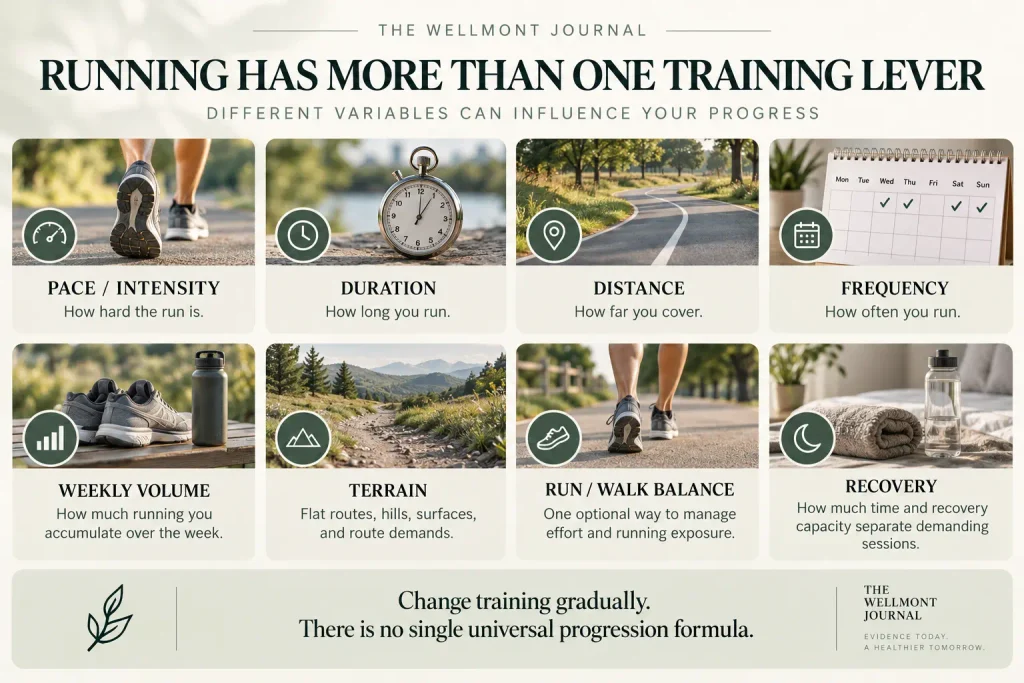
Increasing several at once can create a much larger jump in workload than it appears.
Change One Major Training Lever at a Time
A practical approach is to change one major variable and see how you respond.
For example, you might keep the effort similar while extending some running time.
Or keep duration stable while adding another appropriate running exposure.
Or maintain volume while introducing some higher-intensity work.
There is no scientific law that says you must always:
- increase distance before speed;
- increase time before distance;
- or increase frequency before intensity.
Those can be useful approaches in certain situations.
They are not universal sequences.
The 10% Rule Is Not a Scientific Law
The familiar “10% rule” says runners should limit weekly increases to 10%.
That is not a universally validated safe ceiling.
It is also not a guarantee against injury.
The broader idea behind it — avoid sudden large jumps in workload — is sensible.
But one percentage cannot account for every runner, every training history, every surface, every intensity, or every kind of workload change.
A better goal is gradual progression that remains tolerable and recoverable.
Do not replace one rigid percentage with another.
“Minutes Before Miles” Can Be a Useful Beginner Heuristic
Some new runners find it easier to think in terms of sustainable time rather than mileage.
That can shift attention away from pace and toward completing a manageable running session.
For example, the immediate goal may be to tolerate a certain period of running and walking rather than to force a particular distance.
That is a practical heuristic.
It is not a scientific rule that beginners must always train by minutes.
Some runners prefer distance-based goals.
The useful framework is whichever one helps keep the progression appropriate rather than forcing the pace.
How Often Should You Run to Build Stamina?
There is no universal number of running days that works for everyone.
Useful frequency depends on:
- your current tolerance for running;
- total weekly workload;
- other exercise you perform;
- recovery;
- experience;
- and how demanding each run is.
Repeated exposure matters because running is a specific skill and physical demand.
But more frequent running is not automatically better if each additional session pushes your total workload beyond what you can recover from.
A beginner may need more recovery between runs, while some established runners can tolerate more frequent running exposure.
A useful running frequency provides repeated exposure while still allowing you to recover well enough to keep training consistently.
Gradually Extend Some Runs as Your Tolerance Improves
If the goal is to run longer, some of your training eventually needs to include longer running exposure.
That does not mean every run should become longer.
And it does not mean you need a formal “long run” prescription with a particular mileage or percentage of the week.
It simply means that as your tolerance improves, extending selected sessions can help your body become more accustomed to sustaining running for longer periods.
The increase does not need to be dramatic.
A run that was previously challenging may become comfortable.
At that point, increasing duration can provide a new training stimulus without necessarily increasing intensity.
That is another example of why “harder” and “more” are different.
Harder Running Still Has a Place
Slowing down can help if excessive intensity is limiting how long you can run.
That does not mean all running should be slow.
Harder running and interval training can improve cardiorespiratory fitness, running performance, and endurance-related capacity. Readers who want the wider framework can also review our broader endurance training principles.
The goal is not to remove intensity.
It is to use it deliberately.
Why Faster Work Can Help
Higher-intensity running creates a different training demand from manageable steady running.
Intervals and other harder efforts can provide a strong cardiorespiratory stimulus and help develop the ability to perform at higher intensities.
For runners who already tolerate regular running, selective harder work can be one useful way to keep progressing.
But harder does not automatically mean better.
The value of a hard session depends on what it adds to the rest of the training pattern.
Why Every Run Does Not Need That Stimulus
Harder running can also create greater acute fatigue and recovery demand.
If every run becomes a hard session, the accumulated stress may make it difficult to repeat quality training.
A runner can therefore benefit from hard work without making it the purpose of every run.
The key distinction is not:
easy good, hard bad.
It is:
different sessions can have different jobs.
Beginners and Established Runners Need Different Emphasis
The principles of running endurance apply broadly, but the emphasis changes with experience.
A person learning to tolerate regular running has different needs from someone who already runs consistently and wants to expand performance.
If You Are New to Running
The priority is often making running sustainable enough to repeat.
That may mean:
- slowing down;
- using walk breaks;
- avoiding the urge to turn every run into a test;
- gradually building running-specific tolerance;
- and recovering adequately between sessions.
You do not need mandatory interval training just because intervals can be effective.
For a beginner, learning to control effort and accumulate repeatable running exposure can already be a meaningful training step.
If You Already Run Consistently
Once regular running is well established, more deliberate training choices may become useful.
Potential levers include:
- additional volume;
- selectively longer running;
- harder sessions;
- strength training for seniors for older runners who want a dedicated strength-training continuation;
- better recovery;
- and work that supports running economy.
The exact mix depends on the runner and the goal.
Runners over 50 whose goals also include adding muscle can use our separate guide to build muscle after 50.
This article does not need to become a race plan to make that distinction useful.
General Fitness Helps, but Running Still Requires Running
Aerobic fitness transfers between activities, but only partly.
A strong cyclist or swimmer may have excellent general cardiorespiratory fitness and still find running surprisingly difficult.
Running creates its own muscular, mechanical, technical, and movement-specific demands.
That means a fit non-runner may still need time to build running-specific tolerance.
Cross-Training Can Support Aerobic Fitness
Cycling, swimming, rowing, and elliptical training can support general aerobic conditioning.
They can be useful when you want additional aerobic work without adding more running.
But they do not produce identical running adaptations.
If the goal is to run longer, some running-specific exposure remains important.
Cross-training can support the process.
It does not completely replace practicing the activity you want to improve.
Strength Training Can Support Running Performance
Strength training can complement running.
Evidence suggests it can support running performance and running economy, particularly in trained runners.
That does not mean strength training replaces running.
It also should not be presented as a universal way to raise VO2max.
The useful role is supportive:
in relevant runner populations, strength training can complement running and may improve running economy or performance without replacing running-specific aerobic training.
Running Economy, in Simple Terms
Running economy describes how much energy or oxygen it costs you to run at a given submaximal speed.
Two runners can move at the same pace but require different amounts of energy to do it.
A more economical runner can perform the same submaximal task at a lower relative cost.
Running economy is not the same thing as aerobic capacity.
And improving it does not require turning this article into a detailed discussion of cadence, foot strike, or running-form reconstruction.
Recovery Affects How Hard the Same Pace Feels
A pace that feels manageable on one day can feel surprisingly difficult on another.
That does not necessarily mean you suddenly lost fitness.
Accumulated training fatigue, poor sleep, heat, stress, and incomplete recovery can all change the relative effort of the same pace.
This is another reason a pace number should not be treated as a fixed truth about how hard you are working.
Sleep Is Part of the Training Equation
Sleep deprivation can impair endurance performance.
That does not mean one poor night explains every bad run.
But if you repeatedly train while inadequately recovered, the same workout may feel harder and become less repeatable.
Before assuming you need to push harder, ask whether recovery is allowing the training you already do to work.
Nutrition and Hydration Matter More as Running Demands Increase
For short, manageable running, elaborate fueling strategies are often unnecessary.
As runs become longer, harder, or take place in challenging heat, nutrition and hydration become more relevant.
Adequate energy supports training and recovery.
Carbohydrate availability becomes increasingly relevant during longer or harder exercise.
Hydration matters more as fluid losses increase with duration, temperature, and sweating.
But this is not a race-fueling guide.
There is no need here for grams-per-hour targets, fixed hydration volumes, or electrolyte protocols.
Older adults who want a deeper look at protein needs can read our guide to protein for older adults.
And getting tired while running does not by itself prove a nutrient deficiency or supplement need.

Why Do You Get Tired So Quickly When Running?
There is no single explanation.
Possible contributors include:
- unsustainable relative intensity;
- current running-specific conditioning;
- unfamiliar running load;
- hills or difficult terrain;
- heat and humidity;
- accumulated fatigue;
- inadequate recovery;
- poor sleep;
- nutrition or hydration context;
- or medical factors.
None of these can be diagnosed from one difficult run.
But one of the most useful first checks is whether the effort you chose was sustainable for the duration you expected.
Sometimes “I need more stamina” partly means:
“The pace I chose is above the intensity I can currently sustain.”
That is not the only explanation.
But it is one you can test immediately.
If your tiredness is mainly linked to meals rather than exercise, our separate guide to feeling tired after eating addresses that different pattern.
Feeling Out of Breath Is Not Automatically a Problem
Running increases your body’s demand for oxygen and energy.
As intensity rises, breathing usually becomes harder.
That can be a normal part of exercise.
Being out of breath does not automatically mean you are unfit.
It also does not automatically mean you have a medical problem.
The concern changes when breathlessness is new, severe, unusual, clearly disproportionate to the effort, persistent, or occurs with other concerning symptoms.
When Running Fatigue May Need Medical Attention
Running fatigue is usually a training question first.
Medical evaluation becomes more relevant when your exercise tolerance changes in ways that are persistent, unexplained, severe, or disproportionate to the activity.
Reasons to Discuss Persistent Exercise Intolerance With a Clinician
Consider discussing the pattern with a clinician if you notice:
- a persistent unexplained decline in exercise tolerance;
- unusual fatigue that does not improve with reasonable recovery;
- recurrent breathlessness that seems disproportionate to the effort;
- recurring palpitations;
- new exercise intolerance after an illness;
- symptoms that consistently prevent ordinary exercise you previously tolerated;
- or a meaningful change that you cannot explain through training, recovery, heat, or similar context.
Those symptoms do not identify a specific disease.
They simply deserve a different frame from ordinary training fatigue.
Symptoms That May Need Prompt or Urgent Evaluation
Prompt or urgent medical evaluation may be appropriate for symptoms such as:
- chest pain or pressure during exercise;
- fainting during exercise;
- concerning near-fainting;
- severe or unusual shortness of breath;
- palpitations accompanied by chest discomfort, fainting, or severe breathlessness;
- or a sudden major unexplained reduction in exercise tolerance.
Those situations are different from the normal discomfort of a demanding run.
Frequently Asked Questions About Running Stamina
How can I increase my stamina for running?
Start by choosing a pace you can sustain, then build running-specific exposure gradually through consistent training. Progress one major variable at a time, include harder work selectively when it serves a purpose, and protect recovery so the training remains repeatable.
How do I know if I am running too fast?
A pace may be too fast for a particular run if the effort is too intense to sustain for the intended duration or purpose. The talk test, breathing, perceived effort, and whether you repeatedly fade early can all provide useful clues, but there is no universal pace or heart-rate number that defines “too fast.”
Should I run slower to build endurance?
Sometimes. If your current pace repeatedly prevents you from sustaining the amount of running you intended, slowing down can help you accumulate more running. But slower-only training is not universally optimal; harder sessions can also contribute to endurance when used appropriately.
Does run/walk improve running endurance?
Run/walk can support endurance-building training by making running exposure more manageable, especially for beginners or returning runners. It can help some people accumulate more total running, but the run/walk approach itself is not proven superior to continuous running for everyone, and there is no universal run-to-walk ratio.
How often should I run to build stamina?
There is no universal number of running days. Useful frequency depends on your experience, total workload, other training, current running tolerance, and recovery. The goal is enough repeated running exposure to support adaptation without exceeding what you can recover from.
Should every run feel easy?
No. Some runs can intentionally be hard. The point is that every run does not need to provide the same high-intensity stimulus. Manageable runs and harder sessions can serve different roles in a repeatable training pattern.
How long does it take to improve running endurance?
Measurable improvement can occur within weeks of consistent training, but there is no fixed timeline. Progress depends on your starting point, training dose, running experience, recovery, and adherence, and meaningful endurance development continues over time.