Vagus Nerve Stimulation: What It Is and How the Different Types Compare
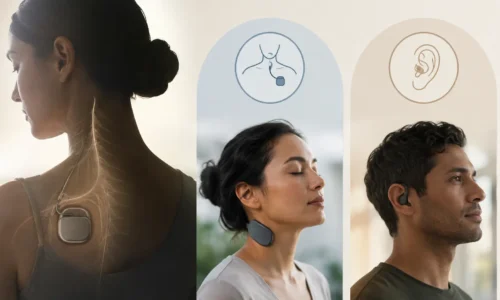
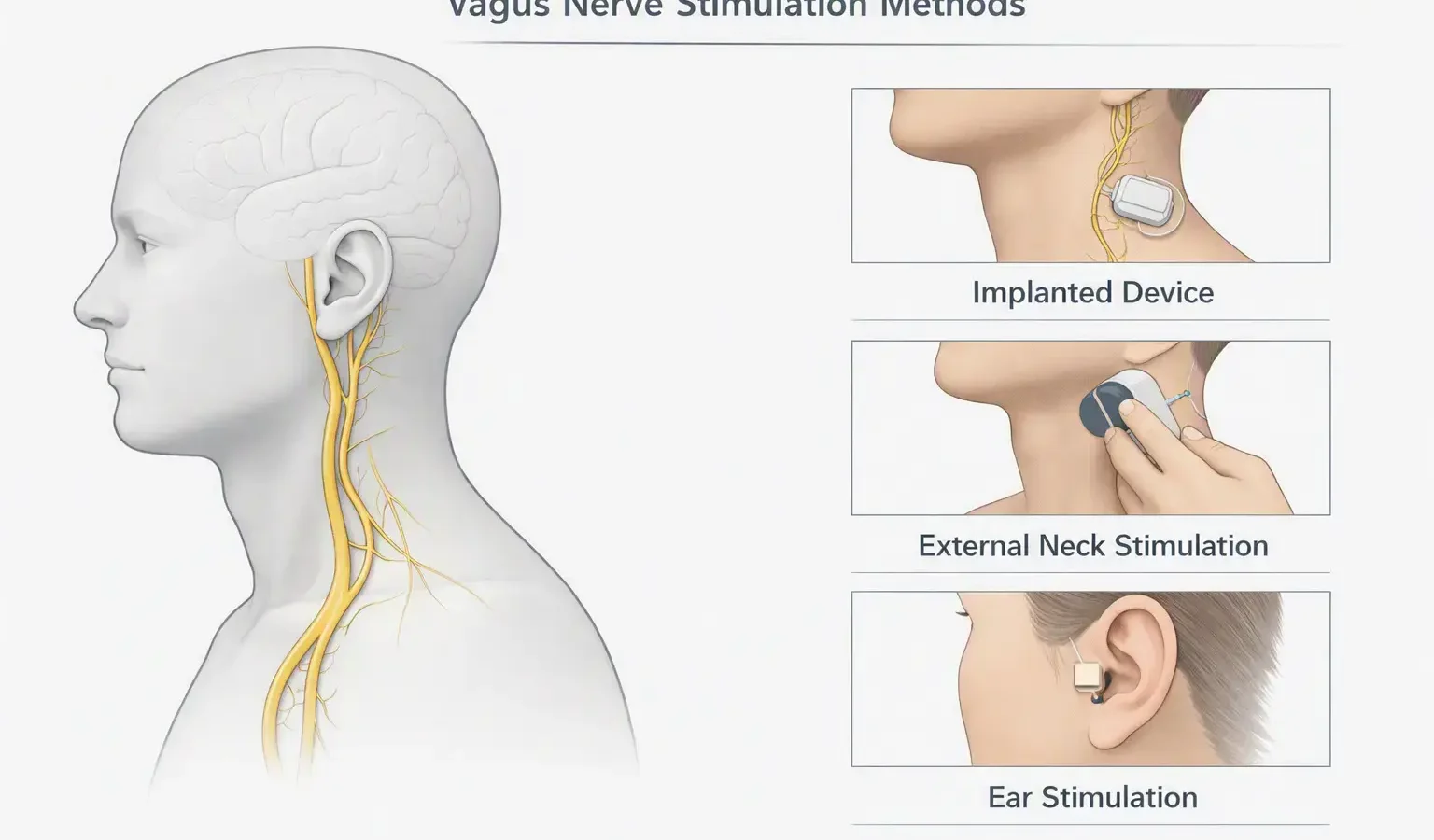
“Vagus nerve stimulation,” or VNS, sounds like the name of a single treatment. In practice, the term can refer to materially different ways of delivering stimulation, from surgically implanted systems to external devices that apply stimulation at the neck or ear.
That distinction matters. Two interventions described as VNS may differ in where stimulation is delivered, how it is delivered, the device and protocol used, the medical condition or outcome being studied, and the regulatory context in which the device is used.
As a result, evidence for one type of VNS should not automatically be treated as evidence for another. A finding involving an implanted system, for example, does not by itself establish that an external cervical device, an auricular stimulation protocol, or a consumer wellness product will produce the same result.
The most useful first step, then, is not to ask whether “VNS” works as though it were one uniform intervention. It is to identify which kind of vagus nerve stimulation is actually being discussed.
What Is Vagus Nerve Stimulation?
Vagus nerve stimulation (VNS) is a broad term for electrical neuromodulation approaches intended to engage the vagus nerve or vagal afferent pathways. Implanted and external cervical approaches target the vagus in the neck, while transcutaneous auricular VNS applies stimulation to selected areas of the outer ear intended to engage afferent fibers of the auricular branch of the vagus nerve.
The vagus nerve is a major cranial nerve with connections between the brain and multiple parts of the body. Its anatomy and functions are complex, and a full explanation is beyond what is needed to distinguish VNS categories here. For that foundation, see how the vagus nerve works.
The important point for understanding VNS is that stimulation can be delivered in different ways and at different locations. Some systems involve surgically implanted components. Others apply stimulation externally. Among external approaches, stimulation may be delivered at the neck or at specific areas of the outer ear.
These differences are not merely variations in product design. They help define what intervention was actually tested and therefore what a particular study or clinical claim can reasonably tell us.
How Vagus Nerve Stimulation Works: The Basic Idea
At a high level, VNS uses electrical stimulation with the goal of influencing neural signaling associated with the vagus nerve and connected nervous-system pathways.
That broad description is useful, but it should not be mistaken for a single, universal mechanism shared identically by every intervention marketed or studied under the VNS label.
An implanted system can differ substantially from an external system. External stimulation at the neck is not the same intervention as stimulation at the ear. Even within one category, devices and research protocols can use different stimulation parameters, treatment schedules, anatomical targets, and intended uses.
For readers, the practical lesson is straightforward: understanding the general idea behind VNS is only the beginning. To interpret a study or health claim, you also need to know how the stimulation was delivered.
Why “VNS” Can Mean Different Things
VNS terminology can become confusing because several labels are used across clinical medicine, research, and consumer health.
- VNS, for vagus nerve stimulation;
- implanted VNS;
- non-invasive or noninvasive VNS;
- cervical VNS;
- transcutaneous VNS, sometimes abbreviated tVNS;
- transcutaneous auricular vagus nerve stimulation, commonly abbreviated taVNS;
- transcutaneous cervical vagus nerve stimulation, sometimes abbreviated tcVNS;
- consumer products described as vagus nerve stimulators or vagal stimulation devices.
Abbreviations are not used uniformly across the literature. In some clinical and regulatory sources, nVNS refers specifically to non-invasive cervical stimulation at the neck. Other scientific literature uses tVNS as an umbrella term for transcutaneous cervical and auricular approaches. When the stimulation site is known, terms such as tcVNS and taVNS are therefore more specific than nVNS or tVNS alone.
These terms overlap in some contexts, but they are not synonyms for one identical intervention.
For example, “non-invasive VNS” is a broad description rather than enough information to identify a specific protocol. An external approach applied at the neck and a transcutaneous approach applied at the ear may both be described as non-invasive, yet they differ in stimulation site and may differ in devices, protocols, evidence bases, and intended uses.
The same caution applies when moving between clinical terminology and consumer marketing. A product that uses vagus-related language should not automatically be assumed to be equivalent to a VNS intervention evaluated in a clinical study.
The Main Types of Vagus Nerve Stimulation
A useful way to organize the VNS landscape is to start with two broad questions:
- Is the stimulation delivered through an implanted system or externally?
- If it is external, where is the stimulation applied?
From there, additional distinctions—including device, protocol, intended use, and regulatory context—become important.
Implanted Vagus Nerve Stimulation
Implanted VNS uses surgically implanted components to deliver electrical stimulation to the cervical vagus nerve.
This is the form of VNS with the longest-established clinical context among the categories discussed here. It should therefore be identified specifically when a source is describing evidence, indications, risks, or regulatory status associated with an implanted system.
The fact that an implanted VNS system has been studied or authorized for a particular medical use does not establish that a non-invasive intervention has the same effects. The delivery method, stimulation characteristics, device, patient population, and clinical context may all differ.
That distinction becomes especially important when broad statements such as “VNS has been shown to…” are used without identifying the form of VNS involved.
Non-Invasive Cervical Vagus Nerve Stimulation
Non-invasive cervical VNS applies stimulation externally in the neck region rather than using a surgically implanted system.
You may also encounter terminology such as non-invasive VNS (nVNS) or transcutaneous cervical VNS (tcVNS), depending on the source and the intervention being described. Because terminology varies, the stimulation site and the source’s own definition are more informative than the abbreviation alone.
The cervical location is an important part of the definition. It separates this category from auricular approaches, which apply stimulation at the ear.
Non-invasive cervical VNS has been used in clinical and research contexts, but the evidence for any specific use needs to be evaluated according to the actual device, protocol, population, and outcome studied. A broad category label alone is not enough to establish effectiveness.
For a closer examination of research involving external approaches, see evidence for non-invasive VNS.
Transcutaneous Auricular Vagus Nerve Stimulation
Transcutaneous auricular vagus nerve stimulation, commonly abbreviated taVNS, applies electrical stimulation through the skin at selected areas of the outer ear intended to engage afferent fibers of the auricular branch of the vagus nerve (ABVN). Commonly studied targets include regions of the concha and tragus, but the ear has overlapping sensory innervation and the precise distribution of vagal fibers is not uniform or fully settled.
It falls within the broader landscape of transcutaneous and non-invasive approaches, but it should not be treated as interchangeable with cervical stimulation.
Research involving taVNS can also vary considerably in stimulation location, equipment, parameters, treatment schedules, study populations, and outcomes. For that reason, “taVNS” is a more informative label than simply “VNS,” but it still does not tell you everything needed to interpret a study.
This article does not attempt to determine whether taVNS works for particular health outcomes. That requires examining the specific evidence rather than extrapolating from the category name.
Other Consumer and Wellness Approaches
The consumer market adds another layer of terminology.
Products may be promoted using phrases such as “vagus nerve stimulation,” “vagal stimulation,” or broader nervous-system and relaxation language. Those descriptions alone do not establish that a product is equivalent to an implanted VNS system, a particular cervical VNS device, or an auricular protocol used in published research.
Consumer products can differ in:
- the anatomical site being stimulated;
- the form of stimulation used;
- stimulation parameters and protocols;
- intended use;
- regulatory position;
- and the amount and type of evidence available for the exact product.
Some products associated with vagus-nerve wellness may therefore require a different classification altogether rather than being assumed to represent clinically studied VNS.
The key question is not simply whether a product uses the words “vagus nerve.” It is what the product actually does and what evidence exists for that specific intervention.
How the Different VNS Approaches Compare
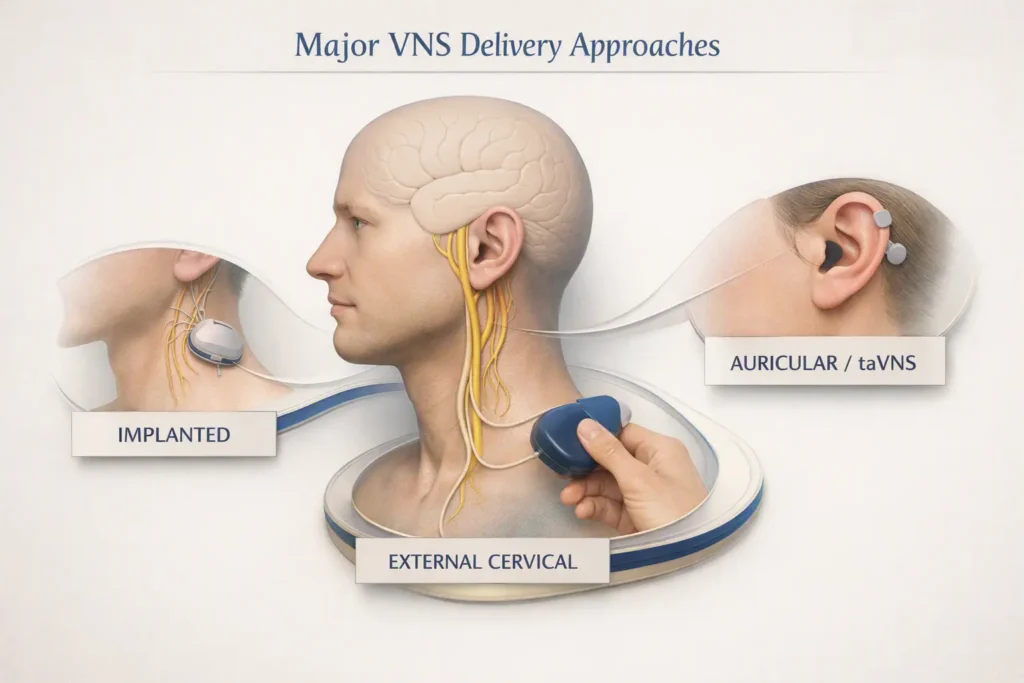
The easiest way to compare VNS approaches is not to rank them. It is to classify them.
A reader-friendly comparison looks like this:
| Question | Implanted VNS | External Cervical VNS | Transcutaneous Auricular VNS |
| How is stimulation delivered? | Through surgically implanted components | Externally through the skin at the neck | Externally through the skin at the ear |
| General stimulation area | Cervical vagus nerve | Side of the neck, targeting the cervical vagus | Selected outer-ear regions intended to engage afferent fibers of the auricular branch of the vagus nerve |
| Surgical implantation involved? | Yes | No | No |
| Context | Established clinical uses; exact system and indication matter | Clinical and research contexts; exact device and intended use matter | Research and investigational contexts; clinical and regulatory status depends on the specific intervention and intended use |
| Can evidence from another VNS category automatically be applied here? | No | No | No |
This table classifies delivery approaches. It does not imply equivalent mechanisms, efficacy, safety, indications, or regulatory status.
Where Stimulation Is Delivered
Anatomical location is one of the first details to identify when reading about VNS.
Implanted VNS and external cervical VNS both involve the cervical region in different ways, but one uses implanted components while the other delivers stimulation externally.
Auricular VNS instead applies stimulation at selected parts of the outer ear intended to engage afferent fibers of the auricular branch of the vagus nerve.
Those anatomical and delivery distinctions are among the reasons that a finding from one category cannot simply be copied to another.
Implanted vs External Delivery
The implanted-versus-external distinction is fundamental.
Implanted VNS involves a medical procedure and implanted hardware. External approaches do not require surgical implantation.
But “external” is still too broad to tell you exactly what intervention is involved. An external cervical device and an auricular stimulation protocol can differ in target location, stimulation characteristics, device design, and evidence.
So while “implanted versus non-invasive” is a useful first division, it should not be the last one.
Clinical, Prescription, Research, and Consumer Context
Another useful question is where an intervention sits in practice.
A VNS intervention may be encountered as part of established clinical care, as a prescription medical device, in an investigational or research setting, or as a consumer wellness product.
Those contexts should not be collapsed into one category.
They are not necessarily mutually exclusive, either. Regulatory status, prescription or over-the-counter availability, use in clinical care, use in research, and commercial positioning describe different aspects of an intervention and can overlap.
A research intervention, for example, may be used under a specific study protocol that does not correspond to the way a consumer product is used. Likewise, evidence involving a particular prescription device should not be assumed to validate unrelated products simply because their marketing uses similar terminology.
When evaluating a VNS claim, the context is part of the evidence.
Regulatory Context
In the United States, regulatory terms should be used precisely. FDA approval and FDA clearance refer to different premarket pathways, while establishment registration and device listing do not by themselves mean that FDA has approved, cleared, or authorized a device. A product described as general wellness may also fall under a different regulatory framework from a device authorized for a medical indication. Likewise, FCC equipment authorization concerns compliance with applicable communications and radiofrequency requirements, not whether a product has been shown clinically effective for a health condition. Regulatory claims should therefore be tied to the specific product, jurisdiction, intended use, and applicable regulatory pathway.
For that reason, vague descriptions such as “FDA certified” should not be used as shorthand for a device’s regulatory position. The relevant question is what specific regulatory status applies to the specific product and intended use.
Regulatory status also should not be generalized from one VNS category to all forms of vagus nerve stimulation.
Why Evidence From One Type of VNS Does Not Automatically Apply to Another
This is the most important principle for making sense of VNS research and marketing claims:
Evidence belongs to the intervention that was actually studied.
If a study finds an effect using one VNS system, that finding does not automatically establish the same effect for every other intervention described as vagus nerve stimulation.
Several variables can change what a study actually tells us.
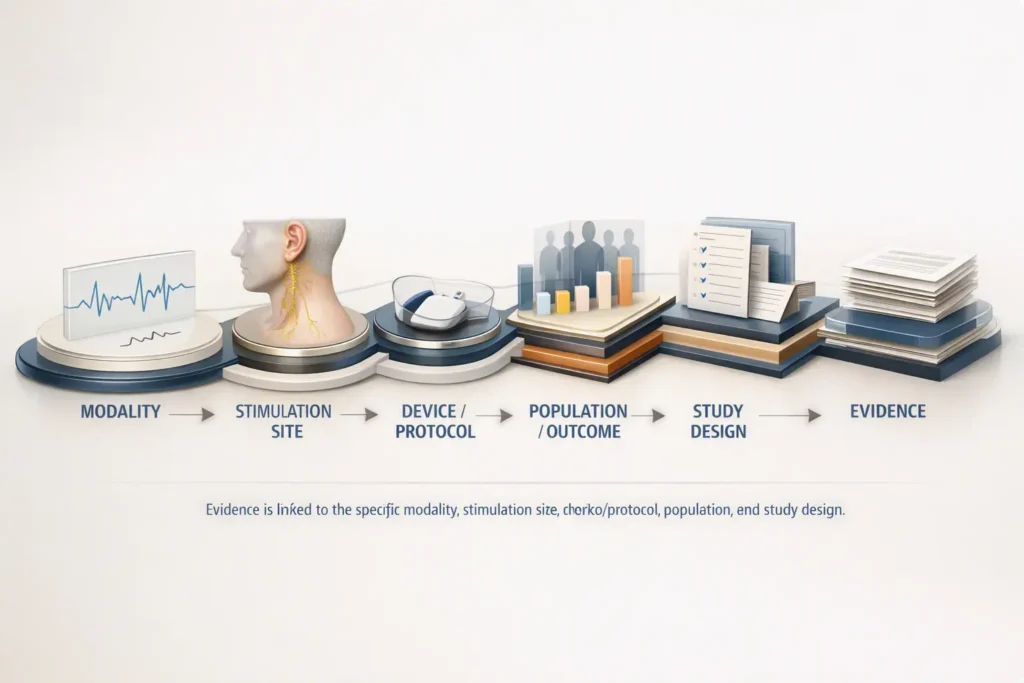
Modality: Was the intervention implanted or external?
Stimulation site: Was stimulation delivered at the cervical vagus nerve, the neck externally, or an auricular location?
Device and protocol: What equipment was used? What stimulation parameters and treatment schedule were tested?
Population: Who participated in the study? Findings in one patient or research population may not apply to everyone.
Indication or outcome: What exactly was the intervention intended to address, and what did the researchers measure?
Study design: Was the evidence from a controlled clinical trial, an observational study, an early feasibility study, or another type of research?
These distinctions prevent a common reasoning error: starting with evidence for one intervention and gradually broadening it until it appears to validate an entire product category.
For example, this reasoning is not justified without supporting evidence:
implanted VNS evidence
→ therefore non-invasive VNS works the same way
→ therefore cervical and auricular VNS are equivalent
→ therefore a consumer vagus nerve product produces the same clinical outcome.
Each arrow introduces a new assumption.
The better approach is to keep the evidence attached to the modality, stimulation site, device or protocol, population, outcome, and study design that were actually evaluated.
Where Non-Invasive VNS Fits
“Non-invasive VNS” is best understood as a broad description whose exact meaning can depend on the source rather than as a guarantee that all interventions described that way are equivalent.
External cervical stimulation and transcutaneous auricular stimulation are both encountered within the broader non-invasive VNS landscape, but they differ in where stimulation is delivered and may differ in devices, protocols, intended uses, and supporting evidence.
Terminology also varies across scientific, clinical, and regulatory sources. That makes it useful to look beyond an abbreviation such as tVNS, taVNS, tcVNS, or nVNS and read how the authors or regulators define the intervention.
Once the question changes from “Which type of VNS is this?” to “What does research show about this non-invasive approach?”, a more detailed evidence review is needed.
See non-invasive VNS evidence and safety for that next step.
How to Read VNS Claims More Carefully
When you encounter a statement such as “VNS has been shown to reduce…” or “studies show vagus nerve stimulation can…,” the abbreviation alone does not give you enough information to judge the claim.
Before drawing a conclusion, ask:
- Which form of VNS was studied? Was it implanted, external cervical, auricular, or something else?
- Where was stimulation delivered? “Vagus nerve stimulation” does not identify the stimulation site by itself.
- Which device or protocol was used? Findings involving a specific system or research protocol do not automatically apply to every device in the same broad category.
- Who was studied? A result in a defined clinical population should not automatically be generalized to healthy adults or people with different conditions.
- What outcome was measured? Evidence for one indication or outcome is not evidence for every proposed use of VNS.
- What kind of evidence supports the claim? A controlled clinical study, an early research study, and a manufacturer claim do not provide the same kind of support.
- What is the regulatory and intended-use context? Is the intervention being discussed as an established clinical treatment, a prescription device, a research intervention, or a consumer wellness product?
This framework does not require readers to become experts in neuromodulation. It simply keeps the claim connected to the intervention and evidence that actually produced it.
Where to Go Next
If your main question is about the nerve itself—where it travels, what it connects to, and why it has such broad physiological relevance—start with how the vagus nerve works.
If you already understand the main VNS categories and want to know what research shows about external approaches, including the limitations and safety considerations of that evidence, continue to evidence for non-invasive VNS.
If your question has shifted from understanding the science to identifying and comparing device categories, see compare vagus nerve stimulation devices.
The distinction to keep in mind throughout is simple: “VNS” names a broad field of stimulation approaches, not one interchangeable intervention. Before interpreting a claim about vagus nerve stimulation, identify the modality, stimulation site, device or protocol, population, outcome, study design, and context behind it.