Non-Invasive Vagus Nerve Stimulation: Types, Evidence, and Safety
“Non-invasive vagus nerve stimulation” sounds like a single intervention. It is not.
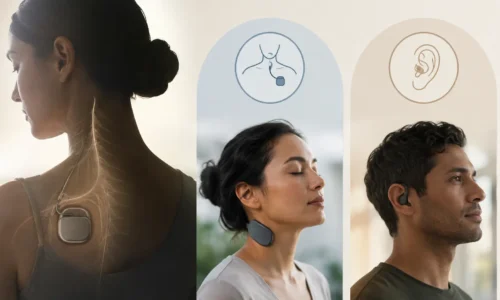
Research includes stimulation delivered at different anatomical sites, most importantly the side of the neck and selected areas of the outer ear. Devices, electrical parameters, treatment schedules, study populations, and outcomes also vary.
That means a positive finding for one cervical protocol does not establish that auricular stimulation produces the same result. Likewise, evidence from one ear site, device, or research protocol cannot automatically be generalized to every form of transcutaneous auricular stimulation or to consumer products sold using vagus-related language.
The most useful question is therefore not simply, “Does non-invasive VNS work?” It is: Which form of stimulation was studied, in whom, for what outcome, and with what quality of evidence?
What Does “Non-Invasive Vagus Nerve Stimulation” Mean?
In this context, “non-invasive” generally means that stimulation is delivered without surgically implanted stimulation hardware.
That description tells you something about delivery. It does not tell you:
- where stimulation is applied;
- which anatomical pathway is being targeted;
- which waveform or device is used;
- how long or how often stimulation is delivered;
- what condition or outcome is being studied;
- how strong the supporting evidence is;
- whether a specific device has a particular regulatory status;
- or what safety limitations apply.
“Non-invasive” is therefore not a certification of effectiveness or safety.
It is also not enough information to identify the intervention. A device applied to the side of the neck and electrodes placed at selected areas of the ear may both be discussed under the broad umbrella of non-invasive VNS, yet they represent different stimulation approaches.
For a broader explanation of implanted, external, cervical, and auricular VNS terminology, see types of vagus nerve stimulation.
The First Distinction That Matters: Cervical vs Auricular VNS
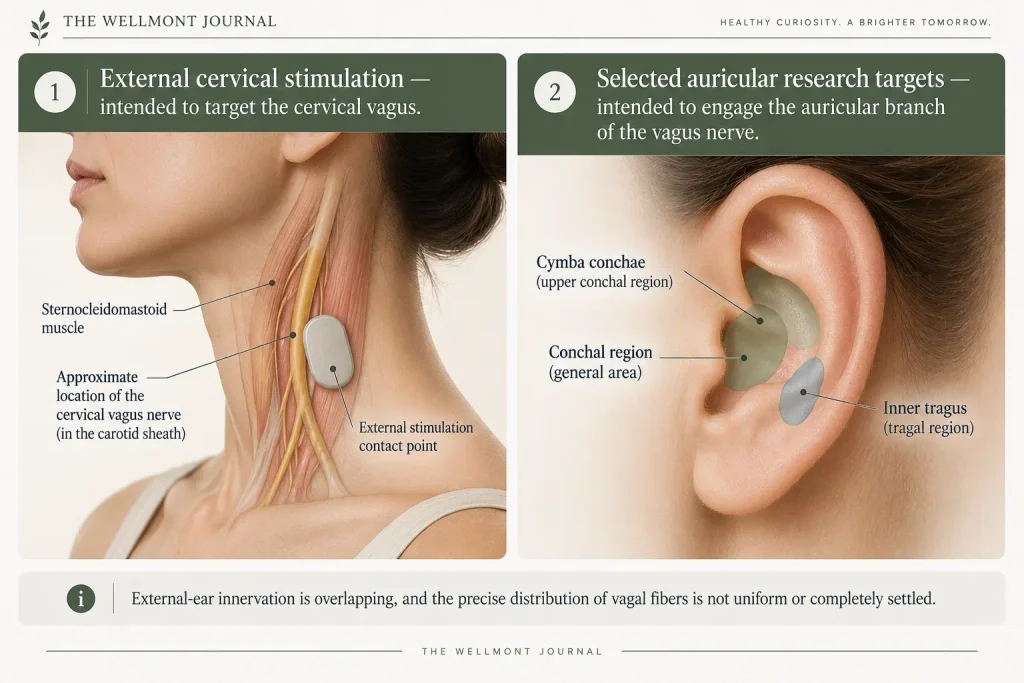
The most important first split in the non-invasive literature is anatomical.
Cervical Non-Invasive VNS
Cervical non-invasive VNS applies stimulation externally at the side of the neck, with the cervical vagus as the intended neural target.
Depending on the source, this approach may be described as non-invasive VNS, nVNS, transcutaneous cervical VNS, or tcVNS. The label alone is not enough; study methods should confirm that stimulation was actually delivered at the neck.
Among non-invasive approaches, cervical VNS has a relatively more developed U.S. clinical and regulatory evidence stream for selected headache uses. That does not mean cervical VNS is uniformly effective across headache disorders, endpoints, devices, or populations. As the migraine and cluster-headache evidence shows, results can differ substantially by outcome and subgroup.
Transcutaneous Auricular VNS
Transcutaneous auricular vagus nerve stimulation, or taVNS, applies electrical stimulation through the skin at selected areas of the outer ear intended to engage afferent fibers of the auricular branch of the vagus nerve (ABVN).
Research protocols have used areas including regions of the concha and tragus or inner tragus. But the ear has overlapping sensory innervation, and the exact distribution of vagal fibers is not uniform or completely settled.
For that reason, it would be too strong to say that the whole outer ear is vagally innervated, that tragal and conchal stimulation are necessarily equivalent, or that electrical current applied at a study site reaches only vagal fibers.
Auricular research is also highly heterogeneous. Electrode placement, waveform, intensity, session duration, schedule, sham design, population, and outcome can differ from one study to another.
Why Evidence Cannot Be Transferred Between Them
Cervical and auricular stimulation should not be treated as interchangeable versions of one standardized treatment.
| CERVICAL EVIDENCE ≠ AURICULAR EVIDENCE AURICULAR EVIDENCE ≠ CERVICAL EVIDENCE |
A cervical non-invasive VNS trial in people with migraine does not establish efficacy for taVNS in migraine. A taVNS meta-analysis in depression does not establish that external cervical stimulation produces the same effect.
Even within one modality, evidence may depend on exact site, device, protocol, population, and outcome.
That distinction is foundational to everything that follows.
Why “tVNS” Can Be a Misleading Shortcut
The abbreviation “tVNS” is used inconsistently.
In some scientific literature, it functions as a broad shorthand for transcutaneous vagus nerve stimulation. In other papers, it is used in practice to refer mainly to auricular stimulation. “nVNS” can also be used differently depending on the clinical, regulatory, or research source.
That creates a problem when studies are summarized too loosely.
Writing that “a tVNS study found…” can hide the most important detail: where stimulation was actually delivered.
When methods identify the site, a more precise description is preferable:
- “a cervical non-invasive VNS trial…”
- “a transcutaneous auricular VNS study…”
Similarly, tcVNS should be treated as cervical only when study methods confirm neck stimulation, and taVNS should refer specifically to auricular stimulation.
If a source uses ambiguous terminology and the stimulation site cannot be resolved, that uncertainty should remain visible rather than being guessed away.
| tVNS can mean different things in different papers. |
How to Read the Evidence Without Overgeneralizing It
A useful way to interpret non-invasive VNS research is to keep eight questions attached to every claim:
- What modality was used?
- Where was stimulation applied?
- Which device and protocol were used?
- Who was studied?
- What outcome was measured?
- What type and quality of evidence support the finding?
- What regulatory context applies?
- What safety limitations accompany the evidence?
Site Matters
Neck stimulation and ear stimulation are not the same intervention.
Within auricular research, one ear target should not automatically be treated as equivalent to another. Within cervical research, one device or stimulation method should not automatically stand in for all external neck-based VNS.
Anatomical location is part of the identity of the evidence.
Device and Protocol Matter
Even when two studies stimulate the same broad anatomical region, they may use different protocols.
- waveform;
- intensity;
- electrode placement;
- session length;
- treatment schedule;
- sham design.
These details can affect both interpretation and reproducibility.
They are also why research protocols should not be converted into do-it-yourself stimulation instructions. A scientific paper describing stimulation parameters is evidence about a study protocol, not a general self-treatment recipe.
Population and Outcome Matter
A result in one population or on one endpoint does not automatically extend to another.
- episodic cluster headache is not the same population as chronic cluster headache;
- lower seizure frequency is not the same outcome as seizure freedom;
- a change in a physiological stress response is not the same as established clinical efficacy for PTSD;
- a change in heart-rate variability is not the same as demonstrated clinical benefit.
These distinctions can change the meaning of an otherwise impressive-sounding result.
Evidence Type Matters
Not all evidence carries the same weight.
An individual study may offer an early signal. A randomized, sham-controlled trial can provide stronger comparative evidence, but its result still depends on sample size, endpoint choice, adherence, blinding, and study quality.
A systematic review or meta-analysis can combine results across studies, but it does not erase differences among protocols or fix limitations in the underlying trials.
And mechanistic or physiological evidence can help explain what may be happening biologically without proving that an intervention improves a clinical outcome.
There is therefore no defensible single evidence grade for “non-invasive VNS” as a whole.
Cervical Non-Invasive VNS: Where the Evidence Is Most Developed
Cervical non-invasive VNS has one of the more developed clinical evidence streams within the broader non-invasive VNS field, particularly in headache research.
That does not mean every cervical VNS trial is positive or every endpoint is established.
Migraine
Cervical non-invasive VNS has been studied both for acute and preventive migraine-related outcomes, and the literature now includes randomized trials and meta-analyses.
A 2026 meta-analysis of non-invasive VNS in migraine included 7 randomized controlled trials involving 917 participants, but it pooled a mixed evidence base: four trials used cervical stimulation and three used auricular stimulation. It therefore should not be interpreted as cervical-only evidence. A 2023 systematic review and meta-analysis separated cervical and auricular approaches, allowing the modality-specific findings to be interpreted more directly.
One important preventive study is PREMIUM II.
PREMIUM II enrolled 336 participants in a preventive migraine trial. The prespecified modified intention-to-treat population included 113 participants who completed at least 70 days of the double-blind period and met the trial’s adherence threshold. In that analysis, the reduction in monthly migraine days was 3.12 days with active nVNS versus 2.29 with sham; the between-group difference did not reach statistical significance (p=0.2329).
The ≥50% responder rate favored active treatment—44.87% versus 26.81% with sham (p=0.0481)—but that secondary/responder finding should be interpreted alongside the nonsignificant primary endpoint.
Those two facts should remain together. PREMIUM II should not be summarized simply as either “positive” or “negative.”
The COVID-19 pandemic led to early termination, leaving the analyzed population substantially smaller than the sample originally targeted for full statistical power.
Taken together, cervical nVNS has a relatively mature evidence stream in migraine compared with many other non-invasive VNS applications, but findings vary by endpoint and protocol.
That is different from saying that cervical nVNS has been proven to prevent migraine broadly.
Cluster Headache
Cluster headache research further illustrates why subgroup and endpoint distinctions matter.
In ACT1, the intention-to-treat population included 133 participants. The overall primary response endpoint did not reach statistical significance.
However, a prespecified episodic-cluster subgroup showed benefit, while the chronic-cluster subgroup did not show an equivalent result.
A later pooled analysis of ACT1 and ACT2 included 225 participants and preserved the important distinction between episodic and chronic cluster headache.
The appropriate interpretation is therefore not that “nVNS works for cluster headache.”
A more precise characterization is that evidence is more developed for particular cervical nVNS episodic-cluster endpoints than for chronic cluster headache, and the population distinction matters.
Stress and PTSD-Related Research
Cervical stimulation has also been studied in stress-related and PTSD research, but this evidence is much less mature.
A 2025 systematic review included seven published papers on transcutaneous cervical VNS in PTSD and rated the overall certainty of evidence as very low. Importantly, six of the seven publications were sibling analyses derived from the same randomized trial protocol, so the seven papers should not be interpreted as seven independent randomized trials.
A small randomized, double-blind, sham-controlled study involving 25 people with PTSD reported effects on physiological stress-response measures following cervical tcVNS.
That is mechanistically and scientifically interesting, but a change in physiological stress response is not the same as established clinical efficacy for PTSD.
These findings should therefore be considered preliminary rather than a basis for recommending tcVNS as a PTSD treatment.
Auricular VNS: A Broader but More Heterogeneous Research Base
Auricular VNS has been studied across a wide range of conditions and outcomes.
That breadth can make the evidence base appear stronger than it is if all studies are grouped together without regard to protocol, population, study quality, or outcome.
The more appropriate interpretation is condition-specific.
Depression: Promising Findings, Low-Certainty Evidence
A 2023 systematic review and meta-analysis included 12 studies with 838 participants and reported reductions in depression-scale scores favoring taVNS in pooled analyses.
However, important comparisons were supported by low to very low certainty evidence.
That makes “promising but low-certainty” a more accurate characterization than saying taVNS has been established as a treatment for depression.
The findings belong to the particular auricular protocols, populations, scales, and studies included in that synthesis.
Drug-Resistant Epilepsy
A 2025 systematic review and meta-analysis evaluated 4 randomized controlled trials involving 368 patients with drug-resistant epilepsy.
The analysis reported effects on seizure-frequency outcomes, but the pooled responder-rate estimate did not reach conventional statistical significance, and there was no significant difference in seizure freedom.
Methodological concerns also remained.
That creates a mixed evidence picture rather than a simple efficacy conclusion.
It is especially important not to strengthen these taVNS findings using evidence from implanted VNS. Implanted VNS for epilepsy is a separate intervention with a separate evidence and regulatory history.
Sleep and Insomnia
A 2026 systematic review and meta-analysis included 14 randomized controlled trials, with 11 included in meta-analysis, examining taVNS in sleep-related research.
The authors reported promising findings, but also characterized the evidence as preliminary because of heterogeneity and limitations in interpretation.
Those results should therefore not be generalized to consumer sleep devices or used to claim that taVNS has been established as a treatment for insomnia.
The evidence belongs to the specific auricular research protocols that were studied.
Stroke Rehabilitation
Auricular VNS has also been investigated as an adjunct to rehabilitation after stroke.
A 2026 systematic review and meta-analysis examining taVNS combined with exercise included 16 studies and 708 participants.
Reported findings suggest a research signal worth continued investigation, but interpretation depends on the rehabilitation protocol, stimulation method, study design, and outcome assessed.
This evidence should remain separate from the evidence for implanted VNS used in rehabilitation research or clinical care.
Implanted VNS findings cannot be used to upgrade the strength of taVNS evidence.
Chronic Pain
A 2024 systematic review and meta-analysis included 15 studies examining transcutaneous VNS across chronic pain-related research.
The pooled findings included small-to-moderate effects, but there was significant heterogeneity across the evidence base.
The review included both auricular and cervical stimulation, so its overall pooled estimate should not be presented as evidence for either modality alone.
Where the source distinguishes cervical and auricular approaches, those subgroup differences should be preserved rather than combined into a universal “VNS for pain” conclusion.
Because chronic pain itself includes diverse conditions and study populations, the evidence does not establish broad efficacy across pain disorders.
Autonomic Measures and HRV
Heart-rate variability, or HRV, is sometimes used in taVNS research as a physiological measure.
But HRV should not be treated as a universal proof that stimulation successfully “activated the vagus” or produced a clinically meaningful effect.
A living Bayesian meta-analysis found strong evidence against a robust acute effect of taVNS on vagally mediated HRV compared with sham stimulation.
Individual small studies may report selected physiological changes, but those findings do not make HRV a universal biomarker of successful taVNS or clinical benefit.
A physiological measure and a patient-centered treatment outcome are different kinds of evidence.
Other Emerging Outcomes
Auricular stimulation continues to be studied across additional areas, including anxiety-related, gastrointestinal, inflammatory, and other physiological outcomes.
The existence of research in these areas should not be interpreted as evidence that taVNS has an established therapeutic role across those conditions.
For emerging indications, the key questions remain the same: which protocol was studied, in whom, against what comparator, and with what level of certainty?
Where the Evidence Is More Mature — and Where It Is Still Preliminary
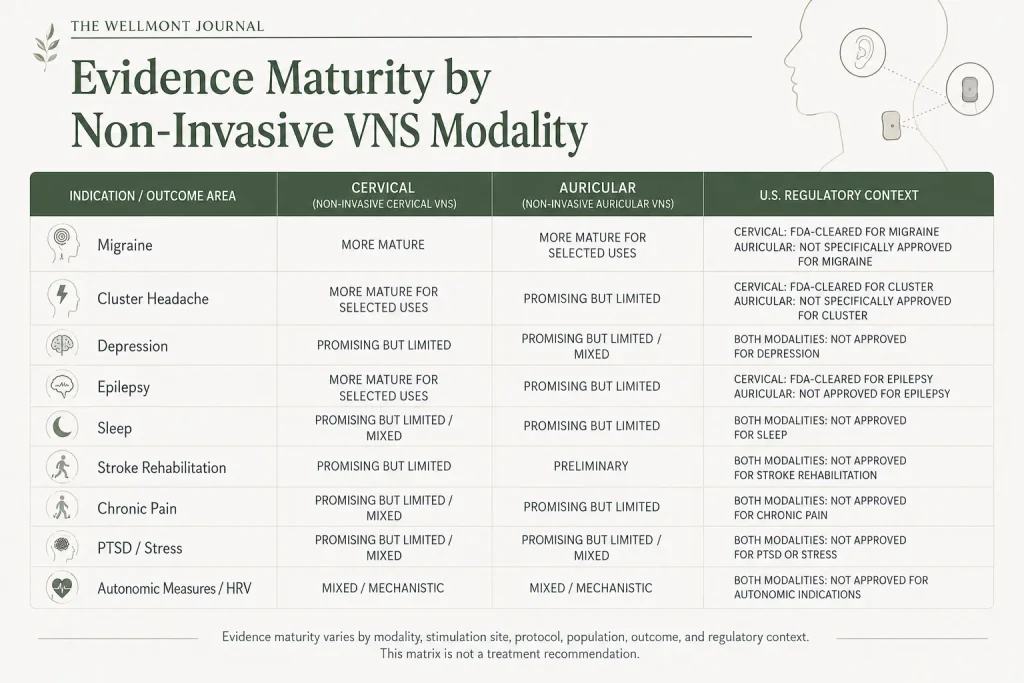
The non-invasive VNS literature is best understood as a collection of evidence streams rather than one unified answer.
Some areas have larger randomized programs, regulatory history, or repeated trials. Others remain early, heterogeneous, mechanistic, or low-certainty.
A reasonable high-level interpretation is:
- Cervical migraine research: more mature than many other non-invasive VNS applications, but findings vary by endpoint and protocol.
- Cervical episodic cluster-headache research: more mature for selected endpoints than the evidence for chronic cluster headache.
- Cervical PTSD/stress research: preliminary, with very-low-certainty treatment evidence and several publications arising from one underlying trial protocol.
- Auricular depression research: promising but limited by low or very low certainty.
- Auricular epilepsy research: promising but mixed, with seizure-frequency signals but less convincing responder and seizure-freedom findings.
- Auricular sleep research: promising but preliminary and heterogeneous.
- Auricular stroke-rehabilitation research: promising but still dependent on heterogeneous protocols and rehabilitation contexts.
- Transcutaneous VNS for chronic pain: promising but limited, with modality and condition heterogeneity.
- Auricular HRV/autonomic findings: mixed or mechanistic; HRV is not an established proxy for clinical benefit.
“More mature” does not mean universally effective, and “preliminary” does not mean disproven.
It describes how developed and interpretable an evidence stream is.
Evidence Maturity by Non-Invasive VNS Modality
| Outcome | Cervical | Auricular | U.S. regulatory context |
| Migraine | MORE MATURE — Multiple randomized programs and modality-specific syntheses exist; results vary by endpoint. | PROMISING BUT LIMITED — Randomized auricular studies exist, but protocols and evidence are less mature. | gammaCore has device-specific FDA-cleared migraine indications; this does not apply to taVNS as a category. |
| Cluster headache | MORE MATURE FOR SELECTED USES — Stronger signal for episodic than chronic cluster headache. | NOT ESTABLISHED / INSUFFICIENT — No comparable auricular evidence stream established in this source package. | Device-specific gammaCore clearance applies; acute effectiveness has not been established for chronic cluster headache. |
| Depression | NOT ESTABLISHED / INSUFFICIENT — No comparable cervical treatment evidence stream established here. | PROMISING BUT LIMITED — 12-study synthesis, with important comparisons at low to very low certainty. | No FDA-cleared non-invasive VNS indication for depression established in the reviewed U.S. records. |
| Epilepsy | NOT ESTABLISHED / INSUFFICIENT — Do not import implanted-VNS evidence. | PROMISING BUT LIMITED / MIXED — Four RCTs showed seizure-frequency signals; responder and seizure-freedom findings were less convincing. | No FDA-cleared non-invasive VNS epilepsy indication established in the reviewed records; implanted VNS is separate. |
| Sleep | NOT ESTABLISHED / INSUFFICIENT. | PROMISING BUT LIMITED / PRELIMINARY — 14 RCTs identified in a 2026 review; heterogeneity limits interpretation. | No FDA-cleared non-invasive VNS sleep indication established in the reviewed records. |
| Stroke rehabilitation | NOT ESTABLISHED / INSUFFICIENT. | PROMISING BUT LIMITED — 16 studies/708 participants of taVNS paired with exercise; protocol and rehabilitation-context heterogeneity remain. | No FDA-cleared taVNS stroke-rehabilitation indication established; implanted paired-VNS evidence is separate. |
| Chronic pain | PROMISING BUT LIMITED — Small cervical subgroup within a heterogeneous 2024 synthesis. | PROMISING BUT LIMITED — Auricular subgroup signals exist, but conditions, protocols, and comparators were heterogeneous. | No broad FDA-cleared non-invasive VNS chronic-pain indication established in the reviewed records. |
| PTSD / stress | PRELIMINARY — Small randomized work plus very-low-certainty review; six of seven publications arose from one trial protocol. | NOT ESTABLISHED / INSUFFICIENT. | gammaCore has FDA Breakthrough Device designation for PTSD, but this is not FDA clearance for PTSD treatment. |
| Autonomic measures / HRV | NOT ESTABLISHED / INSUFFICIENT AS A UNIVERSAL BIOMARKER. | MIXED / MECHANISTIC — Bayesian meta-analysis found strong evidence against a robust acute taVNS effect on vagally mediated HRV versus sham. | Physiological biomarker findings do not constitute FDA-cleared treatment indications or proof of clinical efficacy. |
Evidence maturity varies by modality, stimulation site, protocol, population, outcome, and regulatory context. This matrix is not a treatment recommendation.
FDA Status: Clearance Applies to Specific Devices and Uses
Regulatory language is another area where category-wide statements can become misleading.
In the United States, FDA status applies to a specific device, indication, population, and labeling—not to “non-invasive VNS” as an entire category.
gammaCore Sapphire is a prescription Class II external vagal nerve stimulator with FDA-cleared U.S. indications covering specified migraine, cluster-headache, hemicrania continua, and paroxysmal hemicrania uses. The exact indication, age range, and acute-versus-preventive wording differ by use and should be checked against current labeling.
Current U.S. indications include preventive treatment of migraine headache in adolescents age 12 and older and adults; acute treatment of pain associated with migraine headache in adolescents age 12 and older and adults; adjunctive preventive treatment of cluster headache in adults; acute treatment of pain associated with episodic cluster headache in adults; treatment of hemicrania continua in adults; and treatment of paroxysmal hemicrania in adults.
This device-specific regulatory status should not be generalized to chronic-cluster acute treatment or to non-invasive VNS as a category.
Its U.S. regulatory history began with the De Novo classification DEN150048, granted April 14, 2017, followed by multiple 510(k) clearances that expanded or modified the cleared uses, including K182369, K191830, K203546, and K211856.
The correct wording is FDA-cleared where the applicable record supports clearance.
It would be inaccurate to write “non-invasive VNS is FDA cleared,” “taVNS is FDA cleared,” or “FDA-approved non-invasive VNS” as broad category statements.
Regulatory status does not automatically transfer from one cervical device to auricular research systems, investigational devices, or consumer wellness products.
| FDA-cleared does not mean the whole category is FDA-cleared. |
What We Know About Safety
Safety should be interpreted with the same specificity as efficacy.
Auricular research, historical transcutaneous VNS literature, and the labeling of a particular cervical device provide different kinds of safety information. They should not be collapsed into one universal side-effect profile.
Safety Findings in Auricular Research
A major systematic review and meta-analysis of taVNS safety assessed the literature across 177 studies and 6,322 subjects.
Published studies generally reported adverse effects that were mild and transient, with commonly described events including local ear discomfort, tingling, headache, irritation or redness, dizziness, nausea, and stinging or burning sensations.
However, adverse-event reporting was incomplete.
In that synthesis, 55.37% of studies did not report the presence or absence of adverse events.
That missing information matters. A literature base in which many studies do not report adverse events consistently cannot support the claim that taVNS has “no serious risks.”
The review did not identify evidence establishing a causal relationship between taVNS and severe adverse events. That finding should not be interpreted as proof that serious harm is impossible, particularly because adverse-event reporting was incomplete across the literature.
The most defensible interpretation is that published taVNS studies have generally reported mild, transient effects at the protocols studied, while the completeness and consistency of adverse-event reporting remain limitations.
Broader Historical tVNS Safety Findings
A 2018 systematic review by Redgrave and colleagues examined 51 studies involving 1,322 tVNS recipients.
Historical pooled findings included:
- local skin irritation: 18.2%;
- headache: 3.6%;
- nasopharyngitis: 1.7%;
- dropout attributed to side effects: 2.6%.
These figures describe an older mixed transcutaneous VNS literature that included both auricular and cervical stimulation; they should not be treated as universal adverse-event rates for either modality or for current commercial devices.
Cervical Device-Label Effects
Current U.S. labeling for a particular cervical device provides another type of safety evidence.
For gammaCore, device-label materials identify effects such as application-site discomfort, irritation or redness, muscle twitching or contractions, local face, head, or neck pain, headache, dizziness, and tingling or pricking sensations.
These are device-label facts.
They are not a universal adverse-effect profile for taVNS or for every form of non-invasive vagus nerve stimulation.
Contraindication, Warning, Trial Exclusion: These Are Not the Same Thing
One of the easiest ways to distort safety information is to combine every caution into a single “who should avoid VNS” list.
That approach is misleading because different statements can mean very different things.
| Safety category | What it means |
| Formal label contraindication | The specific device labeling states that the device should not be used in the identified circumstance. |
| Warning | The label identifies a specific safety concern or condition requiring caution. |
| Not-evaluated population | The device or intervention has not been adequately evaluated in that group; this does not by itself prove harm. |
| Trial exclusion | A research study excluded participants with a particular characteristic; this does not automatically make that characteristic a universal contraindication. |
| Reported adverse event | An unwanted event was reported during use or in a study; causality and frequency must be interpreted from the source. |
| Theoretical / physiological concern | A concern based on mechanism or physiology rather than established clinical harm. |
For example, current U.S. gammaCore safety labeling lists an active implantable medical device—such as a pacemaker, hearing-aid implant, or other implanted electronic device—as a device-specific contraindication.
Current gammaCore safety labeling also lists simultaneous use of another device, such as a TENS unit or muscle stimulator, as a device-specific contraindication.
For gammaCore, current safety labeling lists pregnant women among populations in whom safety and efficacy have not been evaluated. That is not the same classification as a formal contraindication, and it does not establish that pregnancy has been proven unsafe for all forms of non-invasive VNS.
Likewise, bradycardia, tachycardia, arrhythmia, abnormal baseline ECG findings, prolonged QT, selected cardiovascular or carotid disease, metallic hardware near the neck, prior cervical vagotomy, abnormal cervical anatomy, seizure history, and syncope history belong to device-specific not-evaluated or warning contexts rather than a universal all-nVNS contraindication list.
Open wounds, rash, infection, swelling, cuts, sores, drug patches, or surgical scars at the treatment site belong to device-specific do-not-use site instructions.
A seizure history is a particularly clear example of why universal lists can fail. Although it is a not-evaluated or warning context for gammaCore, taVNS is itself being researched in people with epilepsy. A history of seizures therefore should not be turned into a generic contraindication to all non-invasive VNS.
Pediatric restrictions are also device- and indication-specific.
For gammaCore, current U.S. indications include migraine treatment and prevention from age 12, while children younger than 12 remain outside the evaluated/indicated age range in current safety materials.
The central rule is: trial exclusion ≠ universal contraindication, and not evaluated ≠ known unsafe.
If you are considering a prescription VNS device, check the current labeling for that exact device and discuss its contraindications, warnings, and intended use with a qualified healthcare professional.
Why Research on One Device Does Not Validate Every Consumer Vagus Nerve Product
“Non-invasive” describes how stimulation is delivered.
It does not certify:
- clinical efficacy;
- FDA clearance;
- a therapeutic indication;
- correct vagal targeting;
- an equivalent waveform;
- an equivalent dose;
- equivalent electrode placement;
- equivalent anatomical site;
- or equivalence to a device used in a published clinical trial.
Research on one form of non-invasive VNS therefore does not automatically validate another product.
A consumer device may differ from a research intervention in:
- stimulation site;
- intended neural pathway;
- waveform;
- intensity;
- electrode placement;
- session duration;
- schedule;
- intended use;
- studied population;
- studied outcome.
Even if two products both use the phrase “vagus nerve stimulation,” they should not be assumed to share the same evidence.
Useful questions include:
- Where is stimulation delivered?
- What anatomical pathway is intended?
- What exact protocol was studied?
- Was the exact product studied?
- What population was studied?
- What outcome was measured?
- Was the study randomized or sham-controlled?
- What exact regulatory claim applies?
Those questions can help determine whether a product claim is actually connected to evidence.
They do not answer which device someone should buy. Device comparison and purchasing decisions are a separate editorial task.
| Evidence does not transfer automatically between devices. |
What This Evidence Can — and Cannot — Tell You
Non-invasive VNS is better understood as a family of interventions than as one standardized treatment.
Cervical and auricular evidence must be interpreted separately. Selected cervical headache applications have a more mature U.S. clinical and regulatory evidence stream, but even there, results differ by endpoint and population.
Auricular VNS has a broad and rapidly developing research base. Several applications show promising signals, but much of the evidence remains heterogeneous, preliminary, mixed, or low-certainty depending on the condition and outcome.
Safety findings from studied protocols often involve mild and transient effects, but adverse-event reporting has not always been complete, and exact-device contraindications, warnings, not-evaluated populations, and site restrictions still matter.
Most importantly, category-level evidence cannot establish that an unrelated consumer product is effective, clinically validated, or FDA-cleared.
Evidence belongs to the intervention that was actually studied.
If your next question is how the major device categories differ, see:
compare vagus nerve stimulation devices.
References
1. U.S. Food and Drug Administration. De Novo classification DEN150048; 510(k) records K182369, K191830, K203546, and K211856.
2. gammaCore U.S. Important Safety Information / Warnings and Precautions, document 64000-00206 Rev 2 EN, release 02/2026. Used for exact device-label safety and contraindication language.
3. Auricular anatomy review. PubMed PMID: 31742681.
4. 2026 non-invasive VNS migraine meta-analysis. PubMed PMID: 42578005.
5. 2023 modality-separated migraine systematic review and meta-analysis. PubMed PMID: 37251233.
6. PREMIUM II migraine trial. PubMed PMID: 35001643.
7. ACT1 cluster headache trial. PubMed PMID: 27593728.
8. ACT1 + ACT2 pooled cluster-headache analysis. PubMed PMID: 31246132.
9. 2025 PTSD systematic review. PubMed PMID: 40746136.
10. Randomized cervical tcVNS PTSD study. PubMed PMID: 33344717.
11. taVNS depression systematic review/meta-analysis. PubMed PMID: 37230264.
12. taVNS drug-resistant epilepsy systematic review/meta-analysis. PubMed PMID: 40158411.
13. taVNS sleep systematic review/meta-analysis. PubMed PMID: 42522355.
14. taVNS stroke-rehabilitation systematic review/meta-analysis. PubMed PMID: 41865861.
15. Transcutaneous VNS chronic-pain systematic review/meta-analysis. PubMed PMID: 39131814.
16. Living Bayesian meta-analysis of taVNS and vagally mediated HRV. PubMed PMID: 34473846.
17. taVNS safety systematic review/meta-analysis. PubMed PMID: 36543841.
18. Historical transcutaneous VNS safety systematic review. PubMed PMID: 30217648.