The Vagus Nerve: What It Is, What It Does, and Why It Matters
The vagus nerve is one of the major communication pathways connecting the brain with structures in the neck, chest, and abdomen. It carries multiple kinds of signals and plays an important role in autonomic regulation, particularly through parasympathetic pathways.
That broad reach helps explain why the vagus nerve comes up in discussions about heart function, digestion, breathing, brain-body communication, and vagus nerve stimulation. But it is not a single “master switch” for those systems, and its involvement in a physiological process does not mean that deliberately stimulating the nerve will necessarily produce a specific health benefit.
Understanding the nerve itself is the best place to start.
What Is the Vagus Nerve?
The vagus nerve is cranial nerve X, the tenth of the 12 pairs of cranial nerves.
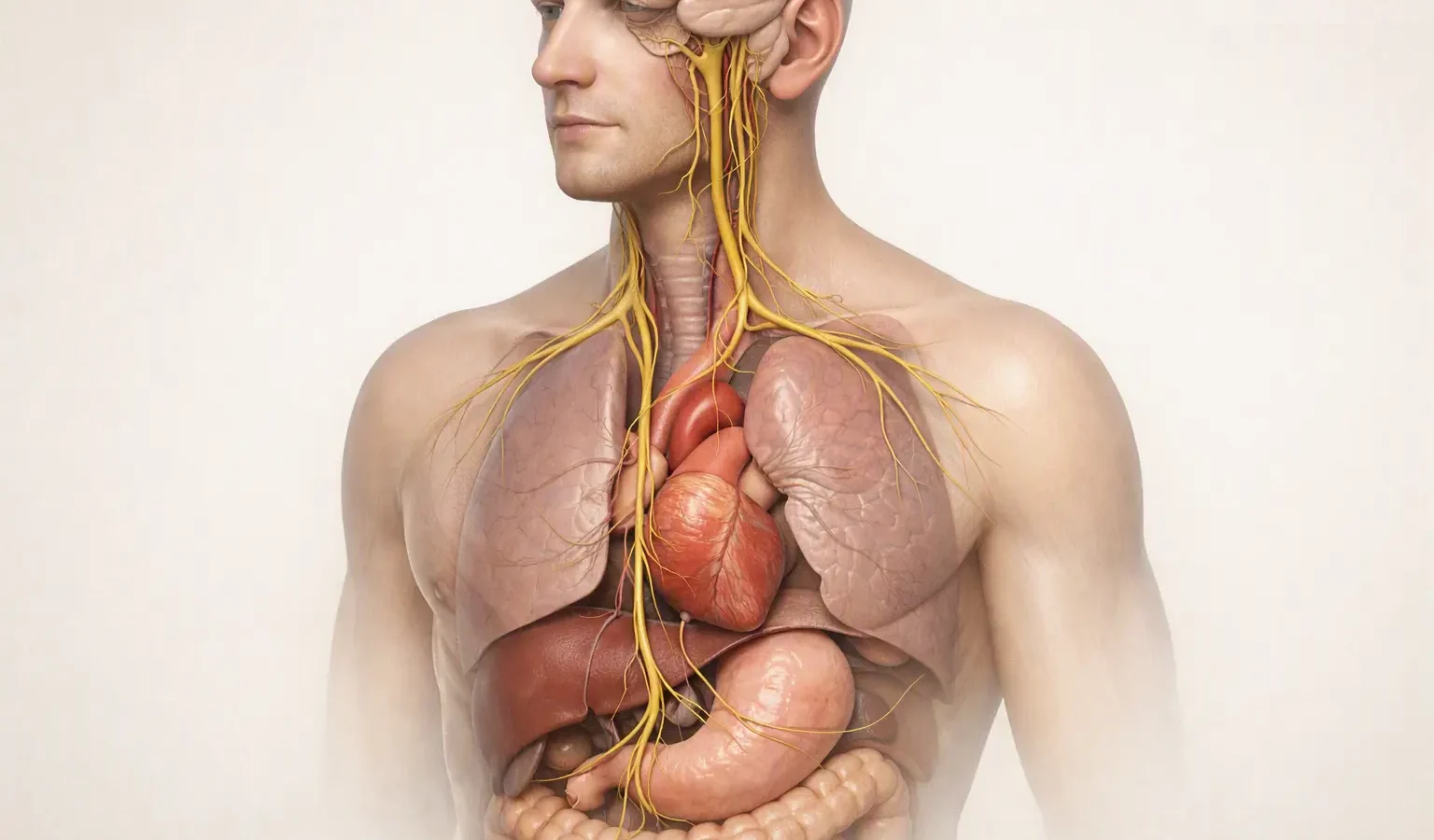
Humans have a left and a right vagus nerve. Each arises from the medulla oblongata in the brainstem, exits the skull, and travels downward through the neck, sending branches to structures along the way before continuing into the chest and abdomen.
Unlike cranial nerves whose functions are concentrated mainly in the head and neck, the vagus has an unusually extensive course. Its branches participate in communication involving several organ systems, which is one reason it has attracted so much scientific and clinical attention.
The nerve contains fibers involved in both carrying information toward the brain and sending signals from the brain to peripheral tissues. At a reader level, that makes it useful to think of the vagus not as a one-way command wire, but as part of a broader two-way communication network between the brain and body.
Where Is the Vagus Nerve?
The vagus nerve begins in connection with the brainstem and descends through the neck.
From there, its branches extend into the chest and abdomen, where vagal pathways are associated with structures including the heart, lungs, and large portions of the upper and mid gastrointestinal tract.
The left and right vagus nerves do not follow perfectly identical paths, and their branches form complex relationships with other nerves and networks throughout the body. A foundational explanation does not require tracing every branch individually, but the overall pattern matters:
brainstem → neck → chest → abdomen
That wide anatomical distribution helps explain why vagal signaling can be relevant to several different physiological systems without making the vagus nerve solely responsible for any one of them.
Why Is It Called the Vagus Nerve?
The name “vagus” is commonly traced to a Latin term associated with wandering, reflecting the nerve’s long and widely distributed course through the body.
The name is descriptive rather than functional. It does not mean that the nerve operates randomly; it refers to how extensively its branches travel compared with many other cranial nerves.
What Does the Vagus Nerve Do?
There is no single function that fully describes the vagus nerve.
Its fibers participate in several kinds of signaling, including sensory information traveling toward the brain, parasympathetic signals traveling to internal organs, and motor signals involved in functions such as swallowing and voice.
- cardiovascular regulation;
- respiratory processes;
- digestive activity;
- swallowing and aspects of voice through relevant branches;
- sensory information from internal organs;
- communication between the brain and parts of the gastrointestinal system;
- parasympathetic regulation of multiple visceral functions.
These relationships should be interpreted carefully. Saying that the vagus nerve participates in a process is different from saying it independently controls that process.
Heart rate, breathing, digestion, and other bodily functions are regulated by interacting neural, hormonal, mechanical, and local physiological systems. The vagus is an important part of some of those systems, not a stand-alone controller.
How the Vagus Nerve Relates to the Autonomic Nervous System
The autonomic nervous system helps regulate many bodily functions that generally operate without continuous conscious direction.
These include aspects of cardiovascular function, digestion, glandular activity, and other internal processes.
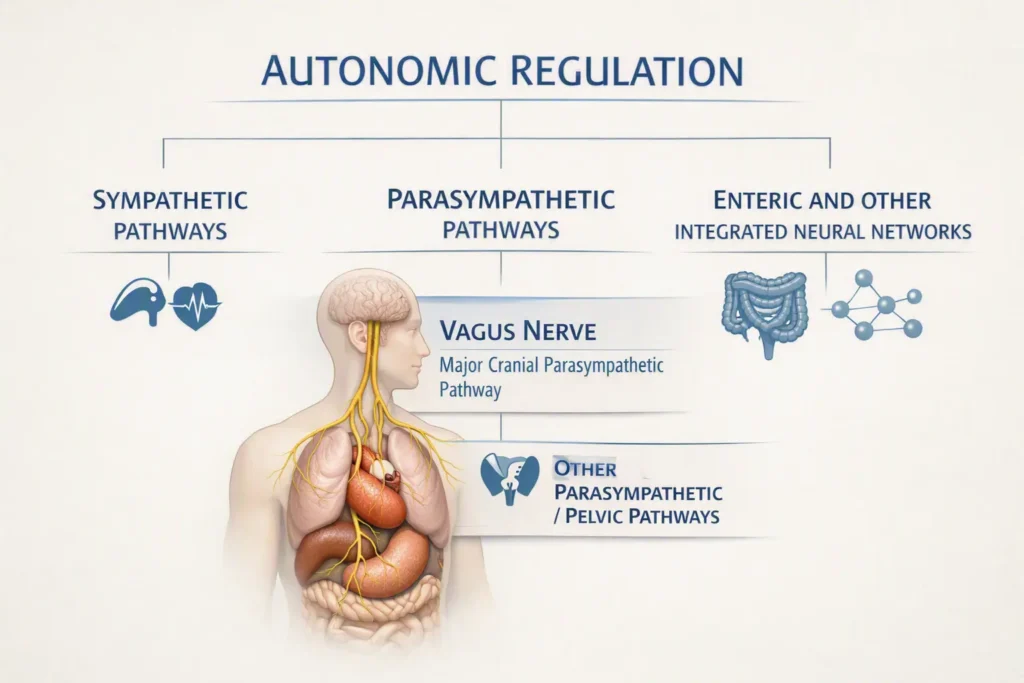
The autonomic nervous system is commonly discussed in terms of sympathetic and parasympathetic divisions, although real physiological regulation is more complex than a simple two-position switch.
The vagus nerve is especially important because it provides a major route for parasympathetic signaling between the brainstem and many organs in the chest and abdomen.
That does not make the vagus nerve synonymous with the autonomic nervous system. It is one important component within a much larger network.
The Vagus Nerve and the Parasympathetic Nervous System
The parasympathetic nervous system is often summarized with the phrase “rest and digest.” That shorthand can be useful for orientation, but it is incomplete.
Parasympathetic pathways participate in regulating a range of physiological activities, and their effects depend on the tissue, context, and interacting neural systems involved.
The vagus nerve is a major parasympathetic pathway connecting the brainstem with structures in the chest and abdomen. Through these pathways, vagal signaling can influence aspects of cardiac, respiratory, and gastrointestinal physiology.
But the vagus nerve is not the entire parasympathetic nervous system, and autonomic regulation elsewhere in the body also involves other cranial and pelvic pathways.
Likewise, more vagal activity should not be assumed to be inherently better in every physiological context. Normal regulation depends on coordinated activity across multiple neural and physiological systems.
How the Vagus Nerve Relates to the Heart
Vagal pathways contribute to autonomic regulation of the heart.
At a high level, parasympathetic signaling through the vagus can influence cardiac activity, including heart rate. This occurs within a broader regulatory system that also involves sympathetic pathways, intrinsic cardiac mechanisms, circulating signals, and other physiological inputs.
For that reason, it would be inaccurate to describe the vagus nerve as simply “controlling” the heart.
It is better understood as one important route through which the nervous system participates in adjusting cardiac function.
How the Vagus Nerve Relates to Breathing and the Lungs
The vagus nerve also carries sensory and autonomic fibers associated with the respiratory system.
Vagal pathways participate in signaling involving the airways and lungs, including reflex and autonomic processes.
Respiration as a whole, however, depends on much more than the vagus nerve. Brainstem respiratory networks, other nerves, respiratory muscles, chemical sensing, airway mechanics, and local physiological mechanisms all contribute.
The vagus is therefore relevant to respiratory physiology without serving as a single controller of breathing.
How the Vagus Nerve Relates to Digestion
The gastrointestinal system is one of the areas most commonly associated with vagal function.
Vagal pathways participate in communication involving parts of the esophagus, stomach, intestines, and other digestive structures. They contribute to parasympathetic regulation and carry sensory information from the digestive system toward the central nervous system.
Vagal distribution is not uniform throughout the gastrointestinal tract; more distal bowel regions also rely importantly on pelvic autonomic pathways.
This makes the vagus an important part of communication between the brain and gastrointestinal tract.
But digestive function also depends on the enteric nervous system, hormones, local reflexes, immune signaling, the microbiome, blood flow, smooth muscle activity, and many other factors.
Calling the vagus nerve the sole controller of digestion would therefore be misleading.
The Vagus Nerve as Part of Brain-Body Communication
One reason the vagus nerve is scientifically interesting is that much of its signaling involves information traveling from peripheral organs toward the brain as well as signals traveling in the other direction.
This bidirectional arrangement allows the central nervous system to receive information about internal conditions while also contributing to regulation of peripheral functions.
The digestive tract is a prominent example, but the broader idea applies across several vagally connected systems.
This is sometimes described in popular health discussions using simplified phrases such as the “brain-gut connection.” The underlying biology is more complex than any one nerve: communication between the brain and gastrointestinal system involves neural, endocrine, metabolic, immune, and other pathways.
The vagus nerve is an important participant in that network rather than the network in its entirety.
What About Inflammation and Stress?
The vagus nerve is also studied in connection with immune signaling and physiological responses to stress.
Research has examined how vagal sensory and autonomic pathways interact with immune and inflammatory processes, while stress responses involve the vagus as part of a much broader autonomic, endocrine, and brain network.
These biological relationships do not mean that simply “activating the vagus nerve” has been shown to treat inflammation or stress.
A mechanistic relationship is not the same as proof of a therapeutic effect. Whether a particular intervention improves a specific health outcome requires evidence for that intervention, population, protocol, and outcome.
Why the Vagus Nerve Receives So Much Scientific Attention
The vagus nerve is unusual in part because of its anatomical reach and the variety of sensory and autonomic signals associated with it.
Researchers study vagal pathways in areas ranging from neurophysiology and gastroenterology to cardiovascular science, neuromodulation, and brain-body communication.
Its scientific relevance does not come from being a universal “healing nerve.” It comes from being a major neural pathway situated at the intersection of several physiological systems.
That distinction is important because popular descriptions can make the nerve sound more powerful and more independently controlling than the underlying biology supports.
How This Leads to Vagus Nerve Stimulation
Because the vagus nerve carries important neural signals and has wide anatomical connections, researchers and clinicians have developed ways to electrically stimulate vagal pathways.
That field is known broadly as vagus nerve stimulation, or VNS.
This is where the boundary of this foundational article matters. VNS is not one single intervention, and explaining its implanted, external, cervical, auricular, clinical, and consumer categories requires a separate taxonomy.
For that explanation, see types of vagus nerve stimulation.
The important point to carry forward is that understanding the anatomy of the vagus nerve helps explain why it is scientifically interesting. It does not, by itself, establish that stimulating the nerve will produce a particular clinical benefit.
Where to Go Next
The vagus nerve is cranial nerve X, a paired neural pathway that extends from the brainstem through the neck and into the chest and abdomen. It carries sensory, parasympathetic, and motor information and is a major component of parasympathetic signaling involving several internal organs.
Its wide distribution helps explain why the nerve appears in research involving the cardiovascular, respiratory, gastrointestinal, autonomic, and brain-body systems.
If your next question is how clinicians and researchers attempt to stimulate this nerve—and why different stimulation methods should not be treated as interchangeable—continue to types of vagus nerve stimulation.