Tired After Eating: Is It Really the Food Making You Sleepy?
You finish lunch, sit back down, and suddenly staying alert feels harder than it did an hour ago. It is natural to blame the food. After all, you ate — and then you got sleepy.
The meal may be part of the explanation. But the timing alone does not prove that food caused the whole effect.
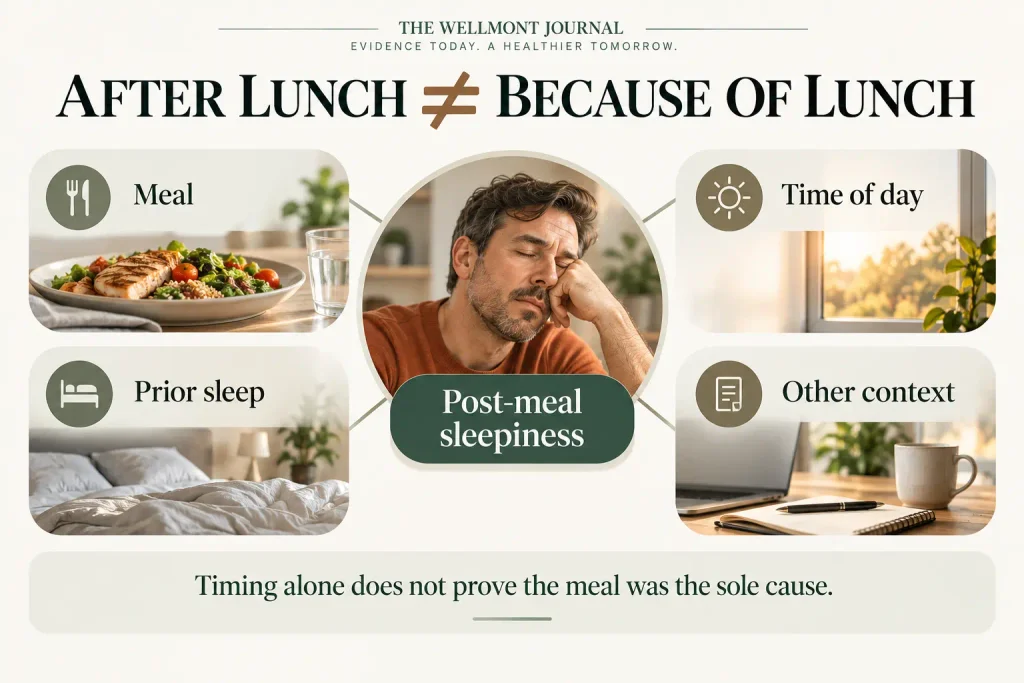
One important clue is that alertness can naturally dip in the early-to-mid afternoon even when lunch is skipped. In other words, “after lunch” does not automatically mean “because of lunch.” Your internal daily rhythm and the sleep pressure you have accumulated can overlap with whatever the meal itself is doing.
Food can still matter. Larger meals may make drowsiness more noticeable for some people, and meal composition can influence post-meal physiology. Prior sleep, alcohol, medications, and individual metabolic context can change the pattern too.
That is why feeling tired after eating is better treated as a pattern to understand than as a diagnosis. By itself, it does not establish reactive hypoglycemia, diabetes, insulin resistance, or mitochondrial dysfunction.
The more useful question is whether your sleepiness actually tracks the meal — or whether the meal is only one piece of a larger pattern.
Is It Normal to Feel Tired After Eating?
Yes. Mild, temporary sleepiness after eating can occur in healthy adults.
That does not mean everyone experiences it, or that one mechanism explains every episode. A person who gets mildly drowsy after a large Sunday lunch may be experiencing something very different from someone who becomes overwhelmingly sleepy after every meal.
Severity matters. So do timing, frequency, associated symptoms, and whether you feel sleepy at other times of day.
If the feeling is mild, occasional, and short-lived, it may simply reflect an ordinary combination of meal effects and daily fluctuations in alertness.
If it is persistent, worsening, severe, or accompanied by symptoms such as marked weakness, sweating, tremor, palpitations, confusion, or near-fainting, the pattern deserves more attention.
Post-Meal Sleepiness Can Occur in Healthy Adults but Is Nonspecific
Sleepiness means you feel inclined to fall asleep or have difficulty staying awake.
Tiredness is broader. You may describe yourself as tired even when you do not feel capable of falling asleep.
Fatigue often describes a more persistent reduction in physical or mental energy or capacity.
Postprandial somnolence is the more formal term for sleepiness after eating.
In everyday conversation, these experiences overlap. Clinically, however, the distinction can matter because persistent fatigue is not the same problem as a brief period of drowsiness after lunch.
There is also an old explanation worth putting aside: ordinary post-meal sleepiness is not well explained by the idea that blood “rushes to your stomach” and leaves your brain deprived of blood. Digestion does change circulation, but that simple blood-diversion story does not adequately explain everyday post-meal drowsiness.
Related reading: If the experience is more about mental cloudiness than a pull toward sleep, our guide to brain fog explains that broader symptom without treating it as a diagnosis.
Why You Can Get Sleepy After Lunch Even When Lunch Is Not the Whole Cause
Lunch gets blamed partly because of timing.
Human alertness is not constant from morning to night. Circadian biology and accumulated sleep pressure influence when we feel more or less alert, and an early-to-mid-afternoon decline in alertness can occur independently of eating.
Most importantly, this afternoon dip can still occur when lunch is skipped.
That changes how to interpret a familiar experience.
If you eat lunch at noon and feel sleepy afterward, the sequence is real. But sequence is not proof of sole causation. The meal may have contributed while an underlying afternoon decline in alertness was happening at the same time.
This also explains why two apparently contradictory observations can both be true: a large lunch may make you feel sleepier, and you might still experience some afternoon sleepiness without eating that lunch.
Poor sleep can strengthen the effect. If you begin the day carrying substantial sleep pressure, the natural afternoon decline in alertness may feel much more pronounced. The meal can then look more responsible than it actually is.
A useful clue is consistency. If you become sleepy at roughly the same afternoon time regardless of what you eat — or even when lunch is delayed — time of day deserves more consideration.
How Much You Eat Can Still Matter
Recognizing the afternoon dip does not mean food is irrelevant.
Meal size can matter too.
Larger meals may make post-meal drowsiness more noticeable for some people. What the evidence does not support is a universal calorie threshold beyond which everyone becomes sleepy.
So instead of asking whether a particular meal was objectively “too big,” ask a more practical question:
Does your sleepiness reliably become stronger after meals that are unusually large for you?
If a large restaurant lunch consistently leaves you much more drowsy than a smaller lunch eaten at the same time of day, meal size becomes a useful part of the pattern.
One episode is less informative. A repeatable difference is more useful.
That still does not tell you the exact mechanism or establish a medical problem. It simply gives you a variable you can reasonably test.
What You Eat May Matter Too — Just Not in One Simple Way
Meal composition changes post-meal physiology, so what you eat can influence how you feel afterward.
The problem begins when that reasonable statement gets converted into universal rules.
“Carbs make you sleepy.”
“Fat makes you sluggish.”
“Protein keeps you alert.”
Human responses are not that simple.
Meal size, nutrient combination, time of day, previous sleep, alcohol, and individual metabolic responses can overlap. The same meal can also feel different on different days depending on the context in which you eat it.
Carbohydrates and the “Sugar Crash” Story
Rapidly digested or higher-glycemic carbohydrate patterns can produce larger post-meal glucose and insulin excursions.
But glucose normally rises and falls after eating.
A normal post-meal rise followed by a decline is not the same thing as hypoglycemia.
That distinction gets lost when people use the phrase “sugar crash” to describe any period of tiredness after sweets, refined carbohydrates, or a large meal.
The subjective experience may be real. The diagnosis is not established by the feeling.
If you eat something sweet and later become tired, you can reasonably observe that the two events occurred together. You cannot conclude from that alone that your glucose fell abnormally low.
A subjective “sugar crash” is not the same thing as documented hypoglycemia.
Why “Carbs Automatically Make You Sleepy” Is Too Simple
Carbohydrates do not have one universal effect on alertness.
Imagine the same carbohydrate-containing lunch eaten under several different conditions: one follows a good night’s sleep; another follows four or five hours of sleep; one is a moderate mixed meal; another is unusually large; one is eaten at noon; another is eaten at a different point in the day; one includes alcohol; another does not.
Those contexts can produce different experiences even when some of the foods are similar.
So noticing that you become tired after certain carbohydrate-heavy meals can be useful pattern information. It is not a reason to assume that carbohydrates automatically cause sleepiness or that you need to adopt an extreme low-carbohydrate diet.
It also does not prove reactive hypoglycemia or insulin resistance.
What About Tryptophan and Serotonin?
Tryptophan and serotonin are often used to explain why certain foods supposedly make us sleepy.
There is real biology behind the discussion. Tryptophan is involved in pathways relevant to serotonin, and nutrient intake can influence amino-acid availability.
But the popular story — eat a tryptophan-containing food, serotonin rises, and you become sleepy — oversimplifies what happens after an ordinary mixed meal.
Tryptophan is consumed alongside other amino acids, and its movement and availability depend on more than whether one particular food contains it.
So tryptophan may be part of the physiology worth studying, but it is not a satisfying universal explanation for everyday post-meal sleepiness. The familiar “turkey makes you sleepy” story should not carry the weight of the whole explanation.
Sleep, Alcohol, and Medications Can Change the Pattern
Sometimes the most revealing clue is not what was on the plate. It is what was already happening before you ate.
Poor Sleep Can Make the Meal Look More Responsible Than It Is
Insufficient or disrupted sleep increases the tendency toward daytime sleepiness and attention lapses.
If you carry that sleep pressure into lunch, eating and drowsiness may occur close together even though inadequate sleep is an important part of the background.
Ask yourself: Was substantial daytime sleepiness already present before the meal?
If you were struggling to stay alert through the morning, changing lunch may not solve the larger issue.
The same is true if you become sleepy during meetings, while reading, as a passenger in a car, or whenever you sit quietly — whether you have recently eaten or not.
That pattern extends beyond a food-specific explanation.
Related reading: If what you are trying to improve is broader physical capacity rather than meal-specific drowsiness, see how to increase stamina and endurance.
Alcohol With Meals
Alcohol can contribute its own sedating effects.
If the meal most likely to make you drowsy is dinner with alcohol, it may be misleading to attribute the entire effect to the food.
Meal size, time of day, and alcohol can all overlap.
That does not prove which factor is dominant, but it gives you a better set of variables to consider.
Medication or Dose Changes
Medication can also change the pattern.
Some medications can affect alertness or other physiological systems relevant to how you feel around meals.
If your post-meal sleepiness appeared after starting a medication, changing a dose, or changing when you take it, do not automatically assume food is responsible.
That pattern is worth discussing with the clinician or prescriber involved in your care.
Do not stop or alter prescribed medication on your own simply to test the theory.
When Blood Glucose Becomes a Different Question
Post-meal tiredness alone does not diagnose a glucose disorder.
That point is important because ordinary drowsiness, reactive hypoglycemia, hyperglycemia, diabetes, and insulin resistance are frequently blended together online as if they were interchangeable explanations.
They are not.
Blood glucose becomes a more specific clinical question when the broader symptom pattern, medical history, medications, or appropriately interpreted glucose measurements provide a reason to investigate it.
A Normal Post-Meal Glucose Response Is Not the Same as Hypoglycemia
Blood glucose normally changes after eating.
A normal post-meal glucose response is not the same thing as hyperglycemia, and neither is automatically the same thing as true hypoglycemia.
Those are distinct physiological and clinical concepts.
You cannot reliably distinguish them based only on whether you feel tired.
This is why “I felt a crash” is not enough to establish that blood glucose actually fell abnormally low.
Reactive Hypoglycemia Is More Than “I Feel Tired After Eating”
Reactive hypoglycemia is distinct from ordinary post-meal sleepiness.
The clinical logic involves compatible symptoms together with documented low glucose and improvement of those symptoms when glucose is raised, in the appropriate clinical context.
Timing can be relevant, but timing alone does not make the diagnosis.
Neither does tiredness alone.
And a single consumer continuous glucose monitor reading should not be treated as a stand-alone diagnosis without appropriate clinical interpretation.
A pattern involving marked weakness, sweating, tremor, palpitations, confusion, or near-fainting is more clinically relevant than mild drowsiness after lunch. Even then, symptoms alone do not prove hypoglycemia without documented low glucose in the appropriate context.
Does Feeling Tired After Eating Mean Diabetes?
No.
Post-meal tiredness is not a diabetes test.
Fatigue can occur in diabetes, but fatigue is nonspecific and has many possible explanations.
Other symptoms — such as frequent urination, excessive thirst, or unexplained weight loss — can change the context and make medical evaluation more relevant.
They still do not turn post-meal sleepiness into a diagnostic test.
Feeling tired after eating does not by itself diagnose diabetes.
Does It Mean Insulin Resistance?
No.
Post-meal drowsiness is not a validated diagnostic marker for insulin resistance, and insulin resistance may exist without obvious symptoms.
The inference “I ate carbohydrates, became tired, therefore I have insulin resistance” is unsupported.
A repeatable response to certain meals may be useful information about your personal pattern. It does not identify the underlying metabolic diagnosis.
One Important Exception: Symptoms After Bariatric or Gastric Surgery
Previous bariatric or gastric surgery changes the context of meal-related symptoms.
Some people in this setting can experience post-meal gastrointestinal symptoms, dizziness, weakness, sweating, palpitations, or delayed episodes involving documented low glucose.
That is a specific post-surgical context and should not be generalized to everyone who gets sleepy after eating.
Symptoms alone also do not establish dumping syndrome or post-bariatric hypoglycemia.
If recurring meal-related episodes began after bariatric, gastric, or relevant esophageal surgery, discussing the pattern with the bariatric or medical team is more appropriate than trying to diagnose it from meal timing alone.
Does Your Pattern Actually Track the Meal?
A single sleepy afternoon provides limited information.
A repeated pattern can tell you more.
The goal is not to diagnose yourself. It is to notice whether sleepiness tracks meal size, meal composition, time of day, previous sleep, alcohol, medications, or whether it occurs independently of eating.
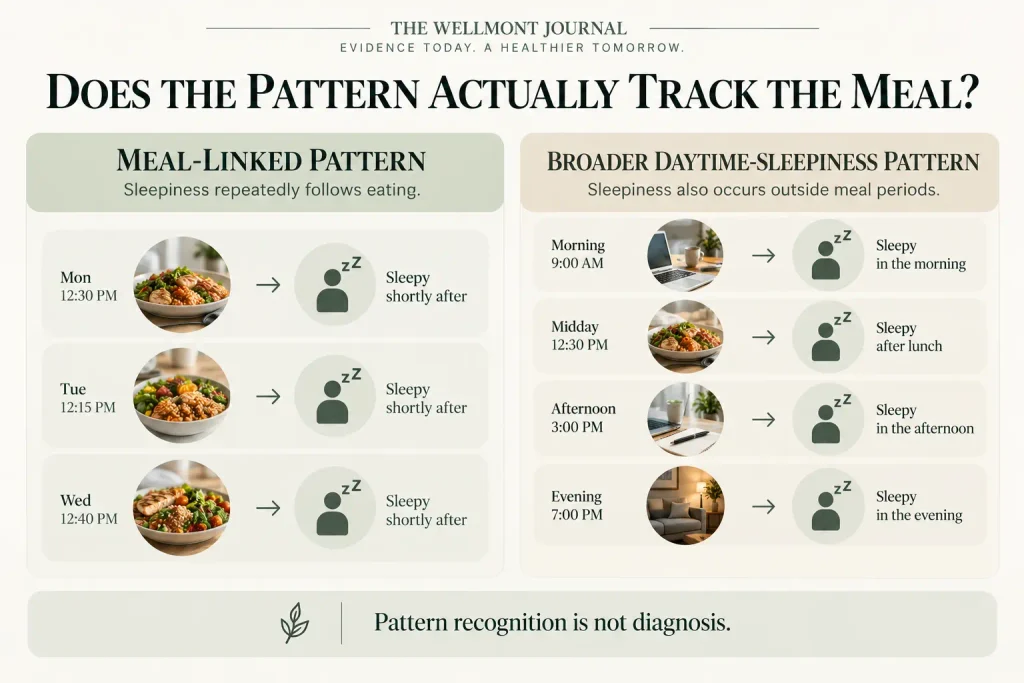
The matrix below is NON-DIAGNOSTIC. It is designed to help organize the pattern, not label a condition.
| When it happens | Meal / context | Other symptoms | What the pattern may suggest | What it does not prove | When evaluation may be reasonable |
| Lunch-time sleepiness after poor sleep | Early/mid-afternoon after inadequate sleep | Mainly drowsiness | Circadian dip plus inadequate sleep may overlap | That lunch composition caused the sleepiness | If daytime sleepiness is persistent or functionally significant |
| Mild sleepiness after a large lunch | Unusually large meal in the afternoon | Mild drowsiness | Meal size and afternoon timing may overlap | Metabolic disease | Usually not necessary if mild, occasional, and isolated |
| Persistent daytime sleepiness regardless of eating | Occurs before and after meals | Ongoing sleepiness | The primary issue may extend beyond meals | A specific sleep or medical disorder | If persistent, worsening, or impairing |
| Sleepiness after normal-sized meals throughout the day | Multiple ordinary meals | Repeated drowsiness | Meal timing may be only one part of a broader pattern | Food intolerance, diabetes, or hypoglycemia | If frequent or interfering with daily function |
| Tiredness after sugary or rapidly digested carbohydrate-heavy meals | Higher-glycemic or rapidly digested foods | Tiredness or drowsiness | Meal composition may affect the post-meal experience | Reactive hypoglycemia or insulin resistance | If recurrent, severe, or accompanied by other concerning symptoms |
| Drowsiness after an alcohol-containing meal | Meal plus alcohol | Sedation or drowsiness | Alcohol may contribute independently | Metabolic disease | If symptoms are disproportionate or also occur without alcohol |
| Symptoms 2–4 hours after eating | Delayed after a meal | Varies | Timing is worth documenting | Reactive hypoglycemia | If recurrent, especially with compatible additional symptoms |
| Weakness with sweating, tremor, or palpitations | May occur after meals or with relevant medication context | Autonomic symptoms, possibly marked weakness | A pattern more clinically relevant than ordinary sleepiness | Hypoglycemia without documented low glucose | Reasonable, particularly if recurrent, severe, or using glucose-lowering medication |
| Post-meal dizziness or GI symptoms after bariatric or gastric surgery | Relevant surgical history | GI symptoms, dizziness, weakness, sweating, or palpitations | Post-surgical meal-related physiology deserves clinician assessment | Dumping syndrome by symptoms alone | Discuss with the bariatric or medical team |
Low-Risk Things You Can Try
If your symptoms are mild and there are no warning signs, a few simple experiments may help reveal whether the meal is actually an important part of the pattern.
These are observations and low-risk adjustments, not diagnostic tests.
Try Smaller Meals if Very Large Meals Are the Pattern
If unusually large meals consistently precede your worst episodes, compare them with somewhat smaller meals.
You do not need a precise calorie cutoff.
You are looking for a repeatable difference.
If smaller meals reliably produce less drowsiness under otherwise similar circumstances, meal size may be contributing.
Build More Balanced Mixed Meals
If the pattern seems strongest after meals dominated by rapidly digested foods, a more balanced mixed meal can be a reasonable experiment.
That does not mean eliminating carbohydrates.
The goal is not to turn post-meal sleepiness into an argument for one restrictive diet.
Instead, compare how you feel after meals containing a practical mix of protein, fiber-rich carbohydrate, fat, and minimally processed foods with how you feel after the meals that usually precede your symptoms.
Your own repeatable pattern is more useful than a universal food rule.
Related reading: Older adults who want to think more specifically about protein quality and intake can use our guide to protein for older adults.
Consider a Brief Comfortable Walk After Eating
A brief, comfortable walk after a meal has useful evidence for improving post-meal glucose handling.
The evidence is much weaker for the claim that walking specifically prevents subjective post-meal fatigue.
Whether a brief post-meal walk reliably improves post-meal sleepiness or fatigue is less well established, so it should not be presented as a way to prevent a “food coma” or stop a presumed sugar crash.
Think of the walk as a reasonable general habit, not a diagnostic test or guaranteed fatigue treatment.
Related reading: For older adults building a broader movement routine, see our strength-training guide for seniors.

Look at Sleep First if You Are Tired Throughout the Day
If you are tired before meals, after meals, and at unrelated times, repeatedly redesigning your lunch may miss the bigger pattern.
Look at whether you are getting adequate sleep and whether your sleep seems restorative.
Persistent daytime sleepiness independent of meals deserves a different question from ordinary drowsiness after eating.
Related reading: If your goal is broader muscle and physical-capacity support after midlife rather than explaining this symptom, see how to build muscle after 50.
Notice Alcohol and Medication Timing
If the pattern is stronger when alcohol accompanies a meal, note that.
Likewise, notice whether the problem began after a medication was started, its dose changed, or its timing changed.
These observations can help separate “the meal caused it” from a more complicated situation.
Medication changes themselves should be discussed with the relevant clinician or prescriber rather than made independently.
Track Timing and Other Symptoms
You do not need an elaborate symptom journal.
- when the episode happens;
- whether the meal was unusually large;
- its rough composition;
- how well you slept beforehand;
- whether alcohol was involved;
- relevant medication timing;
- other symptoms that occurred with the tiredness;
- whether similar sleepiness happens without eating.
Patterns across repeated episodes are more informative than one sleepy afternoon.
Caffeine may temporarily increase alertness, but it does not explain why the sleepiness is happening. Used later in the day, it may also interfere with subsequent sleep and complicate the pattern further.
Related reading: If the issue you want to solve is specifically running endurance rather than post-meal drowsiness, see how to increase stamina for running.
When Should Post-Meal Tiredness Be Checked by a Doctor?
Mild occasional drowsiness after eating is different from persistent or severe symptoms.
The goal is to keep that distinction proportional: ordinary post-meal sleepiness should not be treated as an emergency, while more concerning patterns should not be dismissed as a routine “food coma.”
Reasons to Discuss It With a Clinician
A clinician discussion may be reasonable if:
- the episodes are persistent or worsening;
- sleepiness is severe enough to interfere with work, driving, exercise, or daily activities;
- episodes include weakness, sweating, tremor, or palpitations;
- you experience confusion or near-fainting;
- a recurring pattern develops several hours after meals;
- you have diabetes or use glucose-lowering medication;
- you have a history of bariatric or gastric surgery;
- fatigue occurs alongside frequent urination, excessive thirst, or unexplained weight loss;
- significant daytime sleepiness occurs regardless of meals;
- the pattern began after a medication was started or its dose or timing changed.
These features do not establish a particular diagnosis.
They simply make evaluation more appropriate than assuming the meal itself explains everything.
Related reading: For older adults, persistent weakness is a separate question from temporary meal-linked drowsiness; our guide to sarcopenia explains that condition without treating weakness alone as a diagnosis.
When Symptoms May Need Prompt or Urgent Attention
Prompt or urgent medical attention is appropriate for genuinely acute events such as:
- fainting or loss of consciousness;
- seizure;
- severe confusion;
- inability to respond normally;
- severe hypoglycemia in someone with known diabetes;
- major acute neurologic or cardiovascular symptoms.
Those situations are fundamentally different from mild temporary sleepiness after a meal.
The larger takeaway is simpler.
Food can contribute to post-meal sleepiness, but “I ate, then I got sleepy” does not prove that the meal was the sole cause. Time of day, prior sleep, meal size and composition, alcohol, medications, and individual context can overlap.
And if the symptom occurs regardless of meals, the meal may not be the most useful place to keep looking.
Tiredness after eating is also not evidence of mitochondrial dysfunction. A nonspecific symptom should not be turned into a mitochondrial diagnosis — or a reason to assume that a mitochondrial supplement is the answer.
Related reading: If you are exploring the supplement category for reasons separate from this symptom, our evidence-aware guide to supplements for mitochondrial function evaluates that category without treating post-meal tiredness as proof of mitochondrial dysfunction.
Frequently Asked Questions About Feeling Tired After Eating
Is it normal to feel tired after eating?
Yes. Mild, temporary sleepiness after eating can occur in healthy adults. Meal size or composition may contribute, but time of day, prior sleep, alcohol, medications, and individual context can also influence how sleepy you feel.
Why do I get sleepy after lunch?
Part of the explanation may be the natural early-to-mid-afternoon decline in alertness. That dip can occur even when lunch is skipped, although the meal itself — particularly its size — may still contribute.
Why do carbs or sugary meals sometimes make me tired?
Rapidly digested carbohydrates can produce larger post-meal glucose and insulin excursions, but that does not mean carbohydrates automatically cause sleepiness. Feeling tired after a sugary meal also does not prove reactive hypoglycemia or an abnormal “sugar crash.”
Is tiredness after eating a sign of diabetes?
Not by itself. Diabetes can be associated with fatigue, but post-meal tiredness is nonspecific and is not a diagnostic test for diabetes. Other symptoms and appropriate clinical testing determine whether diabetes is a concern.
How is reactive hypoglycemia different from ordinary post-meal sleepiness?
Reactive hypoglycemia involves compatible symptoms together with documented low glucose and improvement of those symptoms when glucose is raised, in the appropriate clinical context. Ordinary post-meal sleepiness can occur without low glucose, so feeling sleepy after eating does not establish reactive hypoglycemia.
When should post-meal fatigue be checked by a doctor?
Evaluation is reasonable when episodes are persistent, worsening, severe, functionally impairing, or accompanied by symptoms such as marked weakness, sweating, tremor, palpitations, confusion, or near-fainting. Relevant diabetes medication, bariatric or gastric surgery, medication changes, unexplained weight loss, excessive thirst, frequent urination, or significant daytime sleepiness regardless of meals can also make evaluation more appropriate.