Pulsetto Review: Evidence, Claims, Safety, and Ownership
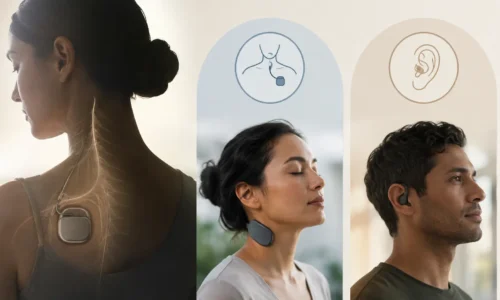
Pulsetto is a consumer bilateral cervical neuromodulation product marketed for general wellness. It is designed to deliver electrical stimulation at the neck and is used with a smartphone app and conductive gel.
More importantly for anyone investigating the product, Pulsetto now has genuine product-specific human research. That makes it inaccurate to dismiss the device by saying there is simply “no evidence.”
But the other extreme is not supported either.
The research ranges from a peer-reviewed acute physiology study to a four-week supplement abstract, observational wearable data, a master’s thesis, and a registered protocol without reported results. These sources answer different questions and carry very different evidentiary weight.
Broader research on vagus nerve stimulation can provide scientific context, but it does not establish that Pulsetto itself produces the same effects.
This review therefore focuses on the exact product: what has actually been studied, how that compares with the claims a consumer may encounter, what the regulatory record means, what Pulsetto says about safety, and what ownership involves.
EVIDENCE BOUNDARY
Evidence about VNS generally is not automatically evidence about Pulsetto.
What Is Pulsetto?
Pulsetto is made by UAB Pulsetto, a Lithuanian company. Its current U.S. lineup includes Pulsetto Lite and Pulsetto FIT.
Pulsetto is marketed as a general-wellness product and is not intended by the manufacturer to diagnose, treat, cure, or prevent disease or a medical condition.
That distinction matters throughout this review. Pulsetto may be discussed alongside medical VNS devices online, but that does not give it the regulatory status, indications, or clinical evidence of those devices.
Pulsetto Lite vs Pulsetto FIT
Pulsetto Lite and Pulsetto FIT are the two current models.
FIT is the newer model and is also the model specifically named in a registered human research protocol.
Historical research requires more care. Several studies identify the intervention simply as Pulsetto rather than Pulsetto FIT. Those studies should not be retroactively described as FIT studies unless the source itself establishes that model identity.
For a consumer, the model distinction matters for current features and pricing. For evaluating evidence, the more important rule is that research belongs to the device actually identified in the study.
Where and How It Stimulates
Pulsetto is worn at the neck and uses bilateral cervical placement.
Normal use involves a smartphone app, Bluetooth connectivity, conductive gel or another specified contact medium, and a rechargeable device with USB-C charging.
Those characteristics describe how the product is used. They do not establish that Pulsetto is clinically equivalent to prescription cervical VNS devices or that evidence from another cervical stimulation system transfers to Pulsetto.
View Current Pulsetto Models and Product Details.
What Does Pulsetto Claim to Do?
Pulsetto’s marketing is built around wellness-oriented outcomes and vagus-related language. Consumers may encounter references to stress, anxiety, sleep, HRV or “vagal tone,” scientific evidence, and clinical proof.
Some of those ideas connect to outcomes or physiological measures that have appeared in Pulsetto research.
But the connection is not always one-to-one.
A study can measure a depression symptom score without establishing treatment for clinical depression. A wearable dataset can show an association with sleep duration without proving that the device caused the change. An acute cardiovascular or EEG response can demonstrate a physiological effect without establishing durable improvement in anxiety, sleep, or stress.
Why Wording Matters
The important question is not merely whether a marketing statement can be linked to a study.
It is whether the wording accurately represents:
- the population studied;
- the outcome measured;
- the study design;
- the comparator;
- the duration;
- the exact product;
- and the maturity of the evidence.
That distinction becomes particularly important with percentage claims and terms such as “Clinically Proven” and “science-backed.”
What Human Research Has Actually Tested Pulsetto?
Pulsetto’s exact-product evidence is no longer empty. It is also not one unified clinical evidence program.
The studies differ in design, publication status, population, duration, comparator, and outcome.
Exact-Product Evidence Table
| Study / year | Pulsetto model / device identity | Publication type | Participants | Design / comparator | What was measured | Main reported finding | What it can support | What it cannot establish | Funding / conflict / affiliation | Evidence maturity |
| Ahmed et al., 2026 | Pulsetto identified | Peer-reviewed journal article | 35 total across four groups; Pulsetto cervical group n=9 | Randomized multi-group acute physiological study; time control and cervical/auricular stimulation groups | Blood pressure, systolic BP variability, EEG activity, heart rate | Cervical Pulsetto group reportedly showed lower systolic BP during stimulation, reduced low-frequency systolic BP variability, increased alpha-wave activity after stimulation, and no significant heart-rate change | Exact-product evidence that acute physiological effects were observed under the studied conditions | Treatment of anxiety, depression, insomnia, stress, or durable wellness benefit | Pulsetto Tech supplied two study devices free of charge (reported value US$700); authors reported no employment or financial interests in Pulsetto Tech | Peer-reviewed exact-product acute physiology |
| Pukenaite et al., 2026 | Pulsetto identified | European Psychiatry supplement abstract | 40 enrolled; 37 completed; healthy adults ages 21–64 | Four weeks; unilateral vs bilateral stimulation; no inactive/sham comparator identified | PHQ-9, GAD-7, PSQI, hair cortisol, hair cortisone | Approximate aggregate changes reported for symptom scales; bilateral hair cortisol result reported as statistically significant | Evidence that symptom-score and biomarker changes were reported during a small exact-product study | Causal treatment effects for depression, anxiety disorders, or insomnia | One author was affiliated with Pulsetto; the published abstract states “Disclosure of Interest: None Declared” and does not identify a study-funding source. Pulsetto separately describes company/EU-project support in its own research materials; that manufacturer statement is not the abstract’s funding disclosure. | Preliminary exact-product supplement-abstract evidence |
| Pauliukevičius et al., 2026 | Pulsetto | Real-world observational analysis | 36 U.S. users; 969 nightly observations | Observational; no untreated/sham comparator | Wearable-estimated sleep duration from Garmin, Apple Watch, and Oura across first six weeks | Pulsetto use was associated with increasing wearable-estimated sleep duration over the observed period | Exact-product observational association | Proof that Pulsetto caused longer sleep or treats insomnia | Industry-supported collaboration | Exact-product observational evidence |
| van den Bogaert, 2024 | Pulsetto | TU Delft master’s thesis | Healthy experiment: 40 participants, 30 active / 10 sham; separate exploratory AF experiment n=8 | Academic experimental work; 10-minute healthy-participant session; additional exploratory experiment | HRV and cardiac/autonomic measures | Reported acute physiological changes | Exact-product non-peer-reviewed physiological research | Established clinical efficacy or durable treatment benefit | TU Delft repository lists Erasmus MC as sponsor; Pulsetto-specific financial support was not established in the sources reviewed | Non-peer-reviewed academic research |
| NCT07274332 | Pulsetto FIT | Registered clinical research protocol | Estimated enrollment 36 | Randomized sham-controlled crossover physiological protocol; 0 Hz sham and 10, 25, 50, 100 Hz conditions | HRV, blood pressure, respiratory rate | No posted results | Evidence that a controlled Pulsetto FIT physiological study has been registered | Any positive result, treatment effect, or completed-trial conclusion | Lead sponsor/responsible party: Sefa Haktan Hatik; Sinop University study location; no posted results | Registered / unreported protocol |
The table makes one point especially clear: exact-product evidence is not automatically clinical-treatment evidence.
Peer-Reviewed Acute Physiology: Ahmed et al. (2026)
Ahmed and colleagues published a 2026 study in the *American Journal of Physiology-Regulatory, Integrative and Comparative Physiology* examining acute cervical and auricular stimulation in young healthy adults.
The study included a time-control group of 10 participants, a bilateral cervical Pulsetto group of nine, a cymba-conchae group of seven, and a tragus group of nine.
In the Pulsetto group, the researchers reported lower systolic blood pressure during stimulation, reduced low-frequency systolic blood-pressure variability, increased alpha-wave EEG activity after stimulation, and no significant change in heart rate.
This is important because it is peer-reviewed, exact-product human research.
It is also a small acute physiology experiment.
The Pulsetto group contained nine participants, the participants were healthy young adults, and the experiment was not designed to determine whether Pulsetto treats anxiety, depression, insomnia, or chronic stress.
The study supports a narrower conclusion: measurable acute physiological effects were reported under the conditions tested.
Pulsetto Tech supplied two Pulsetto devices for the study free of charge, with a reported value of US$700. The authors stated that none was employed by Pulsetto Tech or had a financial interest in the company. The study is therefore appropriately described as peer-reviewed academic research with manufacturer-supplied study devices, rather than simply as “independent.”
Four-Week Symptom and Biomarker Abstract: Pukenaite et al. (2026)
A 2026 *European Psychiatry* supplement abstract examined Pulsetto use over four weeks in healthy adults ages 21 to 64.
Forty people enrolled and 37 completed the study. Participants were assigned to unilateral or bilateral stimulation and used the intervention twice daily for eight-minute sessions.
The researchers measured PHQ-9 depressive-symptom scores, GAD-7 anxiety scores, PSQI sleep-quality scores, hair cortisol, and hair cortisone.
The abstract reports approximate aggregate changes of 56% for PHQ-9, 45% for GAD-7, and 41% for PSQI. It also reports a statistically significant hair-cortisol result in the bilateral group, with p=0.024, while the unilateral result was not statistically significant at p=0.159.
Those numbers require context.
The study did not identify an inactive, no-treatment, or sham comparator. The principal comparison was unilateral versus bilateral stimulation.
Without an inactive control, changes over four weeks cannot be cleanly separated from expectancy, routine, repeated measurement, regression to the mean, contextual or placebo effects, spontaneous change, or the effect of receiving one form of stimulation rather than another.
The participants were also described as healthy adults. Changes in symptom questionnaires in that population do not establish treatment efficacy for clinical depression, an anxiety disorder, or insomnia.
One author was affiliated with Pulsetto. Pulsetto separately describes company/EU-project support for this research in its own materials. That manufacturer statement is distinct from the published abstract, which states “Disclosure of Interest: None Declared” and does not identify a study-funding source.
Real-World Wearable Sleep Data
Pauliukevičius and colleagues reported observational data from 36 U.S. Pulsetto users, covering 969 nightly observations collected through Garmin, Apple Watch, and Oura devices during the first six weeks.
The analysis reported an association of approximately 0.12 hour per week with total sleep time, corresponding roughly to a 35-to-40-minute difference between the first and sixth weeks.
The wording “association” is important.
There was no untreated or sham comparator. Real-world wearable data can show what happened alongside product use, but it cannot by itself establish that Pulsetto caused the observed change.
A defensible summary is:
Pulsetto use was associated with longer wearable-estimated sleep duration in this dataset.
That is different from saying Pulsetto “increased sleep by 40 minutes” or that it treats insomnia.
The research was an industry-supported collaboration, which should remain visible when interpreting it.
The TU Delft Master’s Thesis
A 2024 master’s thesis by F.A. van den Bogaert at TU Delft also examined the exact Pulsetto device.
The healthy-participant experiment involved 40 people, with 30 in an active condition and 10 in a sham condition, and used a 10-minute session. The thesis reported changes in HRV and other cardiac/autonomic measures.
A separate exploratory experiment involved eight participants in an atrial-fibrillation context.
This is useful exact-product academic research, but it is not a peer-reviewed clinical trial.
A master’s thesis can contribute data and help generate hypotheses. It does not carry the same publication status as a peer-reviewed replicated clinical evidence program, and acute changes in cardiac or autonomic measures should not be converted into claims that Pulsetto treats a medical condition.
The TU Delft repository lists Erasmus MC as sponsor. Pulsetto-specific financial support was not established in the sources reviewed.
The Pulsetto FIT Registered Trial
A registered study, NCT07274332, specifically names Pulsetto FIT.
The registry describes an estimated 36 healthy volunteers in a randomized, sham-controlled crossover physiological protocol comparing a 0 Hz sham condition with 10, 25, 50, and 100 Hz conditions. Outcomes include HRV, blood pressure, and respiratory rate.
Although the registry title uses “auricular,” the intervention description identifies Pulsetto FIT placement at the cervical region.
The intervention should therefore be described from the actual methods as cervical, not as auricular stimulation.
As reviewed on September 3, 2026, the registry still lists the study as not yet recruiting and has no posted results.
The lead sponsor/responsible party is Sefa Haktan Hatik, and the listed study location is Sinop University.
A registered protocol shows that a study has been planned or registered. It does not tell us what the results are.
What the Evidence Can—and Cannot—Tell Us
Taken together, the evidence supports a more nuanced conclusion than either “Pulsetto has no evidence” or “Pulsetto is clinically proven.”
Pulsetto has been studied in humans.
Researchers have reported acute physiological effects with the exact product. A small four-week study reported changes in symptom questionnaires and biomarkers. Observational wearable data reported an association with longer estimated sleep duration. A master’s thesis provides additional physiological research, while a registered protocol shows that further controlled physiological investigation has been planned.
What the current evidence does not establish is broad clinical treatment efficacy for anxiety disorders, depression, insomnia, migraine, or generic “stress reduction.”
For the wider research context—without treating category evidence as Pulsetto evidence—see evidence for non-invasive VNS.
Evidence Maturity Matters
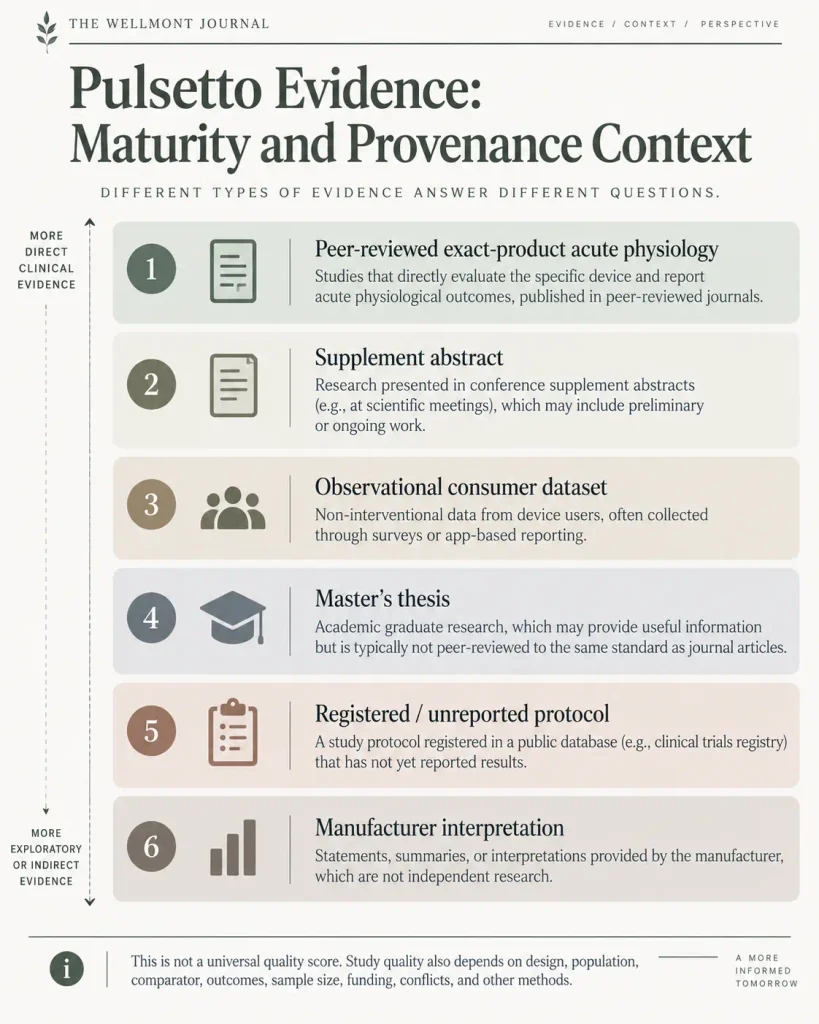
Evidence maturity is not simply a question of whether a study exists.
Publication status, sample size, control group, population, endpoint, duration, replication, conflicts, and the distance between the measured outcome and the marketing claim all matter.
Exact-Product Evidence Is Not the Same as Clinical-Treatment Evidence
An exact-product study answers an important provenance question: was Pulsetto actually the device tested?
It does not automatically answer a second question: was the study capable of establishing a clinically meaningful treatment effect?
For example, the Ahmed study is direct Pulsetto evidence, but it is an acute physiological experiment in healthy adults. The four-week study is also direct Pulsetto evidence, but it does not include an inactive or sham control. The sleep dataset involves real Pulsetto users, but it is observational.
Evidence can therefore be highly direct to the product while still being limited for a broad clinical claim.
HUMAN RESEARCH ≠ ESTABLISHED TREATMENT
Pulsetto has genuine exact-product human research. The current evidence does not establish broad clinical treatment efficacy for anxiety, depression, insomnia, migraine, or generic stress reduction.
Do Pulsetto’s Marketing Claims Match the Research?
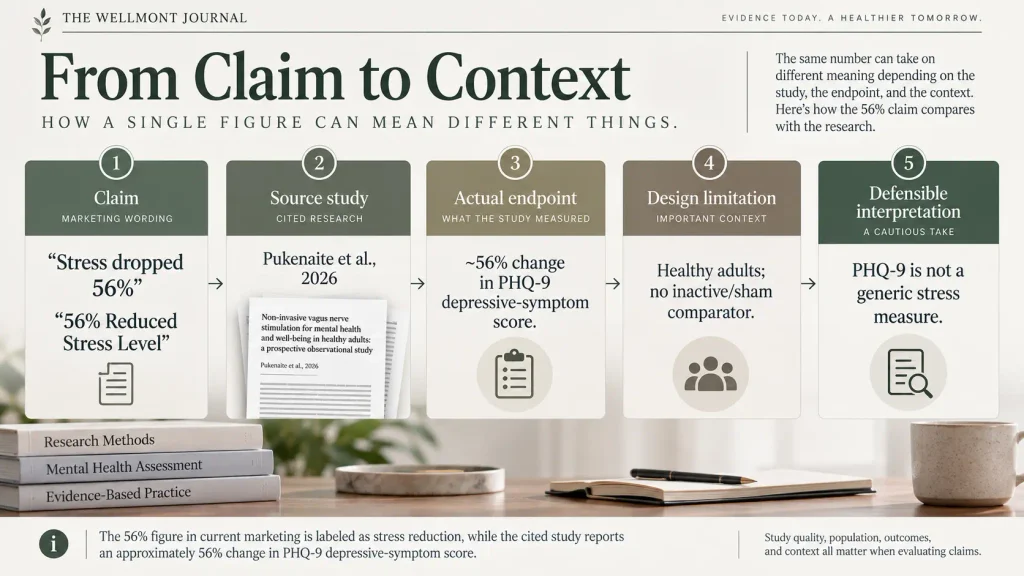
Pulsetto’s marketing deserves a claim-by-claim assessment rather than a single “true” or “false” verdict.
The most useful comparison is between the wording a consumer sees and the endpoint, population, and design of the research behind it.
Marketing-Claim Audit Table
| Marketing claim / wording | Where the claim appears | Relevant evidence | What the study actually measured | What the evidence supports | Important limitation | Editorial interpretation |
| “Stress dropped 56%” / “56% Reduced Stress Level” | Current Pulsetto U.S. homepage/sales content reviewed September 3, 2026 | Pukenaite et al., 2026 | Approximately 56% change in PHQ-9 depressive-symptom score | An approximately 56% PHQ-9 score reduction was reported over the four-week study | PHQ-9 is a depressive-symptom instrument, not a generic stress measure; healthy-adult study; no inactive/sham comparator | Current marketing labels the 56% figure as stress reduction, while the published abstract reports the approximately 56% change for PHQ-9 depressive symptoms. PHQ-9 is not a generic stress measure. |
| “Clinically Proven” | Pulsetto U.S. homepage reviewed September 3, 2026 | Exact-product human research collectively | Acute physiology, symptom scales/biomarkers, observational sleep, thesis work, registered physiological protocol | Pulsetto has been studied in humans | Evidence includes small acute physiological work, supplement-abstract symptom data, observational sleep data, non-peer-reviewed thesis research, and a registered protocol without reported results | Pulsetto does have exact-product human research, but the phrase can imply a broader level of clinical certainty than the current evidence establishes for general treatment claims |
| “Science-backed” / scientific-evidence framing | Pulsetto marketing and research materials | Pulsetto studies plus broader VNS literature where explicitly identified | Multiple different endpoints and study types | There is a real Pulsetto research base, and broader VNS science exists | Broader VNS evidence is not exact-product Pulsetto evidence | Defensible only when the evidence source and distance from the exact product remain clear |
| Anxiety-oriented claims | Pulsetto marketing | Pukenaite et al. | GAD-7 symptom score in healthy adults | Anxiety-score changes were reported during the four-week study | No inactive/sham comparator; not an anxiety-disorder treatment trial | Does not establish treatment efficacy for an anxiety disorder |
| Sleep-oriented claims | Pulsetto marketing | Pukenaite et al.; Pauliukevičius et al. | PSQI score; wearable-estimated sleep duration | Sleep-related changes and associations have been reported | Small uncontrolled symptom study plus observational dataset; causality not established | Supports research interest, not established insomnia treatment |
| HRV / vagal-tone wording | Pulsetto marketing/research materials | TU Delft thesis; registered FIT physiology protocol; broader mechanistic context | HRV and other physiological measures | Pulsetto-related physiological research includes autonomic measures | HRV is not a direct clinical-benefit endpoint; registered protocol has no results | Mechanistic or physiological evidence should not be translated into broad clinical efficacy |
| “4 minutes” messaging | Current Pulsetto routine/usage marketing | Product instructions and marketing | Usage duration | Pulsetto currently promotes some routines using four-minute messaging | Program length varies; short session duration does not establish that clinical benefit occurs within four minutes | Treat as a usage claim, not an efficacy or time-to-benefit claim |
| FCC / safety / scientific-evidence wording | Current Pulsetto Help Center | FCC equipment authorization plus manufacturer interpretation | Radio/electronic-equipment compliance | FCC authorization establishes applicable equipment authorization | FCC does not establish FDA medical clearance or independently prove clinical efficacy | Manufacturer statements linking FCC status to well-being use, scientific evidence, or safety should be identified as manufacturer interpretations |
| “Medical-grade materials,” if used | Pulsetto materials-marketing terminology | Product materials description | Materials terminology | Can describe how the manufacturer characterizes product materials | Does not establish FDA medical-device clearance or a therapeutic indication | Treat as materials-marketing language, not regulatory medical status |
The “56%” Claim Needs an Endpoint Label
Pulsetto’s current U.S. marketing presents the 56% figure as a reduction in stress.
But in the *European Psychiatry* abstract, the approximate 56% change is associated with PHQ-9, a questionnaire measuring depressive symptoms.
PHQ-9 is not a generic stress endpoint.
The distinction is straightforward:
Pulsetto’s current sales language presents the 56% figure as stress reduction, while the published abstract reports the approximately 56% change for PHQ-9, a depressive-symptom questionnaire. PHQ-9 is not a generic stress measure.
That does not justify saying Pulsetto “reduced depression by 56%” either. The study involved healthy adults and did not include an inactive or sham comparator.
The number needs both its actual endpoint and its study-design limitations.
What Does “Clinically Proven” Mean Here?
Pulsetto’s U.S. homepage reviewed September 3, 2026 uses the phrase “Clinically Proven.”
Pulsetto does have exact-product human research. That part is no longer reasonably dismissed.
But “clinically proven” can communicate something broader to a consumer than “human research exists.”
The exact-product evidence currently includes small acute physiological work, supplement-abstract symptom data, observational sleep data, non-peer-reviewed thesis research, and a registered protocol without reported results.
No mature, replicated sham-controlled treatment program establishing Pulsetto for broad clinical claims was identified in the evidence reviewed for this article.
A more precise interpretation is:
Pulsetto does have exact-product human research, but “Clinically Proven” can imply a broader level of clinical certainty than the current evidence establishes for general treatment claims.
“Science-Backed” and Broader VNS Research
“Science-backed” is similarly dependent on what evidence sits behind the phrase.
There is actual Pulsetto-specific research, so it would be inaccurate to imply that every scientific reference is necessarily unrelated to the product.
At the same time, broader cervical VNS, implanted VNS, auricular VNS, or gammaCore research does not become Pulsetto evidence simply because the technologies share vagus-related terminology.
A marketing bibliography can contain relevant background science without proving the performance of the exact product being sold.
The most useful distinction is therefore:
Pulsetto-specific study
versus
related VNS research
versus
mechanistic background.
HRV, Vagal Tone, and Mechanistic Claims
HRV and other autonomic measures appear in Pulsetto-related research.
They can be scientifically useful physiological endpoints.
But a change in HRV is not itself proof that a consumer will experience a meaningful improvement in anxiety, sleep, stress, or another clinical outcome. Nor should “vagal tone” be treated as a single consumer-facing score that proves the device is working.
Physiological findings can support mechanistic investigation. Clinical benefit requires evidence designed to test clinical benefit.
Time-to-Use Claims
Pulsetto currently promotes some routines using four-minute messaging, although program length varies.
That should be interpreted as a usage claim.
A short session duration does not establish that a clinical benefit occurs within four minutes.
Is Pulsetto FDA Approved or FDA Cleared?
We did not identify an FDA clearance or approval for Pulsetto as a medical treatment in the FDA records reviewed.
That should not be rewritten as “FDA rejected,” “FDA banned,” or “FDA certified.”
Pulsetto’s General-Wellness Positioning
Pulsetto is marketed as a general-wellness product and is not intended by the manufacturer to diagnose, treat, cure, or prevent disease or a medical condition.
That positioning is materially different from a medical device with a specific FDA-cleared indication.
It does not prove that Pulsetto has no physiological effect or that every wellness claim is false. It defines an important boundary around how the marketed product should be interpreted.
What FCC Authorization Means
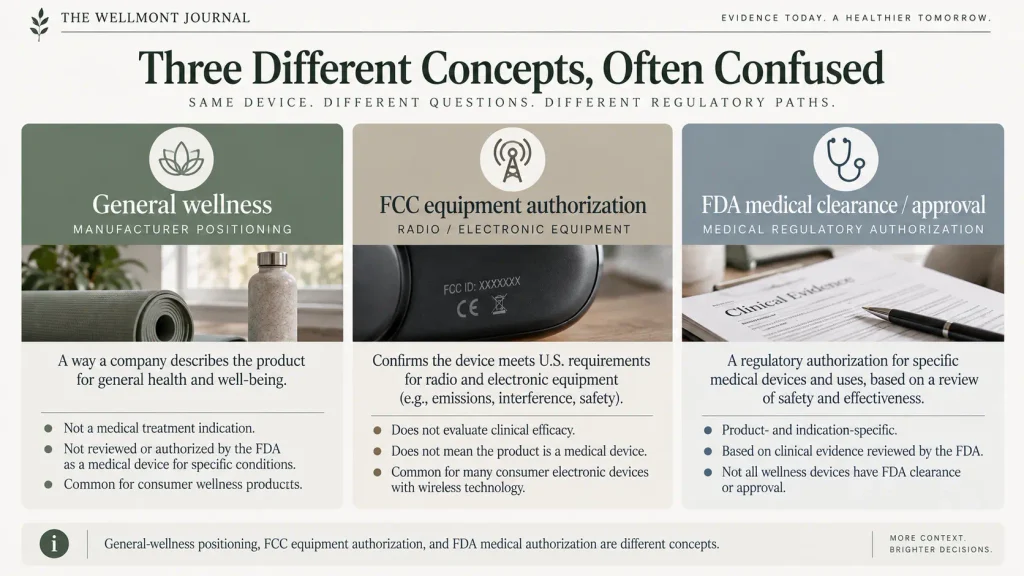
Pulsetto hardware has FCC equipment authorizations associated with its radio/electronic functions.
The newer UAB Pulsetto equipment authorization was granted on August 31, 2026 for FCC ID 2A5T3-BXNPU26V003.
FCC equipment authorization concerns applicable radio or electronic-equipment requirements.
It is not FDA medical clearance.
It does not establish therapeutic effectiveness or clinical efficacy.
Why the Manufacturer FCC Interpretation Needs Caution
Pulsetto’s current Help Center states that FCC certification means the device is approved for “well-being use” and says the certification ensures that Pulsetto is based on scientific evidence and is safe to use. Those are manufacturer interpretations. FCC equipment authorization concerns applicable radio/electronic-equipment requirements; it does not constitute FDA medical clearance or independently establish clinical efficacy.
What Does Pulsetto Say About Safety?
Pulsetto safety information needs to be read in layers.
A formal contraindication is not the same as a population the manufacturer says has not been evaluated. Neither is identical to a use restriction, a possible undesirable effect, or an adverse-event report submitted to FDA surveillance.
Combining all of those into one “do not use” list would overstate what the source material says.
Manufacturer Contraindications
Pulsetto’s current safety materials list contraindications including active implantable electronic medical devices, metallic devices such as stents, bone plates, or bone screws at or near the neck, and simultaneous use with certain other stimulation or electronic devices.
Those restrictions are Pulsetto-specific. They should not be expanded using contraindications copied from another cervical VNS product.
“Not Evaluated” Does Not Mean “Contraindicated”
Pulsetto’s current safety materials separately state that safety and efficacy have not been evaluated in a range of populations and circumstances.
The manufacturer’s current list includes uncontrolled hypertension or hypotension, bradycardia or tachycardia, certain cardiovascular disease or abnormal ECG histories, prior cervical vagotomy, pediatric or pregnant users, active cancer or cancer in remission, abnormal cervical anatomy, histories including brain tumor, aneurysm, bleeding or head trauma, syncope or seizures, and nickel allergy or sensitivity.
“Not evaluated” is not the same as a formal contraindication, and it is not proof that the product is known to be unsafe in every listed population.
Consumers with relevant medical conditions should rely on the current product safety information and appropriate medical guidance rather than restrictions borrowed from another VNS device.
Use Restrictions and Possible Undesirable Effects
Pulsetto’s current safety materials list possible undesirable effects including application-site discomfort or redness, local face/head/neck pain including toothache, muscle twitching or contractions including facial droop or lip pull, headache, dizziness, and tingling or pins-and-needles sensations.
No incidence is established for these effects.
They therefore should not be described as “common,” “rare,” or assigned numerical frequencies without supporting data.
Pulsetto also gives use restrictions, including avoiding damaged or irritated skin, water or wet-skin use, driving or operating machinery during use, and use near MRI, radiofrequency surgical, or CT equipment. Current instructions should be consulted for the complete device-specific list.
What Do FDA MAUDE Reports Tell Us About Pulsetto?
MAUDE LIMITATION
An FDA MAUDE report is a surveillance report, not a finding that a device caused an event. Reports can be voluntary, incomplete, unverified, duplicated, or linked to follow-up records. MAUDE also does not provide the exposure denominator needed to calculate incidence.
REPORT ≠ CAUSATION
NUMBER OF REPORTS ≠ INCIDENCE
MAUDE can still be useful in a product investigation. It can reveal the kinds of events that have been reported to FDA and identify signals worth monitoring.
It cannot, by itself, establish that Pulsetto caused an individual medical event or tell us how frequently an event occurs among users.
Cardiac Report
A voluntary MAUDE report, MDR key 23497093 / MW5178610, was received by FDA on November 7, 2025 for an event dated October 12, 2025. It describes a 72-year-old Pulsetto user who reported palpitations and exercise fatigue after use, followed by urgent-care evaluation for frequent ventricular arrhythmias. The report also states that a later three-day monitor showed 7.4% ventricular beats. The device was not available for evaluation.
This is a voluntary patient-reported surveillance record; it does not establish that Pulsetto caused the arrhythmia.
Thermal/Melting Report and Linked Follow-Up
Linked MAUDE records describe one user’s experience involving two Pulsetto devices. The first device was reported to have developed a cracked housing with exposed wiring. A replacement device was later reported to overheat and melt while charging, with a superficial hand burn reported. FDA records link the reports to the same user and incident history, so they should not be counted as two independent user incidents. The reports document submitted events; they do not by themselves establish the cause of the device failure or injury.
What We Are Not Counting Yet
Not every database result was treated as a distinct incident. Records that could not be adequately resolved, as well as linked or follow-up reports that could double-count the same incident, were excluded from any incident summary.
What Is Pulsetto Like to Own?
Evidence is only one part of an exact-product investigation.
Pulsetto also requires an app, contact medium, charging, and a choice between current models. Optional paid software features and commercial policies can affect the ownership experience.
Because these terms change faster than scientific evidence, price and policy details should be treated as dated snapshots rather than permanent product characteristics.
Lite vs FIT
Pulsetto Lite and Pulsetto FIT make up the current U.S. lineup.
FIT is the newer model. It is also specifically named in the registered NCT07274332 research protocol.
Research involving older or unspecified Pulsetto hardware should not automatically be relabeled as FIT research.
App and Premium
A smartphone app and Bluetooth connection are required for normal operation.
The current manufacturer structure includes free/core app functionality and an optional paid Premium offering.
That distinction matters because “free app” does not necessarily mean every software feature is free.
Premium pricing, trial terms, and included features can change and should be checked as current commercial terms rather than treated as permanent product characteristics.
Conductive Gel
Pulsetto requires conductive gel or the specified contact medium for normal use.
A 60 g gel tube is currently included, and the manufacturer describes it as approximately one month of use.
Actual consumption can vary, so the more durable ownership point is simply that conductive gel is a recurring consumable rather than a one-time setup item.
Price
As checked on September 3, 2026, Pulsetto’s U.S.-facing sales pages listed Lite at about $224, while FIT pricing varied by sales page or promotion, with prices around $251 to $296 observed.
These figures are highly volatile.
They should be read as a dated snapshot, not a permanent price or evidence of value. A temporary discount also says nothing about clinical effectiveness.
Returns
Pulsetto currently advertises a 30-day return window from delivery. Its terms state that the customer must initiate the return within that period and that returned physical products should be in their original, unaltered packaging with the original accessories. The company’s return portal may charge approximately $5–$35 for the return label depending on location, while shipping/handling and subscription fees are excluded from the product refund under the current terms.
A 30-day money-back guarantee does not automatically mean a free return.
The return policy should not be described as “risk-free.”
Warranty
Pulsetto currently states that every device comes with a standard two-year warranty. Optional warranty extensions are separate commercial offerings and can change.
Shipping
Shipping terms can vary by destination, promotion, and fulfillment conditions.
Because a single durable U.S. shipping promise is not necessary to evaluate the evidence, regulatory status, or core ownership requirements, this review does not rely on a fixed shipping-time claim.
Check Current Pulsetto Product Details and Pricing.
What Do Owners Commonly Discuss?
User reviews and discussion forums can be useful for understanding ownership friction, but they are not clinical evidence.
Across the user-experience sources reviewed, recurring discussion topics include device fit and electrode contact, app use, subscription or billing questions, setup, comfort or intensity, refunds, and customer-service experiences.
Those themes can help a prospective owner know what practical questions to investigate.
They cannot establish how frequently a problem occurs across all Pulsetto users, and positive or negative testimonials cannot demonstrate clinical efficacy.
For that reason, this review does not use user stories to decide whether Pulsetto treats anxiety, improves sleep, reduces stress, or produces another health outcome.
It also does not make a platform star rating central to the evidence assessment.
So, What Is the Evidence-Based Take on Pulsetto?
Pulsetto is a consumer bilateral cervical neuromodulation product marketed for general wellness. Normal ownership involves a smartphone app, conductive gel, a rechargeable device, a choice between Lite and FIT, and potentially optional Premium software services.
The product now has genuine exact-product human research.
That evidence includes a peer-reviewed acute physiological study, a small four-week symptom-and-biomarker abstract, observational wearable sleep data, a master’s thesis, and a registered Pulsetto FIT physiological protocol without posted results.
That is meaningfully different from having no product-specific research.
It is also meaningfully different from having established broad clinical treatment efficacy.
The current evidence does not establish Pulsetto as a treatment for anxiety disorders, depression, insomnia, migraine, or generic stress reduction. Acute physiological effects, symptom-score changes in a small study without an inactive control, and observational sleep associations should not be converted into stronger treatment claims than the designs can support.
Marketing language deserves the same precision. A percentage needs its actual endpoint. “Clinically Proven” should not obscure the maturity and design of the underlying studies. “Science-backed” should distinguish Pulsetto-specific evidence from broader VNS research. And FCC authorization should not be interpreted as FDA medical clearance or proof of clinical effectiveness.
Safety also needs to stay source-specific. Manufacturer contraindications, not-evaluated populations, possible undesirable effects, and MAUDE surveillance reports answer different questions and should not be collapsed into a single risk list.
For readers comparing Pulsetto with other product categories, see compare vagus nerve stimulation devices.
Pulsetto has a real and developing exact-product human research base, but much of the current evidence is physiological, observational, preliminary, small, or conducted in healthy adults. It is not yet sufficient to support broad clinical-treatment conclusions. Consumers evaluating it should separate what the exact product has actually demonstrated from what broader VNS science or marketing language may appear to imply.
Disclosure: If you purchase through this link, The Wellmont Journal may earn a commission at no additional cost to you. This does not affect our editorial evaluation.