Strength Training for Seniors: A Practical Guide to Getting Started Safely
Strength training does not have to mean heavy barbells, complicated gym routines, or training like a bodybuilder.
For older adults, the basic idea is much simpler: regularly make your muscles work against resistance, choose exercises that fit your current ability, use enough challenge to stimulate improvement, and progress gradually while maintaining control.
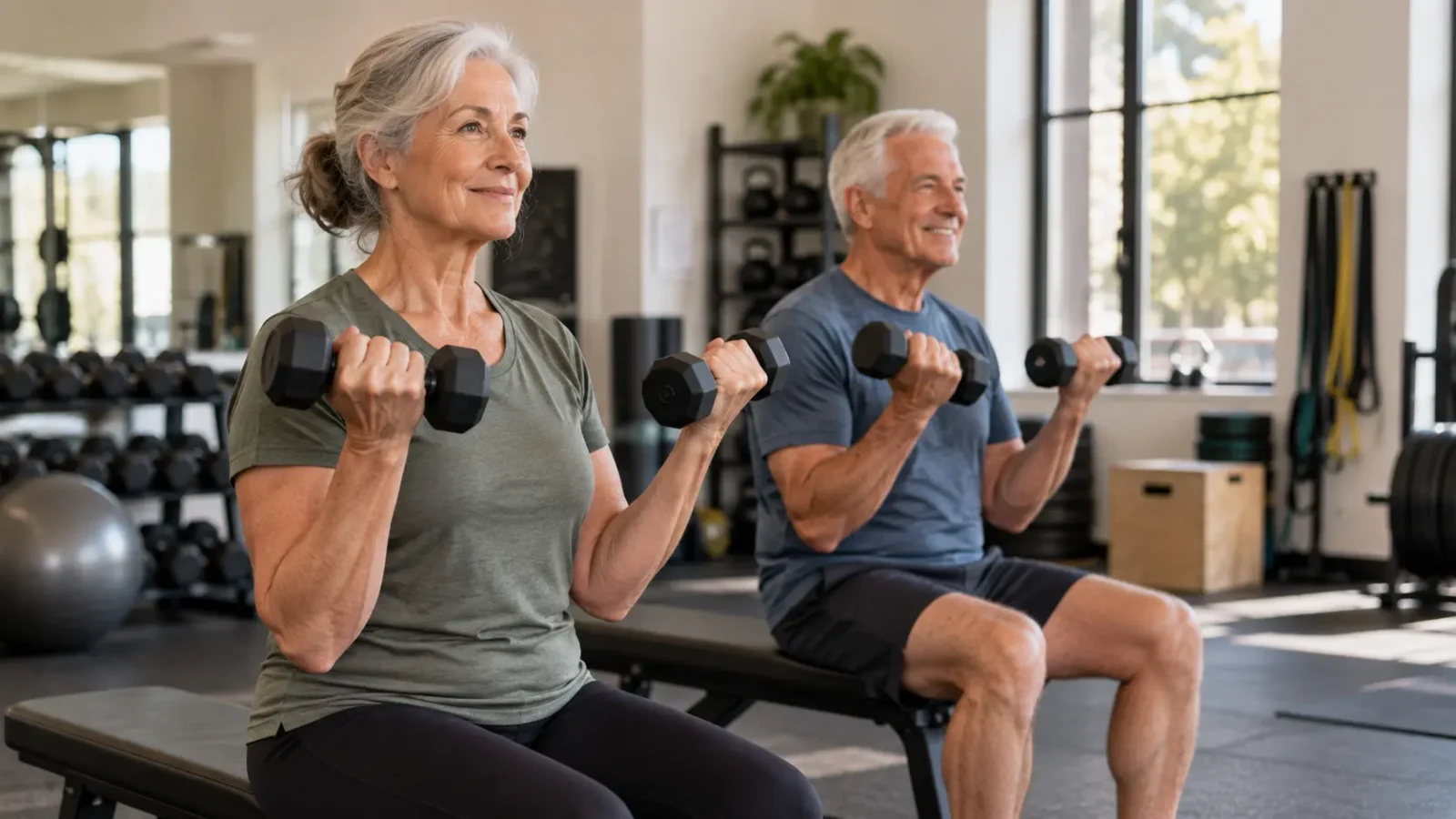
That resistance can come from your own body weight, resistance bands, machines, dumbbells, or other free weights. You can train at home or in a gym. You can also start later in life and still improve strength.
The most useful beginner framework is not built around one perfect workout. It is built around a few practical principles: train the major muscle groups, make the work meaningfully challenging, allow recovery, increase the challenge gradually, and adjust exercise choice or seek guidance when health, mobility, pain, balance, or unexplained functional decline changes the situation.
What Does Strength Training Mean for Older Adults?
Strength training, also called resistance training, means making your muscles work against some form of resistance.
- your body weight;
- resistance bands;
- weight machines;
- dumbbells or other free weights.
For example, standing up from a chair repeatedly can challenge the legs using body weight. A band row can challenge the muscles of the upper back. A machine press or dumbbell press can train the upper body against external resistance.
The equipment itself is not the defining feature. The central idea is that the muscles encounter enough resistance to be challenged and, over time, that challenge can gradually increase as your capacity improves.
That is why effective strength training does not depend on owning a specific type of equipment. Body weight, bands, machines, and free weights can all have a legitimate place depending on access, comfort, technique, balance, current ability, goals, and how easily the exercise can be progressed.
Why Strength Training Matters as You Age
Strength training matters because muscular strength contributes directly to many physical tasks people use every day.
Getting out of a chair, climbing stairs, carrying groceries, lifting household objects, maintaining posture, and moving through daily environments all require some combination of strength and physical function.
Resistance training has strong support for improving muscular strength and physical function in older adults. It can also improve chair-rise ability and selected mobility outcomes. Depending on the individual and the program, it may also support muscle or lean mass, bone health, balance, and quality of life.
Those benefits should still be described realistically. Strength training does not guarantee that someone will remain independent, but stronger muscles can support the physical capabilities involved in everyday independence.
The same caution applies to falls. Strength is important, but strength training alone should not be described as preventing falls. It is better understood as one component of a broader fall-prevention approach that can also include balance work and other appropriate activity.
Some readers exploring strength training because of persistent weakness or declining physical function may also want to understand sarcopenia and age-related changes in muscle strength and function. That is a condition-understanding question rather than something a workout guide can diagnose.
One especially useful distinction is that strength can improve even when visible muscle size changes only modestly. Becoming stronger and becoming visibly more muscular are related goals, but they are not identical.
Is It Ever Too Late to Start Strength Training?
No fixed age makes strength training automatically ineffective. Research shows that older adults can improve strength even when they begin in later life, including people in their 70s and 80s and selected participants at still older ages.
That does not mean every person should use the same exercises, loads, or progression. Studies in very old adults often involve selected or supervised participants, and health, mobility, balance, prior experience, and support needs still matter.
Starting later in life is also different from assuming every change in strength is ordinary aging. Sarcopenia as a clinical muscle disorder is a separate condition-understanding topic when weakness or loss of function becomes persistent or progressive.
Age is one factor in programming, but it is not a complete program by itself. The useful question is not simply how old someone is; it is what that person can currently do with control and how the training can be progressed appropriately.
Before You Start: Safety and When Guidance May Help
Healthy older adults generally do not need a blanket instruction to seek medical clearance before gradually increasing physical activity.
At the same time, some situations make professional input more useful. Significant cardiovascular disease or symptoms, unstable medical conditions, recent hospitalization or surgery, major mobility limitations, recurrent falls, active injury, marked frailty, neurologic disease, significant osteoporosis or fracture concerns, or unexplained progressive weakness can change how exercise should be approached.
The goal is not to turn strength training into a medical procedure. It is to recognize when ordinary beginner programming is enough and when a health, rehabilitation, or movement problem deserves a more individualized assessment.
Who Can Help With What?
A clinician can help evaluate symptoms, medical stability, and health conditions that may affect exercise. A physical therapist can help when rehabilitation, pain, mobility limitations, balance problems, or movement-specific limitations are central. A qualified exercise professional can help with exercise selection, technique, progression, and practical program structure when medical evaluation is not the main issue.
What Should a Beginner Strength Program Cover?
A practical beginner program should aim to train the major muscle groups without requiring a complicated list of exercises.
One useful way to think about coverage is through broad movement categories: a lower-body knee-dominant movement, a hip or posterior-chain movement, an upper-body push, an upper-body pull, trunk or postural work, and—when appropriate—carry or other function-oriented work.
These categories are an organizational model, not a mandatory routine. Different exercises can cover similar functions, and a whole-body format is simply one practical way to make sure important muscle groups are not repeatedly ignored.
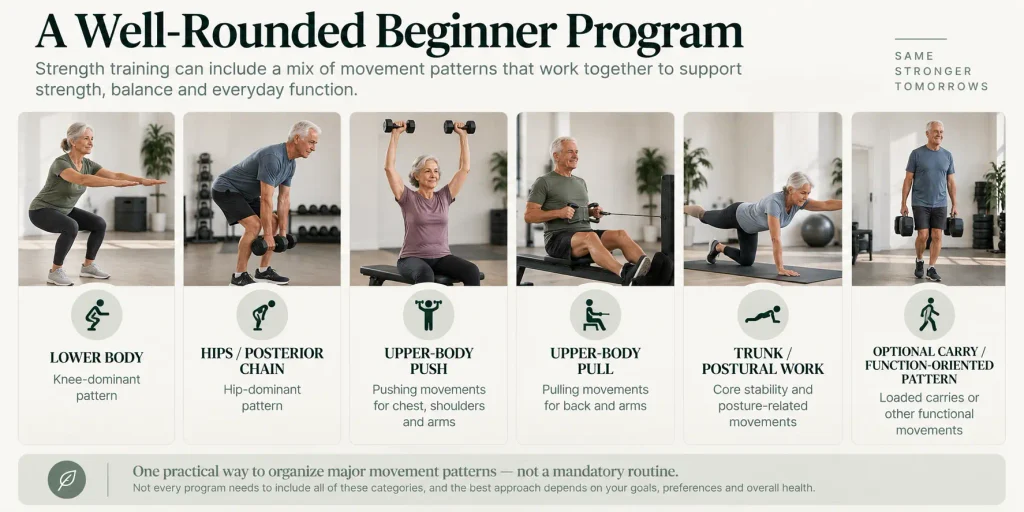
The right exercise should be stable enough to perform with control, appropriate to current mobility and balance, and adjustable as strength improves.
How Often Should Seniors Do Strength Training?
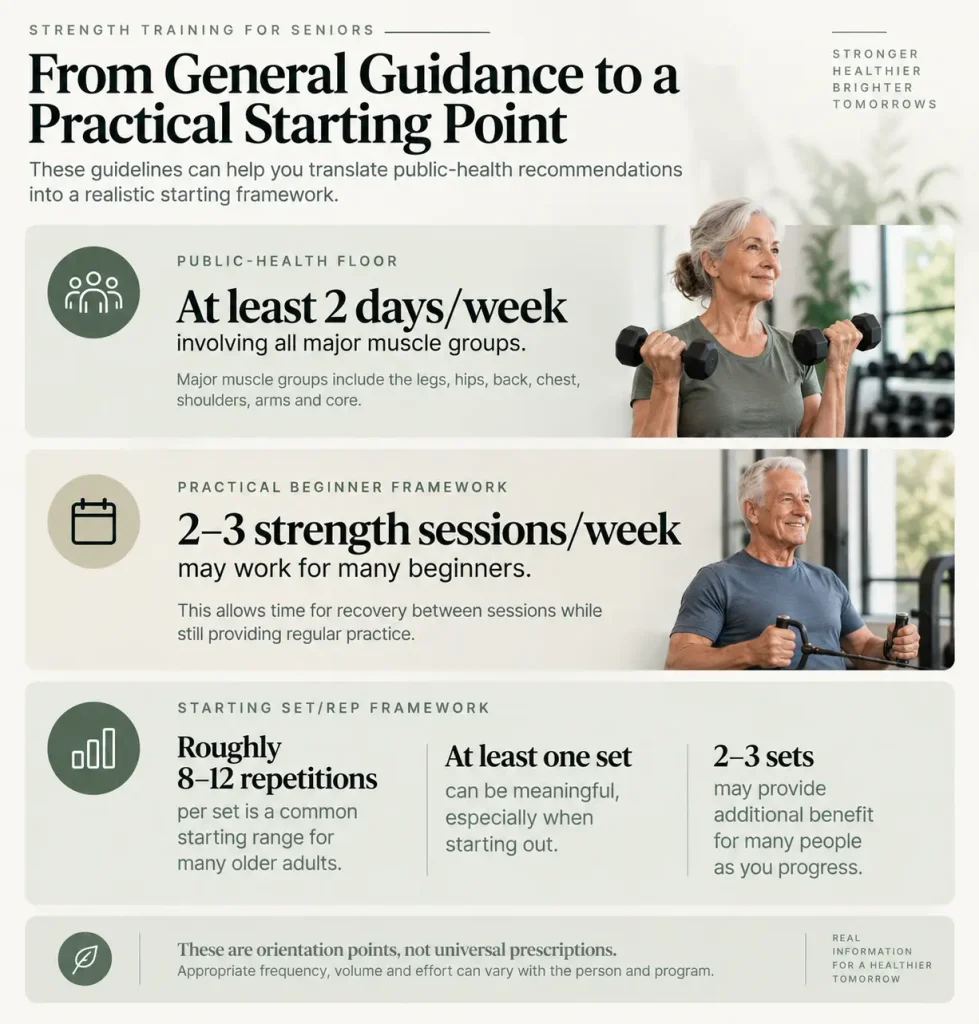
Current U.S. public-health guidance recommends that older adults perform muscle-strengthening activity involving all major muscle groups on at least two days per week.
That is a public-health floor, not a rule that exactly two days is optimal for every person.
For many beginners, two to three strength-training sessions per week can be a practical whole-body framework. Recovery, exercise selection, training volume, other physical activity, and individual tolerance all affect how that schedule feels.
Three days is not automatically better than two. The better schedule is one that provides enough repeated training to make progress while still allowing the person to recover and maintain good-quality movement.
Sets, Repetitions, and How Hard Strength Training Should Feel
A Practical Sets-and-Reps Starting Framework
Roughly 8 to 12 repetitions can form a practical starting range for many strength exercises.
At least one set can be meaningful, and performing two or three sets may provide additional benefit.
That is a flexible starting framework, not a universal prescription. Some exercises, goals, abilities, and programs may reasonably use different repetition ranges or volumes.
How Challenging Should the Resistance Feel?
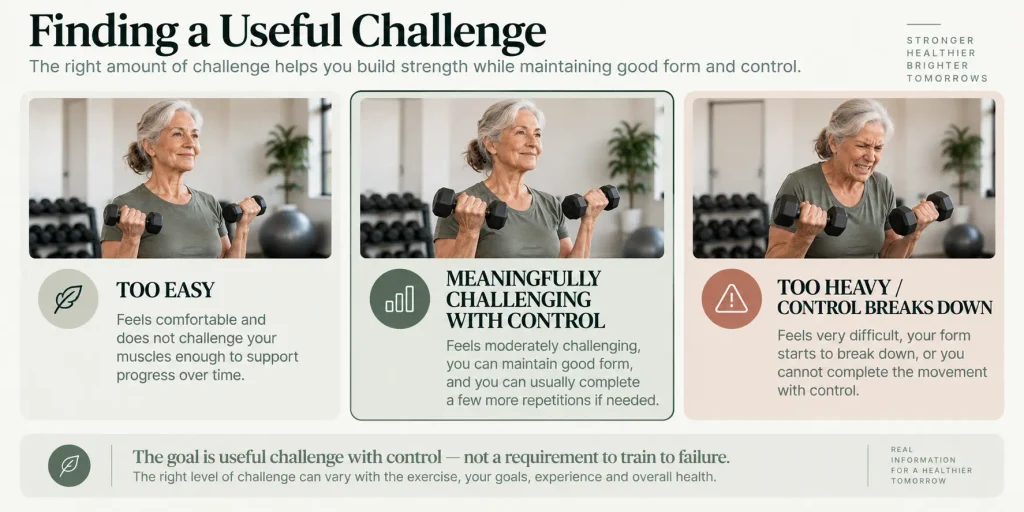
The resistance should feel meaningfully challenging while still allowing controlled movement and appropriate technique.
Older age does not automatically mean someone must use only light weights. At the same time, lifting as heavily as possible is not the default goal for a beginner.
A useful starting point is resistance that requires effort but does not make control break down. If the movement becomes unstable, technique changes substantially, or the task cannot be completed with appropriate control, the resistance or exercise may need adjustment.
You should not need to train to complete muscular failure as a default strategy. Productive training can be challenging without making every set an all-out effort.
Body Weight, Bands, Machines, or Free Weights: Which Is Better?
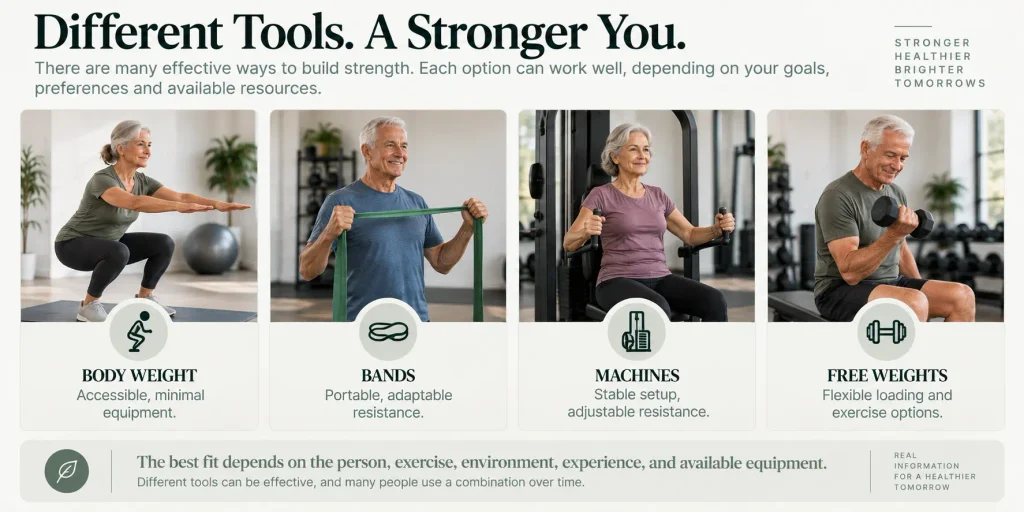
No single resistance-training modality is universally best or safest for older adults.
Body Weight
Body-weight exercises can be useful when they meaningfully challenge the target muscles. Sit-to-stand variations, squatting patterns, calf raises, and push-up variations are examples that can be adapted in difficulty.
Resistance Bands
Bands are portable and can provide adaptable resistance. They can work well at home or while traveling, although setup, anchoring, and the resistance curve of the movement still matter.
Machines
Machines can provide a stable setup and make resistance easy to adjust in small increments. They are one useful option, not an automatic safety winner for every person or exercise.
Dumbbells and Other Free Weights
Free weights allow flexible loading and a wide range of exercises. They can be appropriate for older adults when the chosen movement, resistance, balance demands, and technique fit the individual.
The practical question is not which tool wins. It is which tool allows the target muscles to be challenged with a setup that is accessible, controllable, and progressively adjustable.
Beginner-Friendly Strength Exercise Examples
Exercise examples are most useful as illustrations, not as a prescribed workout. A beginner might choose movements such as:
- sit-to-stand or a chair-supported squat pattern;
- a supported step-up or leg press;
- a calf raise;
- a band or machine row;
- a wall or incline push-up;
- a machine chest press;
- a light dumbbell row;
- another simple trunk or posture-focused movement that can be performed with control.
Not every person needs every example, and some movements need modification when balance, joint comfort, mobility, injury history, or other health factors change the setup.
If the main goal shifts from general strength and function toward deliberately increasing muscle size, the next reader job is building muscle after 50 rather than simply adding more exercises to a beginner strength guide.
How to Progress Without Rushing
Strength training needs to become more challenging over time if you want continued improvement.
Progression does not require a rigid formula or a fixed percentage increase every week. Challenge can increase by adding a small amount of resistance, performing more repetitions within an appropriate range, adding a set, using a more demanding variation, improving usable range of motion where appropriate, or performing the movement with better control.
A sensible sequence is to learn the movement, establish a controllable level of challenge, repeat it consistently, and then make modest changes when the current version becomes manageable.
Progress should not be confused with rushing. A larger jump in load is not automatically better than a smaller change that preserves control and consistency.
Can Seniors Strength Train at Home, or Is a Gym Better?
Yes, older adults can strength train effectively at home. A gym is not required.
Home training can make consistency and access easier, especially when body weight, bands, or suitable free weights provide enough resistance. A gym can offer a wider range of machines and free weights, easier incremental loading, and access to instruction or supervision.
Neither setting is universally superior. The better environment is the one that supports appropriate resistance, safe setup, progression, and consistent participation for that person.
Recovery, Rest, and the Role of Nutrition
Strength training works best as a repeated practice rather than a single hard workout. Recovery between sessions helps make that repetition sustainable.
Some temporary muscular fatigue or soreness can occur, especially after unfamiliar exercise, but soreness is not required for a workout to be effective.
Sleep, overall activity, training volume, and the spacing of demanding sessions can all affect how recovered someone feels.
Nutrition also supports recovery and muscle maintenance. That includes getting enough overall nutrition and sufficient protein.
Readers who want to move from that general principle into food choices, intake considerations, and more detailed implementation can continue with protein needs for older adults.

Contextual advertisement
Considering Advanced Amino Formula?
This strength-training guide does not establish that a particular supplement improves strength, muscle gain, or training results. If you are independently considering Advanced Amino Formula, you can inspect the current product and offer details separately.
Affiliate disclosure: The Wellmont Journal may earn a commission if you purchase through an affiliate link, at no additional cost to you.
Check Advanced Amino Formula details: Go Go!
This is a contextual advertisement, not a claim that Advanced Amino Formula is necessary for strength training or improves strength, muscle gain, recovery, or other training outcomes.
Strength Training vs. Training Specifically to Build Muscle
Strength and muscle size are related, but they are not the same outcome.
Strength can improve without large visible increases in muscle size. Early improvements can also reflect better coordination and the nervous system becoming more effective at producing force in the trained movements.
A general older-adult strength program can prioritize useful strength, function, consistency, and broad muscle-group coverage without becoming a bodybuilding or hypertrophy program.
Readers whose primary goal is increasing muscle size need a different layer of programming detail. That belongs in guidance on training specifically to build muscle after 50.
When Weakness or Functional Decline May Need More Than a Workout Plan
A workout guide cannot diagnose the cause of persistent or progressive weakness.
If strength or everyday function is declining without a clear explanation, if falls are becoming recurrent, or if ordinary tasks are becoming progressively harder, simply adding more training may not answer the underlying question.
That is where understanding sarcopenia and when muscle weakness can reflect more than ordinary aging becomes a different reader task from choosing sets, repetitions, or equipment.
Professional assessment may also be appropriate when weakness is unexplained, progressive, or accompanied by other concerning symptoms.
When to Stop Exercising and Seek Help
Stop and Assess
Stop the exercise and assess what is happening if you develop unusual chest discomfort, unusual shortness of breath, lightheadedness, fainting or near-fainting, sudden severe pain, acute neurologic symptoms, sudden loss of coordination, or an injury that makes normal use of a limb or weight-bearing difficult.
The appropriate next step depends on the symptom and its severity. Serious or sudden symptoms may require urgent evaluation rather than simply waiting for the next workout.
When Symptoms May Be Urgent
Acute chest pain or pressure, sudden one-sided weakness, sudden difficulty speaking, or other possible heart attack or stroke symptoms require emergency evaluation; in the United States, call 911. Fainting during exercise or severe unexpected breathlessness also warrants prompt medical evaluation, and emergency care is appropriate when symptoms are severe, sudden, or ongoing.
Do not assume those symptoms are ordinary exercise reactions.
A strength-training guide cannot determine the cause of an acute symptom, and a workout should not continue while a serious problem is being dismissed as normal fatigue.
When Routine Professional Assessment Makes Sense
Professional assessment can also make sense for problems that are not necessarily emergencies but keep returning or getting worse.
- persistent or worsening joint pain;
- recurrent exercise-related symptoms;
- repeated falls;
- progressive weakness;
- unexplained functional decline;
- continuing inability to perform basic movements safely.
Those situations may call for a clinician, physical therapist, or other appropriate professional depending on the issue.
What Does Not Automatically Mean Something Is Wrong?
Ordinary muscular effort, temporary fatigue, and mild or modest delayed soreness can occur with strength training.
Those experiences do not automatically mean something is wrong.
Soreness is also not required for effective training. A workout can be productive even when you are not sore afterward.
The goal is not to avoid every sensation of effort. It is to distinguish normal training stress from symptoms that are unusual, severe, persistent, progressive, or acute.
Frequently Asked Questions About Strength Training for Seniors
Is it ever too late to start strength training?
No fixed age makes strength training automatically ineffective. Studies support strength gains even in advanced age, including among people over 80, although many trials involve selected or supervised participants. Health, mobility, experience, balance, and the need for supervision still affect how someone should begin.
How often should seniors do strength training?
Current U.S. guidance recommends muscle-strengthening activity involving all major muscle groups on at least two days per week. That is a public-health minimum, not a universal optimum. For many beginners, two to three whole-body sessions per week can be a practical framework if recovery is adequate.
Should older adults lift heavy weights?
Older adults do not automatically need to use only light weights, but they also do not need to lift as heavily as possible. Resistance should feel meaningfully challenging while still allowing good control and appropriate technique. The right load depends on current capacity, experience, exercise choice, balance, and health context.
Are resistance bands, machines, or free weights better for seniors?
No single modality is universally best or safest. Bands, machines, free weights, and body-weight exercises can all be useful. The better choice depends on access, comfort, ability, technique, balance, goals, and how easily the exercise can be progressed.
Can seniors do strength training at home?
Yes. Effective strength training can be done at home using body weight, bands, free weights, or other suitable resistance. A gym can provide more equipment and easier incremental loading, but gym access is not required to build strength.
When should an older adult get professional guidance before strength training?
Professional guidance can be useful when there are unstable medical conditions, significant mobility limitations, rehabilitation needs, recurrent falls, recent surgery or hospitalization, an active injury, or major uncertainty about safe exercise. Concerning or acute symptoms should be medically evaluated rather than treated as a routine programming question. Healthy older adults who increase activity gradually do not automatically require blanket medical clearance.
A Practical Way to Think About Strength Training as You Age
A useful strength-training plan does not need to be complicated.
Start from your current capacity. Train the major muscle groups. Use at least two days per week as the public-health floor for muscle-strengthening activity. Choose resistance that creates meaningful challenge while you maintain control.
Then progress gradually rather than chasing one perfect routine, one piece of equipment, or one definition of “heavy.”
If your goal becomes more specific, let the next step match that goal. Muscle-gain optimization, detailed protein planning, and condition-level questions each deserve their own guidance rather than being forced into one beginner program.
For readers who want a practical next step on nutrition after establishing a training routine, see practical protein guidance for older adults.
The central principle is simple: strength training should be challenging enough to matter, adaptable enough to fit the person, and consistent enough to become a sustainable part of healthy aging.