
How to Increase Stamina and Endurance: Why Harder Workouts Aren’t Always the Answer
If you want more stamina, the obvious instinct is to make your workouts harder.
Sometimes that works. Hard intervals can create a strong training stimulus, and vigorous exercise can improve cardiorespiratory fitness.
But harder is only one way to progress.
You can also increase how long you train, how often you train, how much total work you accumulate across a week, or how well your training matches the activity you actually want to improve. Manageable aerobic work can produce meaningful adaptation too.
That is why every endurance session does not need to feel punishing.
The better question is not, “How hard can I push today?”
It is, “What job is this workout supposed to do, and can I recover well enough to repeat useful training over time?”
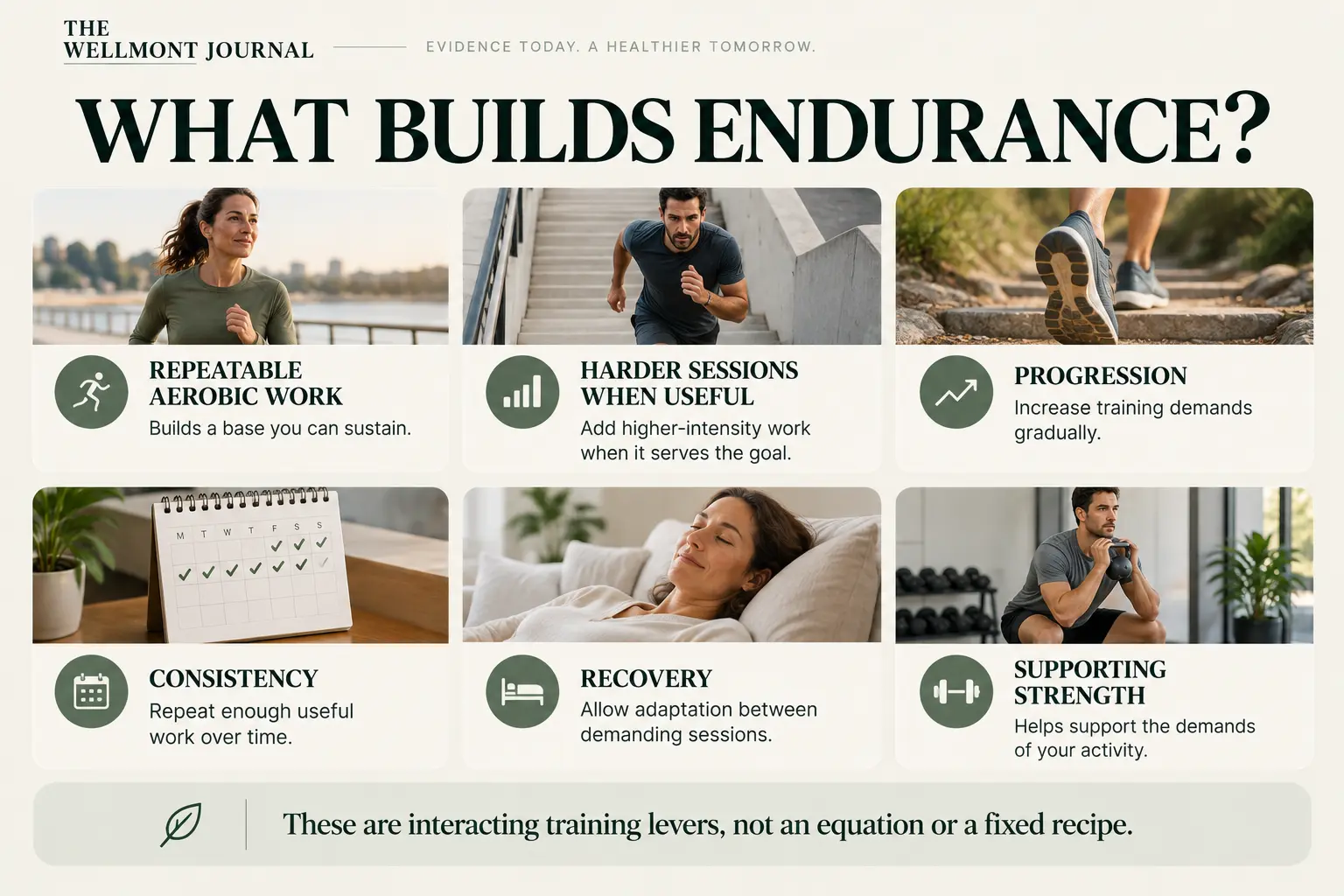
Intensity matters. Volume matters. Consistency matters. Recovery matters. And they are not the same variable.
Harder training is a useful tool.
It is not the entire endurance strategy.
What Does “More Stamina and Endurance” Actually Mean?
In everyday fitness language, stamina and endurance overlap.
People use both words to mean some version of: “I want to keep going longer without getting so tired.”
That is useful enough for conversation, but the limitation you want to improve can differ.
Scientific research may use more specific terms such as cardiorespiratory fitness, aerobic capacity, exercise tolerance, endurance performance, VO2max or VO2peak, or muscular endurance.
You do not need to memorize those terms before you train.
You do need to know what kind of capacity is holding you back.
Are you trying to sustain whole-body aerobic activity longer?
Do your legs or upper body fatigue locally before you feel limited by breathing?
Or are you trying to perform one specific activity — such as cycling, swimming, hiking, rowing, walking, or running — more effectively?
Those are related goals, but they are not identical.

Cardiorespiratory Endurance
Cardiorespiratory endurance is your ability to sustain activity that places an ongoing demand on your heart, lungs, circulation, and working muscles.
Brisk walking, cycling, swimming, rowing, hiking, elliptical training, and running can all challenge this system.
VO2max is one useful measure of aerobic capacity, but endurance is not reducible to one number.
Real-world endurance also depends on factors such as pacing, movement efficiency, local muscular capacity, training status, and how well you tolerate a specific activity.
So improving endurance does not mean chasing one laboratory metric at the expense of everything else.
Muscular Endurance Is a Different Limitation
Sometimes your breathing feels manageable, but a particular muscle group gives out first.
That is more of a local muscular-endurance problem.
For example, your legs may fatigue during a climb even though you do not feel globally exhausted. Or your upper body may become the limiting factor in rowing or swimming.
That distinction matters because the solution may not be simply “do more cardio.”
Strength work, local muscular training, activity-specific practice, and better pacing can all matter depending on what is actually failing first.
If your goal is specifically to build muscle after 50, that is a related but separate training objective from building broad endurance.
There is no single scientific repetition range that defines muscular endurance for every exercise and every person.
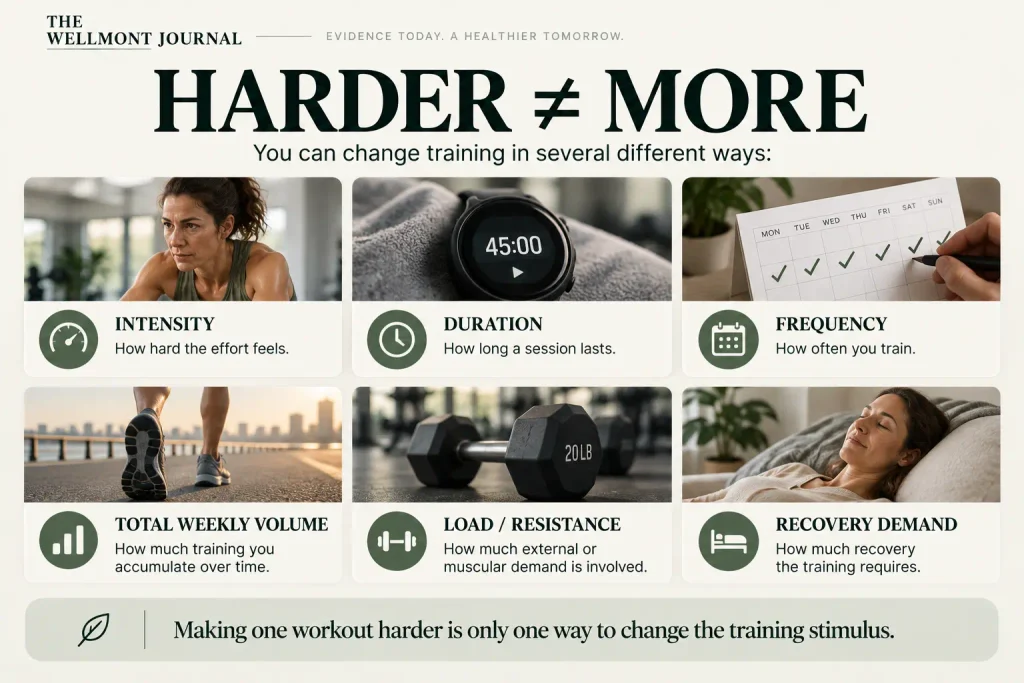
Harder Is Not the Same as More
One of the easiest mistakes in endurance training is treating “harder” and “more” as though they mean the same thing.
They do not.
A workout can change in several ways:
- Intensity: how hard you are working.
- Duration: how long the session lasts.
- Frequency: how often you train.
- Weekly volume: how much total training you accumulate.
- Mode: the activity you use.
- Resistance or load: how much external or muscular demand is involved.
- Recovery demand: how much fatigue the session creates relative to your ability to recover.
If a 30-minute workout becomes more intense, that is one type of progression.
If the same manageable workout becomes 40 minutes, that is another.
If you keep the sessions similar but add another day of training, total weekly work changes again.
Those changes are not interchangeable.
What Happens When You Make a Workout Harder?
Higher-intensity exercise can create a powerful stimulus.
Hard intervals can challenge cardiorespiratory fitness efficiently, and vigorous training can improve endurance-related capacity.
But the fact that a workout creates more fatigue does not automatically mean it creates more useful adaptation.
A session has to be considered in context.
If a very hard workout leaves you unable to train productively for several days, it may contribute less to the larger week than a slightly less aggressive session you can recover from.
That does not make hard training bad.
It means fatigue and adaptation are not the same thing.
What Happens When You Add More Training?
Endurance can also improve by accumulating more useful work.
That might mean:
- gradually extending some sessions;
- training a little more often;
- increasing weekly volume;
- or building a larger base of manageable aerobic work.
This does not mean “just train longer.”
More training is only useful when the increase remains tolerable enough to recover from and repeat.
The goal is not to collect the most minutes possible.
It is to create enough repeated training stress to drive adaptation without making the overall pattern unsustainable.
Manageable Aerobic Work Can Still Build Endurance
A workout does not have to feel maximal to matter.
Manageable aerobic training can improve cardiorespiratory fitness when the effort is challenging enough relative to the person doing it.
That last part matters.
The same brisk walk may be a meaningful aerobic stimulus for one person and barely a training stimulus for another.
So “easy” is not an absolute category.
What matters is the effort relative to your current capacity.
This is also why the idea that every workout should be hard can backfire. If all sessions become highly demanding, you may lose the ability to accumulate useful volume consistently.
Use the Talk Test to Judge Effort Without Pretending the Numbers Are Perfect
You do not need laboratory testing or a perfectly precise heart-rate target to get a rough sense of exercise intensity.
The talk test can help.
At a manageable effort, you may be breathing harder but still able to speak in sentences.
As intensity rises, conversation becomes increasingly difficult.
This is not an exact clinical threshold, and it should not be treated like one.
But it can be a useful real-world tool for distinguishing an effort you can sustain from one that is becoming much harder.
For many general fitness sessions, that relative information is enough to help you avoid accidentally turning every workout into a hard workout.
Easy Enough to Repeat Does Not Mean Too Easy to Matter
A sustainable session can still be productive.
Repeatability is one reason endurance athletes and recreational exercisers alike often use a mixture of lower- and higher-intensity work.
The manageable sessions help accumulate training exposure without making every day maximally demanding.
But there is an important qualifier:
If the workload is too low relative to your current capacity to provide a meaningful training challenge, it may produce little additional adaptation.
“Comfortable enough to repeat” does not mean “so easy that nothing is being challenged.”
The target is useful, recoverable work.
Hard Intervals Work — They Just Do Not Need to Be Every Workout
High-intensity interval training deserves a fair description.
HIIT works.
It can improve cardiorespiratory fitness and can be time-efficient.
For some people and some outcomes, it may produce larger improvements than lower-intensity approaches.
None of that means every endurance workout needs to be HIIT.
And it does not mean HIIT is the universally best method for every person, every outcome, or every training week.
Why Higher-Intensity Work Can Be Useful
Harder sessions can expose you to demands that manageable steady work does not fully reproduce.
They can challenge aerobic capacity, increase tolerance for harder efforts, and provide a strong training stimulus in relatively little time.
That makes them useful tools.
They may be especially helpful when you are already comfortable with your basic aerobic workload and want to add a more demanding stimulus.
The important point is purpose.
A hard session should have a reason to be hard.
Why More Hard Sessions Are Not Automatically Better
Harder sessions also create more recovery demand.
Adding another difficult workout may improve the program.
Or it may simply add fatigue.
The useful question is not whether hard training is effective.
It is whether the extra hard session adds productive stimulus while still allowing you to recover and perform the rest of your training well.
A program can contain hard work without making hard work the default setting.
Why “80/20” Is Not a Universal Endurance Rule
You may have heard that endurance training should follow an “80/20” split, with most training performed at lower intensity and a smaller amount done hard.
That idea comes largely from observations and studies involving endurance athletes and different training-intensity distributions.
It can be a useful way to understand why many endurance-athlete training programs include substantial lower-intensity work alongside harder sessions.
But it is not a universal scientific law.
The ideal distribution depends on the person, the sport, training history, total workload, goals, and how intensity is defined.
Current evidence does not establish one exact mandatory 80/20 split for every general reader.
The broader lesson is more useful than the ratio itself:
You do not need every workout to be hard in order to improve endurance.
Progress by Changing One Training Lever at a Time
Progressive training means gradually creating a larger or more specific challenge as your body adapts.
But progression does not have to mean “push everything upward.”
You can change:
- session duration;
- weekly frequency;
- total weekly volume;
- intensity;
- exercise difficulty;
- resistance or load.
Changing one major variable at a time can make it easier to see how your body responds.
It also reduces the chance that a modest-looking training change becomes much larger than you intended.
The 10% Rule Is Not a Scientific Law
A familiar rule says you should never increase training by more than 10% per week.
That is not a universal scientific law.
It should not be treated as a guaranteed injury-prevention formula.
And replacing it with another fixed percentage would create the same problem.
A better principle is simpler:
Progress gradually enough that the new workload remains tolerable and recoverable.
How quickly that happens depends on your current training, the activity, your history, and how large the change actually is.
Avoid Increasing Everything at Once
Suppose you train three times per week for 30 minutes.
Then, in the same week, you:
- add a fourth session;
- extend every session;
- increase the pace;
- and add intervals.
Each change may look reasonable on its own.
Together, they create a much larger jump in total stress.
That is why changing one major lever at a time can be useful.
You can better judge whether the progression is helping, whether recovery remains adequate, and whether the new workload is something you can repeat.
Consistency Is What Turns Workouts Into Adaptation
One impressive workout does not build endurance.
Repeated exposure does.
Your body adapts to training because the stimulus keeps returning often enough to matter.
That does not mean missing one workout destroys your fitness.
It means long-term consistency matters more than isolated heroic sessions.
Detraining research also shows that fitness can decline when training is substantially reduced or stopped for long enough.
The practical lesson is not to become anxious about missed days.
It is to build a training pattern you can realistically maintain.
The Hardest Workout of the Week Is Not Automatically the Most Important
The session that feels the hardest often gets the most credit.
But a demanding workout only has value as part of the larger pattern.
A moderate session that helps you accumulate volume, recover well, and stay consistent can make an important contribution to the overall training process.
That does not make the hard session unnecessary.
It means its usefulness depends partly on what surrounds it.
Recovery Is Part of Endurance Training
Training provides the stimulus.
Recovery determines whether you are prepared to respond to the next stimulus.
You do not need to treat recovery as something separate from training.
It is one of the variables that determines how much training you can productively absorb.
Sleep Is a Performance Variable
Sleep deprivation can reduce endurance performance.
That does not mean every bad workout is caused by poor sleep.
But if your training suddenly feels harder after several nights of inadequate sleep, recovery deserves attention before you assume your fitness has disappeared.
Sleep also influences how repeatable demanding training feels.
If you are constantly adding intensity while consistently under-recovered, harder workouts may not solve the problem you think they are solving.
Persistent Decline Is Not Something to Blindly Push Through
Normal training includes days when performance feels worse.
That alone does not mean something is wrong.
But a persistent, unexplained decline in exercise tolerance is different from one disappointing workout.
If your capacity continues to fall despite reasonable training and recovery adjustments, simply pushing harder is not always the right response.
That is where a training question can become a medical question.
Strength Training Can Support Endurance
Endurance training and strength training are not opposites.
Strength work can support muscular capacity and, in some endurance settings, endurance performance. Much of the direct performance evidence comes from trained endurance athletes, so the size and type of benefit should not be assumed to be the same for every person or activity.
For some endurance activities, greater strength may also mean that a given submaximal muscular demand represents a smaller fraction of your maximum capacity.
That can be useful.
But strength training does not replace aerobic training.
And it should not be presented as a general shortcut for increasing VO2max.
Its role is supportive and partly activity-dependent.
If you want a dedicated strength implementation route, our strength training for seniors guide covers that goal separately from broad endurance training.
Strength and Muscular Endurance Are Not the Same Thing
Strength is the ability to produce force.
Muscular endurance is the ability of a muscle or muscle group to sustain or repeat work over time.
They overlap, but they are not the same quality.
That is why a universal prescription such as “15 to 20 reps is the scientific endurance range” is too simplistic.
The useful training approach depends on the activity, load, movement, current capacity, and what kind of fatigue is limiting you.
Endurance Transfers Between Activities — But Only Partly
Aerobic fitness can transfer across activities.
A person who develops better general aerobic capacity through cycling may find some benefit when hiking, rowing, swimming, or running.
But transfer is incomplete.
Each activity has its own movement patterns, muscular demands, technical skills, and pacing challenges.
That is why someone can be very fit on a bicycle and still feel unexpectedly taxed during a long hike.
The general engine may be strong.
The specific movement is still unfamiliar.
If your actual goal is specifically to run longer, move from this broad framework to our guide on how to increase stamina for running.
Choose a Mode You Can Repeat, Then Practice the Activity You Want to Improve
If your main goal is general health and stamina, choose aerobic modes you can perform consistently.
Brisk walking, cycling, swimming, rowing, hiking, elliptical training, and running can all work.
You do not need one universally “best” mode.
But if your goal is to improve performance in a specific activity, you eventually need to practice that activity too.
General conditioning helps.
Specific performance remains partly specific.
Why You May Be Getting Tired So Quickly During Exercise
Feeling tired quickly does not automatically mean you have a medical problem.
Sometimes the explanation is much simpler:
The effort you selected is above the intensity you can currently sustain.
Starting too hard can make an endurance session feel unsustainably difficult.
Other possible contributors include:
- current conditioning;
- pacing;
- an unfamiliar activity;
- heat;
- accumulated training fatigue;
- inadequate recovery;
- insufficient sleep;
- dehydration;
- or inadequate energy and carbohydrate availability for the demands of longer or harder exercise.
None of those possibilities can be diagnosed from one bad session.
But they create a better decision framework than assuming: “I have low stamina, so I need to push even harder.”
Sometimes “I need more stamina” partly means: “I need to choose an effort I can sustain long enough to train the system I am trying to improve.”
Breathing harder during demanding exercise can also be normal.
The concern is not that exercise makes you breathe hard.
It is when symptoms are new, severe, unexpected, persistent, or clearly disproportionate to the effort.
If your main complaint is sleepiness that appears after meals rather than during exercise, our guide to feeling tired after eating addresses that different pattern.
Nutrition and Hydration Support Training, but They Are Not a Substitute for Training
Endurance adaptation comes primarily from repeated training.
Nutrition and hydration support that process.
Adequate overall energy helps you perform and recover.
Carbohydrate availability can matter for longer or harder exercise.
Protein supports recovery and broader training adaptation.
Hydration matters, especially when exercise duration, heat, and sweat losses increase.
But nutrition cannot substitute for training.
And low stamina by itself does not prove that you have a nutrient deficiency or need a supplement.
Older adults who want a more detailed nutrition discussion can read our guide to protein for older adults, which addresses protein needs separately from endurance programming.
A Practical Framework for Building More Stamina and Endurance
A useful endurance plan does not need to be complicated.
It needs to answer the right questions in the right order.
Step 1 — Define the Capacity You Want to Improve
Ask what you actually want to get better at:
- sustaining whole-body aerobic activity longer;
- improving local muscular endurance;
- or performing one specific activity better.
That determines what kind of training deserves priority.
Step 2 — Start With a Repeatable Aerobic Baseline
Choose an aerobic activity you can perform consistently.
- brisk walking;
- cycling;
- swimming;
- rowing;
- hiking;
- elliptical training;
- running.
The initial goal is not to prove how hard you can work.
It is to establish a useful workload you can repeat.
Step 3 — Check Whether Pacing Is the Real Limiter
Use simple tools such as the talk test and perceived effort.
Ask:
Can I sustain the effort I selected?
If every session begins at an intensity you can only hold briefly, the immediate problem may be pacing rather than lack of long-term endurance.
Step 4 — Choose One Variable to Progress
Once the baseline feels manageable, change one major training lever.
You might increase:
- duration;
- frequency;
- total weekly volume;
- or intensity.
You do not need to increase all of them at once.
Step 5 — Add Harder Work When It Has a Purpose
Hard intervals can be useful.
They do not have to be mandatory.
Add them when you want a stronger intensity stimulus and when your current training and recovery can support them.
The question is not whether HIIT works.
It does.
The question is whether it serves the next step in your program.
Step 6 — Include Strength Work
Strength training can support muscular capacity and endurance performance.
Use it as a complement to aerobic work, not as a replacement for it.
Step 7 — Protect Recovery
Training only works when you can recover enough to continue training.
Pay attention to:
- sleep;
- total training stress;
- and recovery between demanding sessions.
You do not need a rigid universal recovery timetable.
You need a workload that remains repeatable.
Step 8 — Repeat Long Enough to Judge the Pattern
Do not judge your endurance from one great workout or one terrible workout.
Adaptation requires repeated exposure.
Fitness can improve within weeks, but there is no universal timeline that applies equally to every person and every activity.
Step 9 — Adjust Based on Response
If your current training provides too little challenge, progress appropriately.
If you cannot recover well enough to repeat the training, reduce or redistribute the stress.
That may mean adjusting duration, frequency, intensity, or total volume.
The goal is not to maximize one workout.
It is to make the overall training pattern productive.

When your goal becomes specifically running-focused, use our running-specific endurance training guide rather than turning this broad framework into a running plan.
When Low Exercise Tolerance May Need Medical Attention
Most people trying to improve stamina do not need to interpret normal exercise fatigue as a sign of disease.
Breathing harder and feeling tired during sufficiently demanding exercise can be normal.
Medical attention becomes more relevant when there is a persistent or unexpected change that does not fit the effort or your usual pattern.
Reasons to Discuss a Persistent Change With a Clinician
Consider discussing a change with a clinician if you notice:
- a persistent unexplained decline in exercise tolerance;
- fatigue that seems disproportionate to expected effort;
- persistent unexplained breathlessness;
- recurring palpitations;
- symptoms that continue despite reasonable training and recovery adjustments;
- concern that a medication may be affecting exercise tolerance;
- a material change in capacity in the context of known chronic disease.
These symptoms do not establish a particular diagnosis.
They simply deserve a different frame than “I need to train harder.”
For older adults concerned about persistent weakness or loss of muscle function, our sarcopenia guide explains that clinical condition separately; ordinary low stamina does not establish sarcopenia.
Symptoms That May Need Prompt or Urgent Evaluation
Prompt or urgent evaluation may be appropriate for symptoms such as:
- chest pain or pressure with exercise;
- fainting during exercise;
- concerning near-fainting;
- severe or unusual shortness of breath;
- palpitations accompanied by chest pain, fainting, or severe breathlessness;
- a sudden major unexplained reduction in exercise tolerance.
Those situations are different from the expected discomfort of a challenging workout.
Frequently Asked Questions About Stamina and Endurance
What is the difference between stamina and endurance?
In everyday fitness language, the terms overlap. A more useful distinction is the type of capacity you want to improve: whole-body aerobic endurance, local muscular endurance, or performance in a specific activity.
How can a beginner build stamina?
Start with manageable aerobic work you can repeat consistently, then progress gradually by changing one major variable such as duration, frequency, total volume, or intensity. Recovery and sleep matter because the training has to remain repeatable.
Should every endurance workout be hard?
No. Hard sessions can be useful and effective, but every workout does not need the same intensity. Manageable aerobic work can also build endurance when it provides enough challenge for the individual.
Does walking improve stamina and endurance?
Yes, brisk walking can improve aerobic fitness, especially when it creates a meaningful relative challenge for the person doing it. As fitness improves, the walking pace, duration, terrain, or overall training pattern may need to progress to continue providing enough stimulus.
Is HIIT better than steady cardio for stamina?
HIIT is effective and may produce larger cardiorespiratory-fitness improvements in some comparisons, but steady aerobic training also works. HIIT is not universally necessary or superior for every endurance outcome, and the best approach depends on the individual and the larger training program.
Does strength training improve endurance?
It can support endurance performance and muscular capacity, but it does not replace aerobic training. Its value depends partly on the activity and on what is limiting performance.
How long does it take to build endurance?
Measurable changes can occur within weeks, but there is no universal timeline. Progress depends on your starting point, training dose, activity, recovery, and consistency, and endurance development continues as training becomes more specific and progressive.